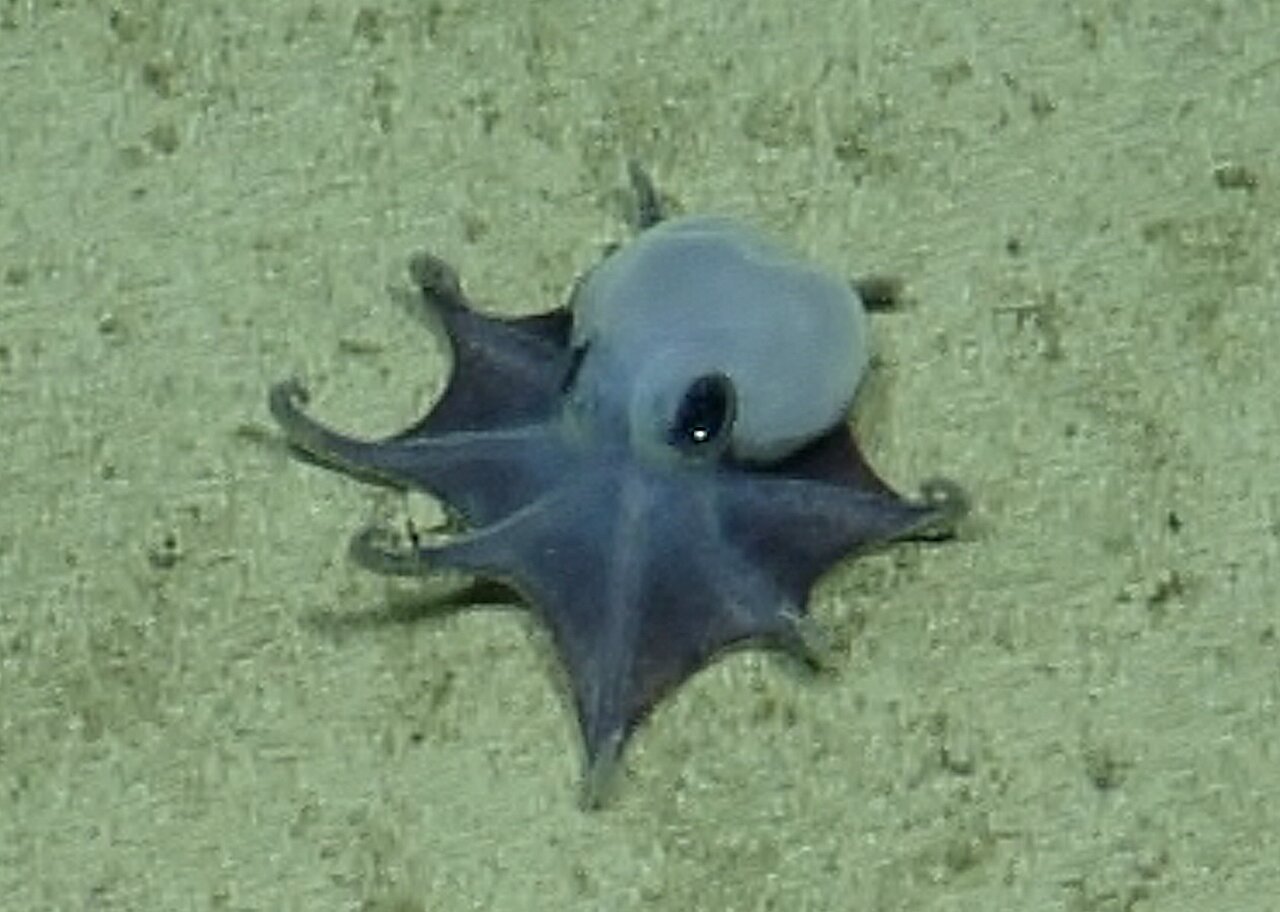
Hidden nearly 5,800 feet below the waters of the Galápagos Islands, a tiny blue octopus unlike anything scientists had ever seen has officially become a newly recognized species. Researchers identified the golf-ball-sized creature using advanced micro CT scanning, revealing internal anatomical details without damaging the only known specimen.
The deep ocean around the Galápagos Islands has long been a place of scientific surprises, but even experienced researchers were caught off guard when a small blue octopus appeared on a remotely operated vehicle’s camera during a 2015 expedition.
The animal was spotted near an underwater mountain off Darwin Island, one of the northernmost islands in the Galápagos archipelago. Scientists aboard the exploration vessel E/V Nautilus were surveying the seafloor using an underwater robot when the unusual octopus came into view at a depth of 5,800 feet (1,773 meters).
At first glance, it looked extraordinary. By the time researchers returned to shore with the specimen, they realized they might be looking at something entirely unknown to science.
Discovery Began During Deep-Sea Expedition
The expedition was conducted in collaboration with the Charles Darwin Foundation and the Galápagos National Park Directorate. Using a remotely operated vehicle, researchers explored areas of the deep seafloor rarely observed by humans.
The team managed to collect one octopus specimen and captured video footage of two others that appeared similar. Back at the Charles Darwin Research Station, scientists sorted through dozens of specimens gathered during the mission. One creature immediately stood out: a tiny blue octopus roughly the size of a golf ball.
Unsure what species it belonged to, researchers contacted octopus specialist Janet Voight, curator emerita of invertebrates at the Field Museum in Chicago.
“Right away, I knew it was something really special,” Voight said. “I’d never seen anything like it.”
The specimen was preserved in alcohol and formalin before being sent from the Galápagos to Chicago for further examination.
Scientists Faced a Difficult Problem
Identifying a new octopus species is not simple. Researchers typically need to examine internal structures such as the mouth, beak, and teeth, which often requires dissecting the specimen.
But there was a major complication: the team had only one specimen.
Voight hesitated to physically cut open what could be the sole known example of the species.
“When you describe a new species of octopus, you have to look at all the parts,” Voight explained. “We only had the one specimen, so I didn’t want to take it apart.”
Instead, the researchers turned to advanced imaging technology.
Micro CT Scans Revealed the Octopus in 3D
To preserve the rare specimen intact, Voight worked with Stephanie Smith, manager of the Field Museum’s X-ray computed tomography laboratory, to create detailed micro CT scans of the octopus.
The imaging method digitally combines thousands of X-ray slices to build a complete 3D model of an object, including its internal anatomy.
Because the technique is non-destructive, it allowed scientists to study delicate structures hidden inside the octopus without physically damaging it.
The scans revealed critical anatomical details, including features of the mouth and internal organ systems that confirmed the animal represented a completely new species.
“What really struck me was that the scan of the little octopus revealed so much information on its internal organ systems,” said Alexander Ziegler of the University of Bonn, senior author of the study.
Researchers noted that soft-tissue imaging of this quality often requires heavy-metal contrast agents, but those chemicals were avoided due to the rarity of the specimen. Even so, the scans produced remarkably clear results.
Officially Named Microeledone galapagensis
The new species has been named Microeledone galapagensis.
Beyond its unusual appearance and deep-sea habitat, the discovery also marked an important personal milestone for Voight. Despite spending four decades studying octopus evolution, this was the first time she officially led a team describing a new octopus species.
“These are little octopuses that live in the deep sea, and hardly anybody on Earth has ever gotten to see them,” Voight said.
She emphasized how little scientists still know about the ocean, particularly the deep Pacific.
“If you took all the land on Earth and pieced it together, you would not cover the Pacific Ocean,” she said. “The oceans are so big, and there’s so much left to explore.”
Deep Ocean Exploration Still Revealing Hidden Life
Researchers involved in the discovery say the tiny octopus highlights how much of the Galápagos deep sea remains unexplored.
Salome Buglass, marine scientist at the University of California Los Angeles and former researcher at the Charles Darwin Foundation, recalled how the unusual specimen immediately captured attention during sorting efforts after the expedition.
“There was something unusual about it,” Buglass said. “Discoveries like these remind us how much of the deep ocean in Galápagos remains unexplored.”
The process of getting the specimen to the right experts took years, but researchers believed the effort was worthwhile because every newly identified species helps scientists better understand the ecosystems hidden beneath the ocean surface.
Why This Matters
The Galápagos Islands are already famous for species found nowhere else on Earth, but the discovery of Microeledone galapagensis shows that even iconic ecosystems still hold major scientific mysteries.
The finding also demonstrates how modern imaging tools such as micro CT scanning are transforming biological research by allowing scientists to study rare organisms without destroying them.
Most importantly, the discovery underscores how little humanity has explored the deep ocean. Scientists say every new species found in these hidden environments provides valuable clues about biodiversity, evolution, and the fragile ecosystems that conservation efforts aim to protect.
Study Details
JANET R. VOIGHT et al, A new species of Microeledone from Galápagos Islands and an amended diagnosis of the Megaleledonidae (Octopoda: Incirrata), Zootaxa (2026). DOI: 10.11646/zootaxa.5814.4.5 , mapress.com/zt/article/view/zootaxa.5814.4.5