Four years after beginning science operations, NASA’s James Webb Space Telescope has produced its most detailed infrared view yet of the nearby galaxy Centaurus A, uncovering its dust-shrouded center, resolving densely packed stars, and revealing new clues about how a supermassive black hole shapes its host galaxy. The anniversary images highlight both Webb’s powerful capabilities and the complex history of one of the closest active galaxies to Earth.
For its fourth science anniversary, NASA’s James Webb Space Telescope has turned its attention to one of the sky’s most studied galaxies—and revealed a version unlike anything seen before.
The new infrared images of Centaurus A penetrate thick curtains of dust that have long concealed the galaxy’s central region in visible light. Instead of an obscured core, Webb exposes a crowded landscape filled with individual stars, intricate dust structures, and the energetic environment surrounding an actively feeding supermassive black hole.
Located 11 million light-years from Earth, Centaurus A is relatively nearby in cosmic terms. Its proximity, combined with its unusually active nature, makes it an important natural laboratory for investigating how galaxies evolve alongside the enormous black holes at their centers.
The anniversary observations also mark four years of science operations for Webb, whose performance has exceeded expectations while delivering increasingly detailed views of the universe.
Looking beyond what earlier telescopes could see
Centaurus A has been observed for decades, but every telescope has revealed only part of the picture.
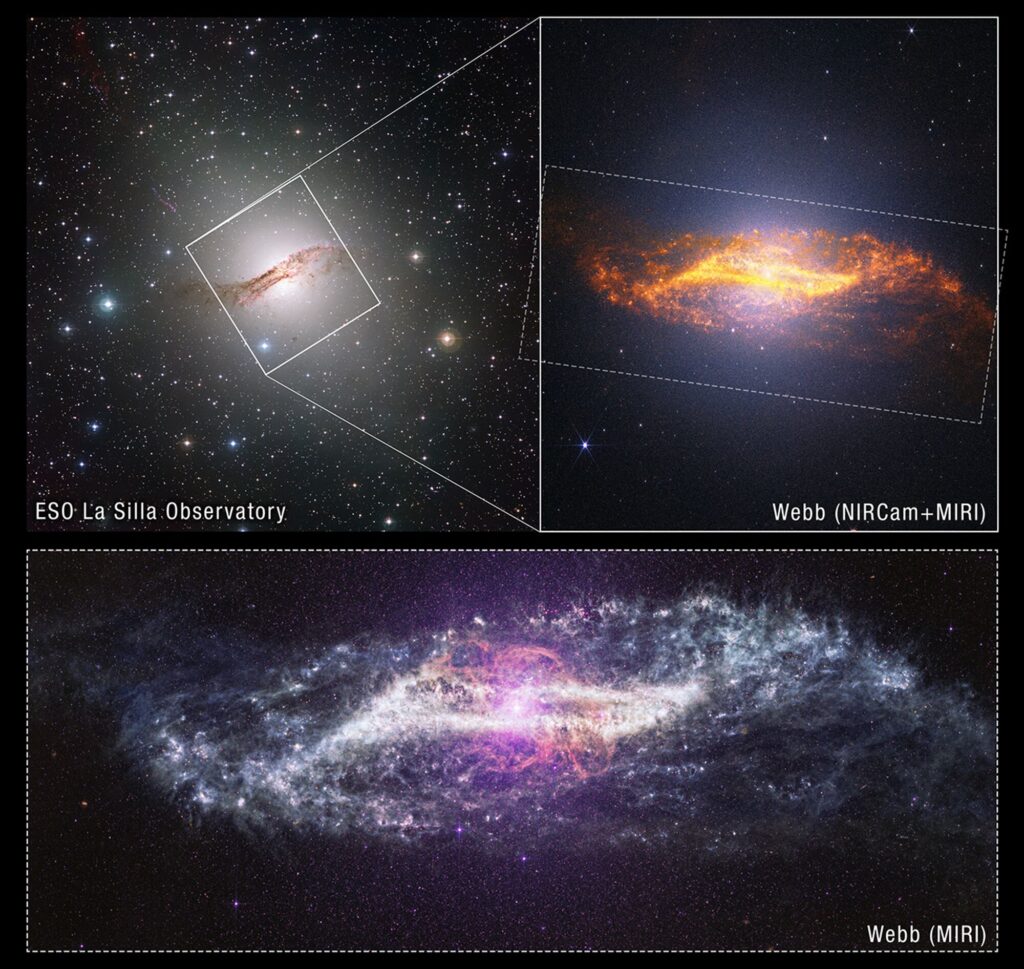
Visible-light observations from NASA’s Hubble Space Telescope could not peer through the dense dust surrounding the galaxy’s core. NASA’s retired Spitzer Space Telescope observed the galaxy in infrared light and uncovered its broad structures, but it lacked the resolution needed to distinguish individual stars in the crowded central region.
Webb bridges those limitations by combining exceptional sensitivity with high-resolution observations across near- and mid-infrared wavelengths. The result is a far more complete view that reveals both the galaxy’s large-scale features and its densely populated stellar interior.
As Shawn Domagal-Goldman, division director for astrophysics at NASA Headquarters in Washington, explained, “No single telescope tells the whole story.”
He added that discoveries build over time as new observatories expand on the foundations established by earlier missions. According to Domagal-Goldman, Webb represents the most powerful step forward so far, opening access to wavelengths and fine details that previous telescopes could not observe and allowing astronomers to investigate structures and processes that had remained hidden.
Dust forms an unexpectedly complex landscape
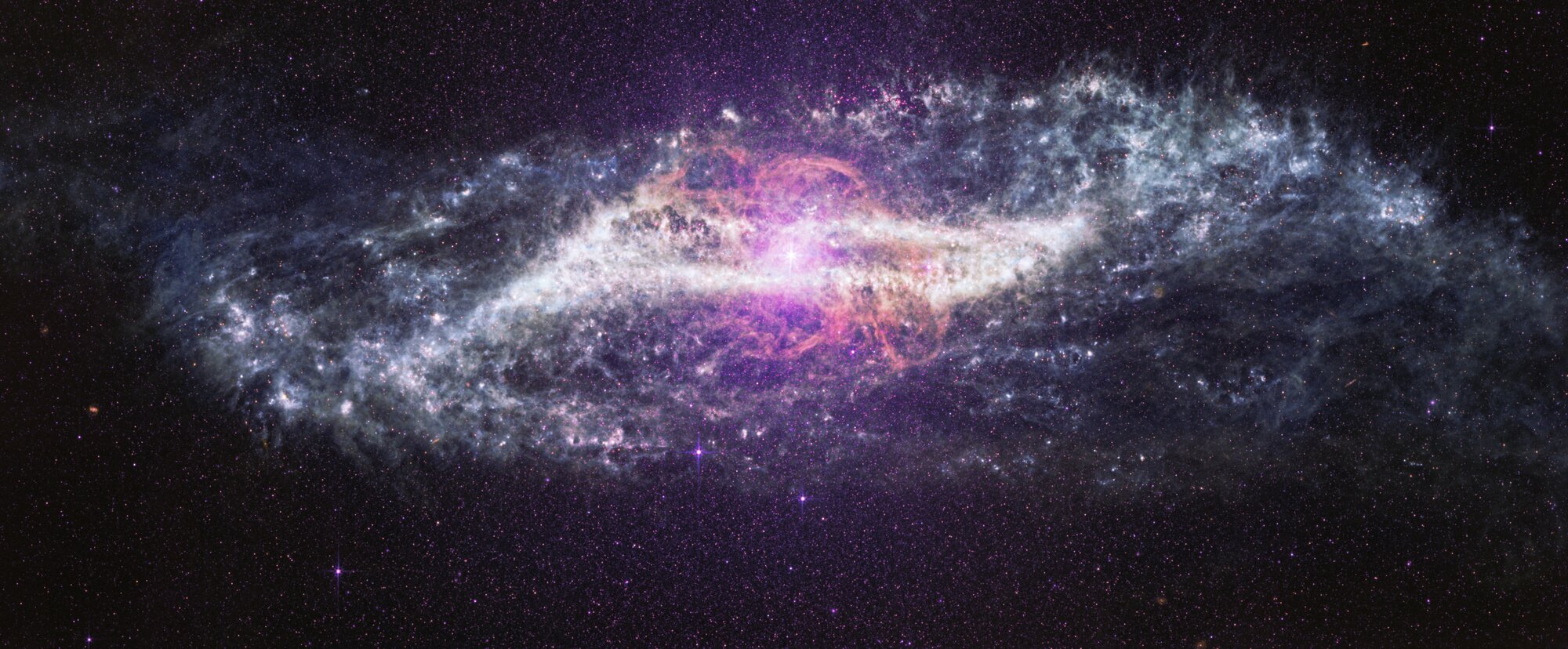
One of the most striking aspects of Webb’s observations comes from its mid-infrared view, which highlights dust distributed throughout the galaxy in remarkable detail.
Rather than appearing as simple dark lanes, the dust forms intricate glowing structures. A warped, parallelogram-shaped band stretches across the galaxy’s center, while wisps of material extend outward like enormous clouds.
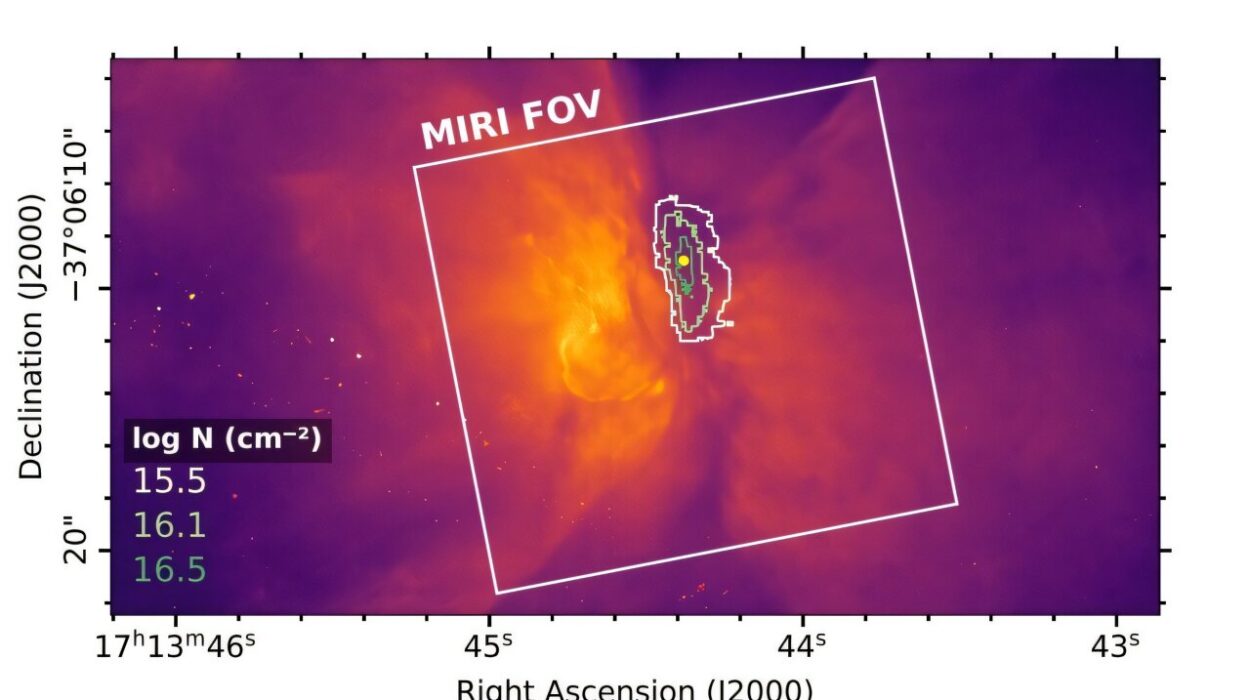
Among the most intriguing discoveries is an unusual S-shaped feature that stands out in images captured by Webb’s Mid-Infrared Instrument (MIRI). Its origin remains uncertain, raising new questions for astronomers. Researchers hope future studies will determine what produced the structure, whether the central black hole influences it, and whether it is connected to star formation triggered by the galaxy’s ancient merger.
The glowing red points scattered throughout the MIRI image also tell an important story. Many represent dust-rich stars or stellar nurseries, where aging stars return material to space or entirely new stars are taking shape. That dust provides the raw material from which future generations of stars and planets can eventually form, making it a key part of the galaxy’s continuing evolution.
Millions of stars preserve the galaxy’s history
Webb’s high resolution transforms what previously looked like a grainy glow into an immense collection of individual stars.
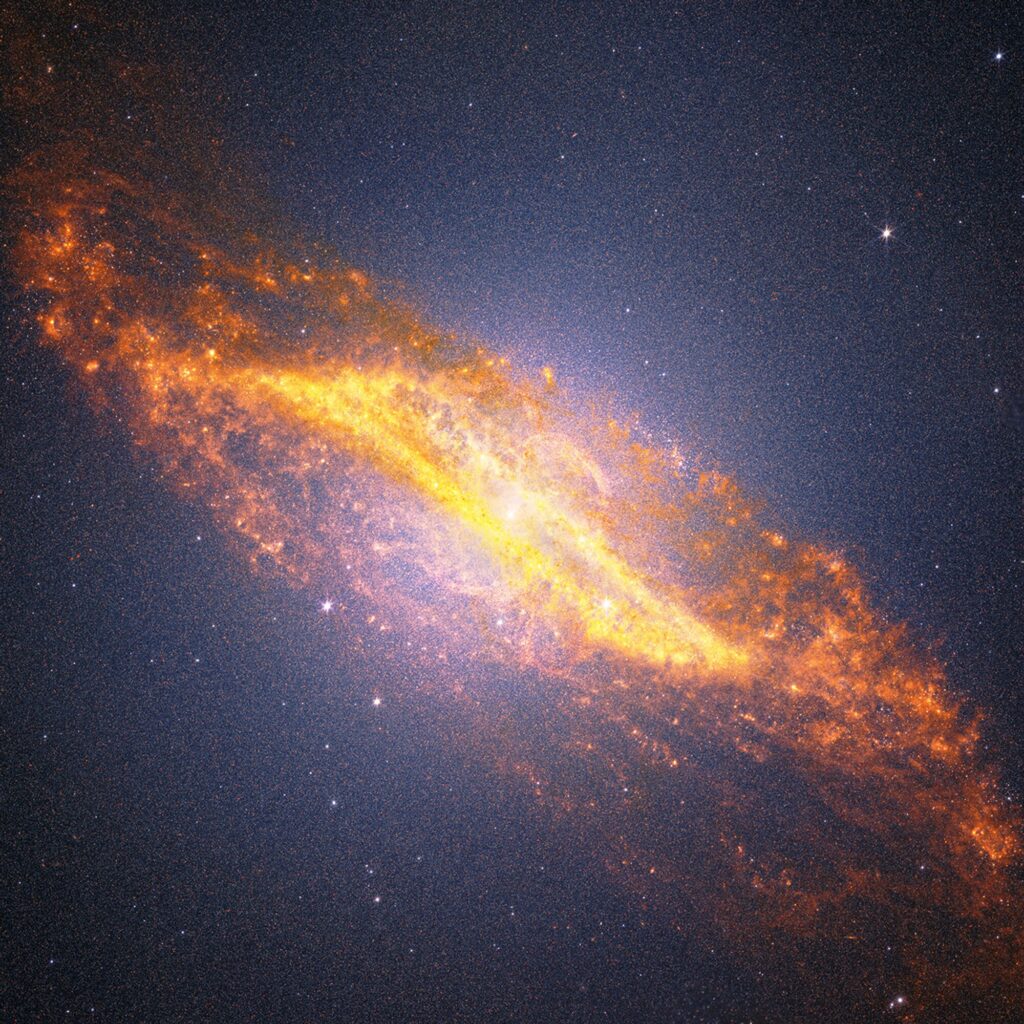
This ability to resolve stars throughout the long-hidden central region gives astronomers a new way to reconstruct Centaurus A’s past. Instead of relying only on the galaxy’s overall appearance, researchers can now examine its stellar population in far greater detail.
Each star contributes evidence about different stages in the galaxy’s history. Together, they help reveal when the oldest stars formed, when star formation slowed, when a major burst of stellar birth followed a galaxy collision, and how new stars emerged from gas disturbed during that event.
Viewed this way, Centaurus A becomes an example of galactic archaeology, with its stellar population serving as a record of billions of years of cosmic change.
An active black hole continues shaping the galaxy
The galaxy’s center is powered by a supermassive black hole that is actively drawing in surrounding material.
As matter falls toward the black hole, enormous amounts of energy are released and powerful jets are launched outward. Those processes influence the surrounding galaxy, making Centaurus A an especially valuable target for studying the relationship between black holes and galaxy evolution.
Webb’s capabilities extend beyond producing detailed images. Using spectroscopy, astronomers can analyze light to measure how gas moves within the galaxy.
Early observations reveal fast-moving ionized gas flowing outward, likely driven by activity around the central black hole. Webb has also detected warmer molecular hydrogen within a warped, rotating disk close to the galaxy’s center.
These observations provide new evidence for one of astronomy’s central questions: how a supermassive black hole affects an entire galaxy.
The emerging picture is not straightforward. The black hole appears capable of both encouraging star formation by compressing gas and suppressing it by pushing material away. Centaurus A offers researchers an unusually nearby opportunity to examine this complex balance in action.
A richer portrait of a familiar galaxy
Centaurus A also carries visible evidence of a dramatic event from its distant past. Roughly 2 billion years ago, it experienced a major collision with another galaxy. That merger reshaped its structure and triggered waves of star formation whose effects remain visible today.
Webb’s observations bring together multiple pieces of this long history. By mapping dust in unprecedented detail, resolving millions of individual stars, and tracing the motion of gas near the central black hole, the telescope presents the galaxy as a living record of its evolution rather than a static object.
The anniversary images demonstrate not only how much more can be learned from observing familiar targets with new technology, but also how Webb continues to uncover layers of complexity that earlier observatories could not reveal. Four years into its science mission, the telescope has transformed Centaurus A from a partially hidden galaxy into one of astronomy’s clearest windows on the intertwined evolution of stars, dust, and supermassive black holes.