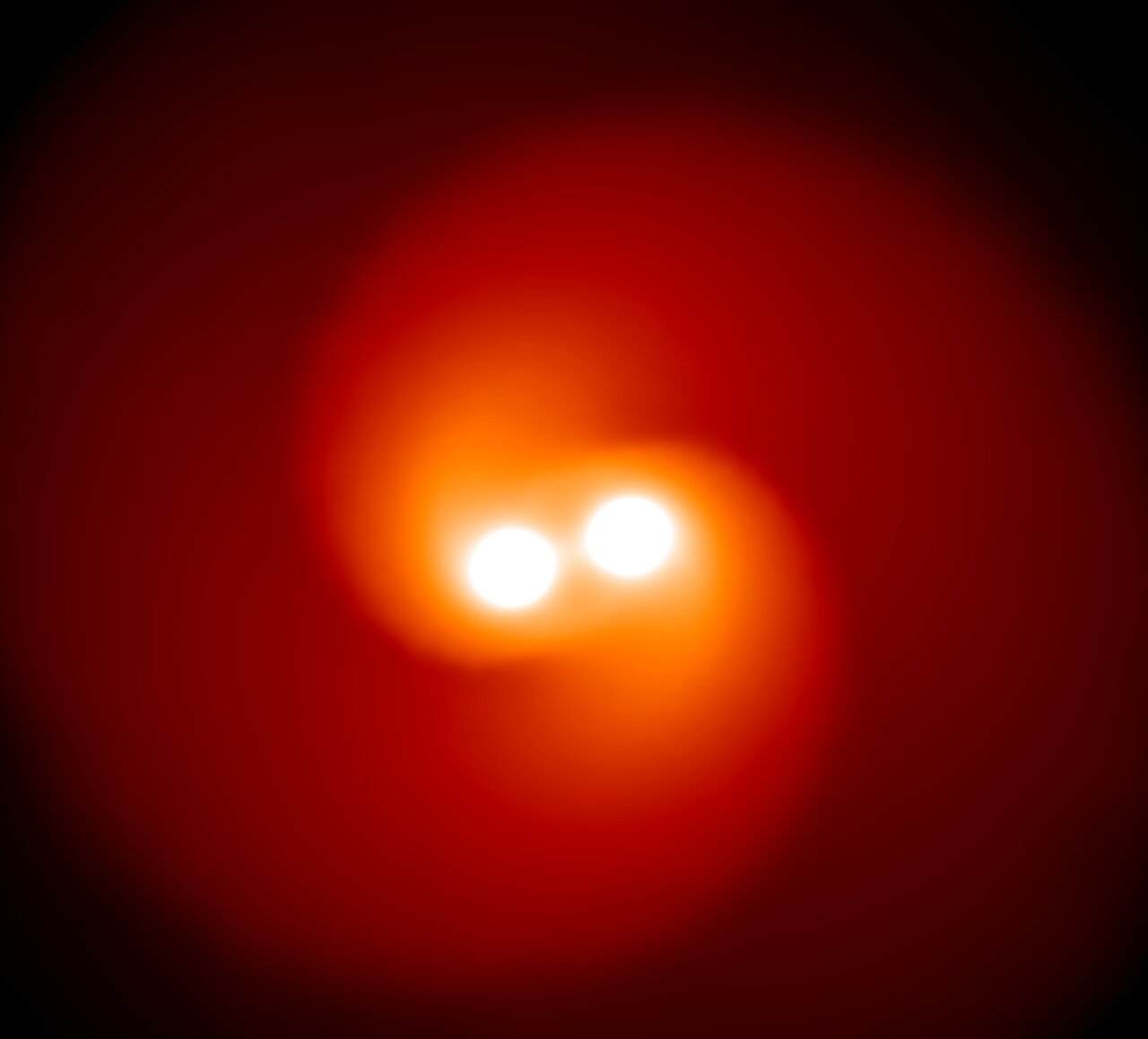
Many of the universe’s brightest long-lasting supernovae may owe their unusual behavior to binary star systems rather than isolated stars. Computer simulations suggest that a companion star can help create a dense cocoon of gas just a few thousand years before the explosion, providing the material that later powers these exceptionally luminous cosmic events.
When a massive star reaches the end of its life, the resulting supernova can briefly outshine entire galaxies. Yet astronomers have long known that some stellar explosions refuse to fade on the expected schedule. Instead, they remain unusually bright for months or even years, sustained by collisions between the expanding debris and dense gas surrounding the dying star.
Where that gas comes from has remained one of the enduring questions in the study of interacting supernovae.
New research led by Sung-Han Tsai, a Ph.D. student, and Dr. Ke-Jung Chen, an assistant research fellow at the Academia Sinica Institute of Astronomy and Astrophysics (ASIAA), points to an answer rooted in stellar companionship. Their findings, published in The Astrophysical Journal Letters, indicate that many of these remarkable explosions may be the product of two stars evolving together rather than one star dying in isolation.
A companion star may prepare the environment for the explosion
Most massive stars are born as members of binary systems, orbiting a companion for millions of years. According to the new study, that long-lived relationship can dramatically reshape the star’s final moments.
As one of the stars nears the end of its life, it expands until it becomes hundreds or even thousands of times larger than the Sun. Its swollen outer layers begin flowing toward its companion in a process of mass transfer.
Not all of that material remains within the binary system. Some of the gas escapes entirely, surrounding both stars in a dense cocoon.
That cocoon becomes critically important only a short time later. Within a few thousand years—a brief interval compared with the star’s overall lifetime—the enlarged star explodes as a supernova. The rapidly expanding blast wave crashes into the nearby gas, converting its enormous kinetic energy into light and producing one of the brightest and most distinctive types of stellar explosions.
The timing is what makes the model work
To investigate this process, the researchers performed hundreds of computer simulations examining how binary stars evolve before a supernova.
Their results highlight the importance of timing.
Earlier episodes of mass transfer can also eject gas, but those events occur millions of years before the explosion. By the time the supernova happens, that material has drifted so far away that it plays little role in the explosion’s appearance.
The newly identified late-stage interaction unfolds much closer to the star’s death—only a few thousand years beforehand. Because the expelled gas remains nearby, the expanding supernova debris naturally collides with it, matching the environments astronomers have inferred from observations of interacting supernovae.
“We found that binary stars can prepare the stage for interacting supernovae with remarkable timing,” Tsai said. “The companion star helps create a dense cocoon around the dying star just before the explosion, providing the fuel that powers these cosmic fireworks.”
More common than previously thought
The simulations suggest this evolutionary pathway is not an unusual exception.
According to the team’s estimates, it could account for roughly one out of every eight core-collapse supernovae. If so, binary interactions may represent a significant and previously underappreciated ingredient in how many massive stars end their lives.
That finding shifts the focus away from viewing these extraordinary explosions as the products of rare stellar circumstances. Instead, interactions between companion stars may be a common mechanism that shapes the diversity seen among exploding massive stars.
Explaining mysterious late brightening
The new model also offers a possible explanation for puzzling supernovae that appear ordinary at first but become unexpectedly brighter long after the initial explosion.
One example is SN 2014C, which initially behaved like a typical supernova before brightening months later as its expanding debris encountered a distant shell of gas.
According to the simulations, such a shell could have been produced during the dying star’s final interaction with its companion, occurring anywhere from centuries to millennia before the explosion. That scenario naturally explains why the debris would not reach the gas until well after the supernova first appeared.
Rather than requiring an unexplained source of surrounding material, the model connects the delayed brightening to the normal evolution of a binary star system approaching its final stages.
Rethinking how massive stars end their lives
The study presents a broader picture of stellar death in which relationships between stars matter as much as the explosion itself.
Instead of treating supernovae as isolated events, the research suggests that many are shaped by interactions that unfold over thousands of years before the final blast. The companion star helps determine the environment into which the explosion expands, influencing how bright the supernova becomes and how long it continues to shine.
“Our study suggests that many stars do not die alone,” Chen said. “Their final appearance may be shaped by a long and intimate partnership with a companion star.”
The findings point toward a simple but far-reaching idea: the remarkable variety seen among interacting supernovae may arise not only from the stars that explode, but also from the companions that accompany them throughout their lives. In many cases, the spectacular light show observed after the explosion may be the lasting signature of a binary partnership that endured until the very end.