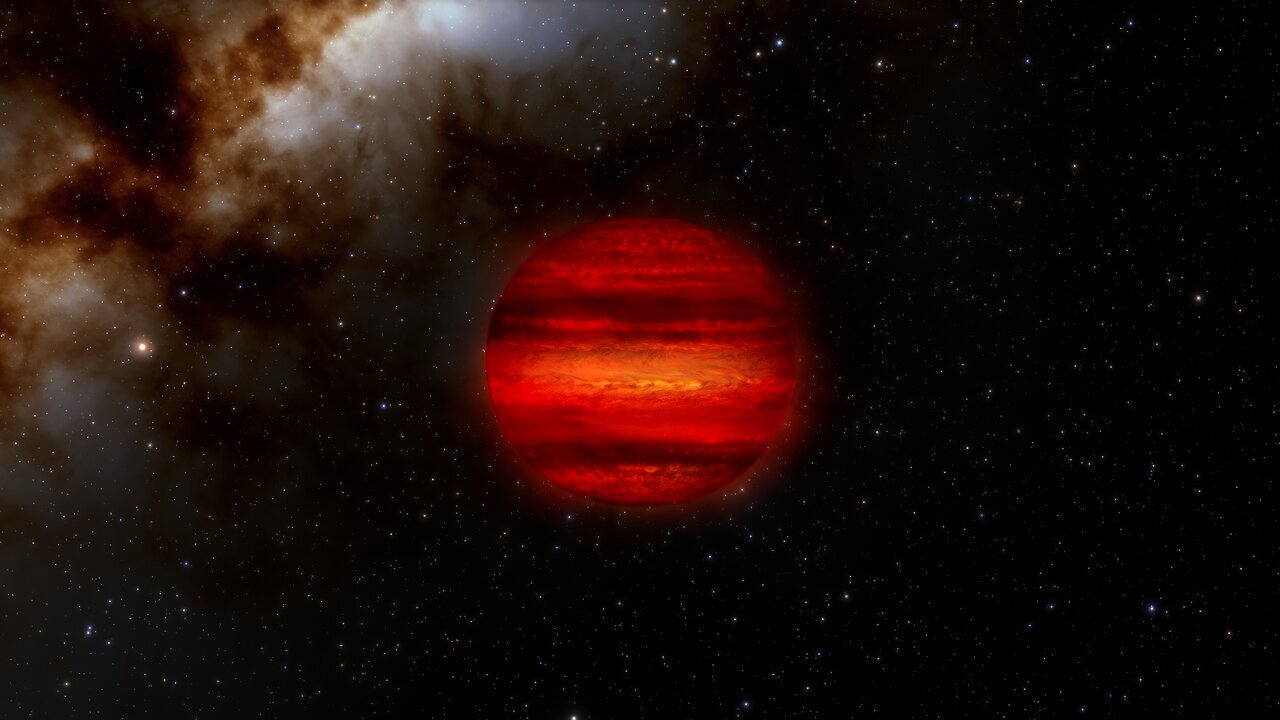
Astronomers have characterized a brown dwarf orbiting HIP 61637, a massive and bright A-type star, revealing a 47.8-Jupiter-mass object in the sparsely populated “brown dwarf desert.” The system is about 396 million years old, and the brown dwarf completes an orbit every 6.829 days on a nearly circular path.
The object, called HIP 61637 b, was discovered by NASA’s Transiting Exoplanet Survey Satellite, or TESS, as it passed in front of its host star.
Those brief dips in the star’s brightness allowed astronomers to identify the companion as a transiting object. The researchers then combined the TESS observations with high-resolution spectroscopy from the Tillinghast Reflector Echelle Spectrograph, or TRES, to measure the companion’s mass and determine the properties of the system.
TESS observed seven complete transits across three observing sectors. Because the star is large, each transit lasts about 9.8 hours, making complete ground-based observations difficult.
The TRES observations provided another crucial measurement. As HIP 61637 b orbits its star, its gravity causes the star to move slightly back and forth. Measuring that motion allowed the researchers to determine the companion’s mass.
The combined analysis gives HIP 61637 b a radius of about 1.15 times that of Jupiter and a mass of 47.8 Jupiter masses.
That places it firmly within the mass range traditionally used to classify brown dwarfs.
A brown dwarf in the middle of the brown dwarf desert
Brown dwarfs occupy an unusual middle ground between planets and stars. They are not massive enough to sustain hydrogen fusion in their cores, but some are massive enough to have fused deuterium during part of their early lives.
The difficulty is that mass alone does not reveal how such an object formed. Some brown dwarfs may form through processes more similar to star formation, while objects at the lower end of the brown dwarf mass range may form through processes associated with planets.
That uncertainty is especially important in a sparsely populated region known as the brown dwarf desert.
The desert refers to the relatively small number of companions with masses around 40 to 50 Jupiter masses. HIP 61637 b has a mass of 47.8 Jupiter masses, placing it close to the middle of this poorly populated region.
That makes the system useful for testing ideas about how massive substellar objects form and evolve.
The host star is unusually massive
HIP 61637 is not an ordinary host star for a transiting brown dwarf.
The star has a mass of 2.86 times that of the Sun and a radius of about 4.33 times the Sun’s radius. Its effective temperature is about 9,180 kelvin.
The researchers identify it as an A-type star that is nearing the end of its main-sequence lifetime and has begun to evolve.
It is also exceptionally bright. The study finds that HIP 61637 is the most massive and brightest star known to host a transiting brown dwarf.
Its evolutionary state is important because it provides a way to estimate the age of the entire system.
The star provides an unusually precise age
Determining the age of a brown dwarf is difficult. Unlike ordinary stars, brown dwarfs cool and change over time in ways that are still being modeled.
In this system, however, the host star is far enough along in its evolution that stellar evolutionary models can provide a relatively tight age estimate.
Using MIST stellar evolutionary tracks, the researchers determine an age of 396 ± 46 million years for HIP 61637.
The surrounding stellar field provides no evidence that HIP 61637 belongs to a young, co-moving stellar association. Other possible age indicators were also not useful for setting a strong independent age constraint. The star’s rapid rotation makes some of these methods particularly difficult to apply.
The age derived from its evolutionary state therefore becomes especially valuable for studying HIP 61637 b.
Because the star and brown dwarf are assumed to have formed at the same time, the stellar age can be used as the age of the brown dwarf.
Its orbit is almost circular
HIP 61637 b travels around its star at an average distance of about 0.10 astronomical units, completing each orbit in just 6.829104 days.
Despite that close orbit, its measured eccentricity is only 0.054 ± 0.013.
An eccentricity of zero represents a perfectly circular orbit. The measured value is therefore very close to circular, although the researchers find it statistically significant rather than exactly zero.
The observations also reveal a small long-term drift in the star’s radial velocity. The team collected 46 TRES measurements over roughly three years and measured a velocity drift of 0.426 ± 0.054 meters per second per day.
A faint stellar companion was found within 2 arcseconds of HIP 61637 in high-resolution imaging, but the researchers conclude that it cannot produce the observed velocity drift. They therefore attribute the drift to another bound object that is too faint and too close to the star to be resolved in the available imaging.
Tides can explain the nearly circular orbit
The researchers examined whether gravitational tides between the star and brown dwarf could have changed the orbit over the system’s lifetime.
The calculations depend on how efficiently the star and brown dwarf dissipate tidal energy, a property described by tidal quality factors. Because these factors are poorly constrained, the team considered broad ranges of possible values.
The calculations indicate that stellar tides can dominate the orbital circularization under the relevant conditions.
The researchers also compared the system with theoretical calculations of tidal dissipation in intermediate-mass stars. Those calculations indicate that tidal dissipation during the star’s main-sequence lifetime would have been strong enough to circularize HIP 61637 b’s orbit.
This provides an explanation consistent with the observed near-circular orbit.
The orbital history, however, does not reveal how the brown dwarf originally formed. A companion that formed with an eccentric orbit could have been circularized by tides, while an object that formed through a planet-like process could have started with a nearly circular orbit.
The brown dwarf tests competing evolution models
The combination of a measured mass, radius and system age makes HIP 61637 b particularly useful for testing models of brown-dwarf evolution.
The researchers compare the observations with two sets of models: the COND03 models and the Sonora 2021 models.
The COND03 models, which include irradiation from the host star, place the brown dwarf’s modeled age between about 120 and 500 million years. That is broadly consistent with the independently determined age of 396 ± 46 million years.
The Sonora 2021 models give a much narrower age range of about 150 to 200 million years. That is inconsistent with the stellar age determination.
One difference between the model sets is important here. Sonora 2021 does not include irradiation from the host star, while HIP 61637 b orbits only about 0.1 astronomical units from a hot, massive star.
The researchers note that irradiation can inflate a brown dwarf’s radius. An inflated object can take longer to cool and contract, potentially affecting the age inferred from its measured size.
The study therefore finds tension between the age indicated by the well-established stellar evolutionary models and the younger age produced by the non-irradiated brown-dwarf models.
The researchers say this points to a need for more complete substellar models that consider a wider range of effects, including irradiation from the host star. They also note that it remains unclear whether irradiation alone can explain the difference or whether another mechanism not captured by current models could be involved.
Its formation remains uncertain
HIP 61637 b’s location in the brown dwarf desert makes its origin particularly difficult to determine.
The researchers describe two broad possibilities. It could have formed more like a companion star through fragmentation of a molecular cloud, or it could have formed more like a giant planet through accretion in a circumstellar disk.
Its present-day orbit cannot distinguish between those possibilities because tidal interactions may have substantially altered the original orbit.
Forming an object with a mass of about 50 Jupiter masses through core accretion would be challenging, but the unusually massive HIP 61637 system could have provided conditions for an exceptionally massive planet.
At the same time, a star-like formation scenario would require an object whose original eccentric orbit has been almost completely circularized.
The researchers conclude that both possibilities push against current theoretical understanding of brown-dwarf formation.
More observations could help
HIP 61637 b’s short orbital period provides many opportunities to observe its transits. The nearly seven-day period is favorable for repeated observations, although the roughly 10-hour transit duration makes complete ground-based transit observations difficult.
The host star’s brightness also makes high-quality spectroscopy possible despite its rapid rotation of about 80 kilometers per second.
Atmospheric observations could eventually provide another way to investigate the object’s origin. Comparing the composition of the brown dwarf with that of its host star could provide clues about whether the companion formed from material in a circumstellar disk or through a star-like process.
The researchers note that HIP 61637 is too bright for follow-up observations with JWST, but transit spectroscopy of similar intermediate-mass brown dwarfs with facilities such as JWST and the Ariel mission could help investigate these formation mechanisms.
HIP 61637 b therefore adds a precisely measured object to a poorly populated part of the brown-dwarf population, with a well-constrained age, mass, radius and orbit. Its nearly circular orbit is consistent with tidal circularization, while its measured properties also expose differences between current models of brown-dwarf evolution.
The study is available as a preprint on arXiv.