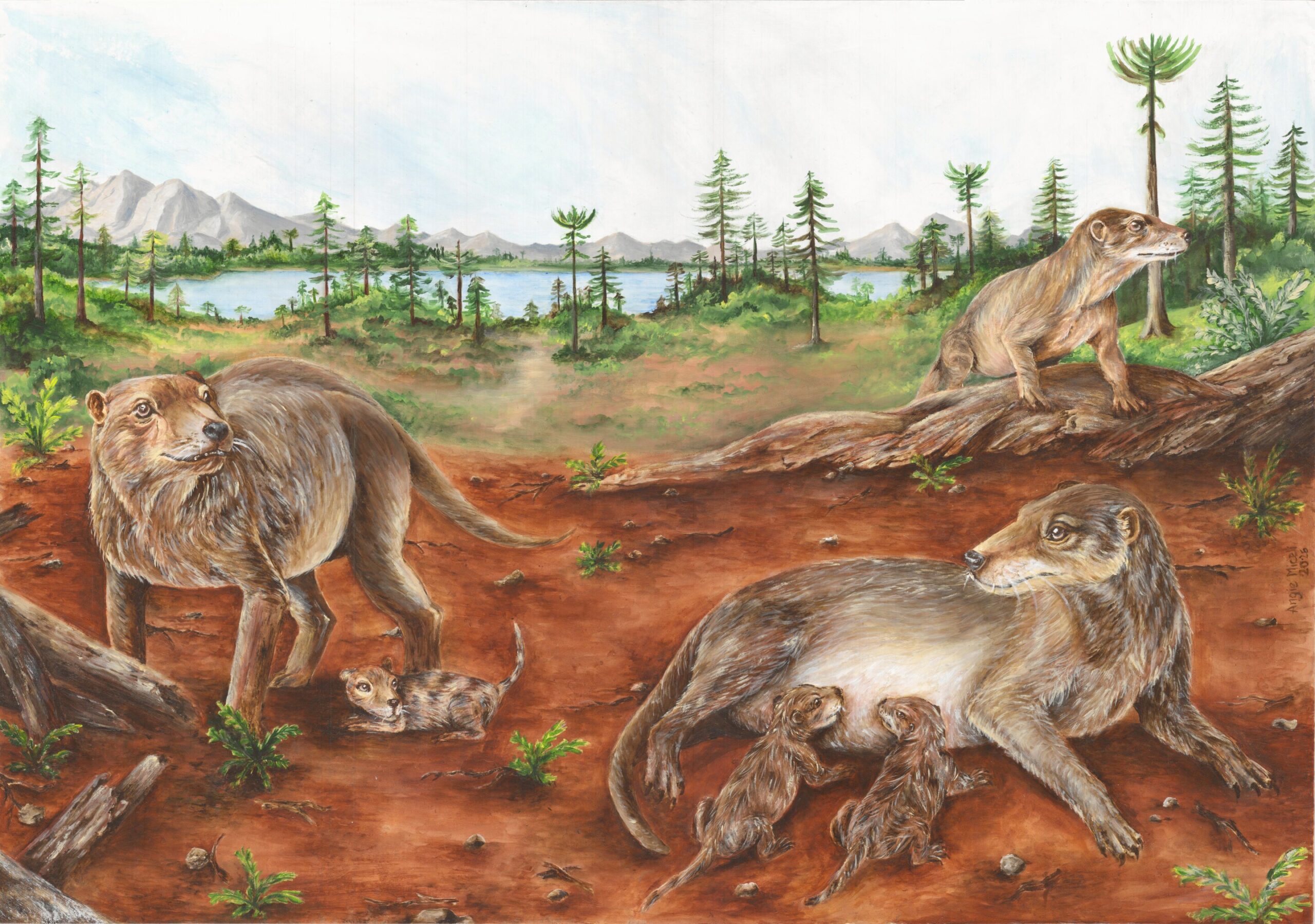
A fossil of the Triassic mammal relative Chiniquodon theotonicus contains a growth mark in its bones that researchers interpret as evidence of birth, while estimates of its newborn size closely match living placental mammals. The finding suggests that live birth evolved in the mammalian lineage far earlier than previously recognized, possibly as early as about 236 million years ago.
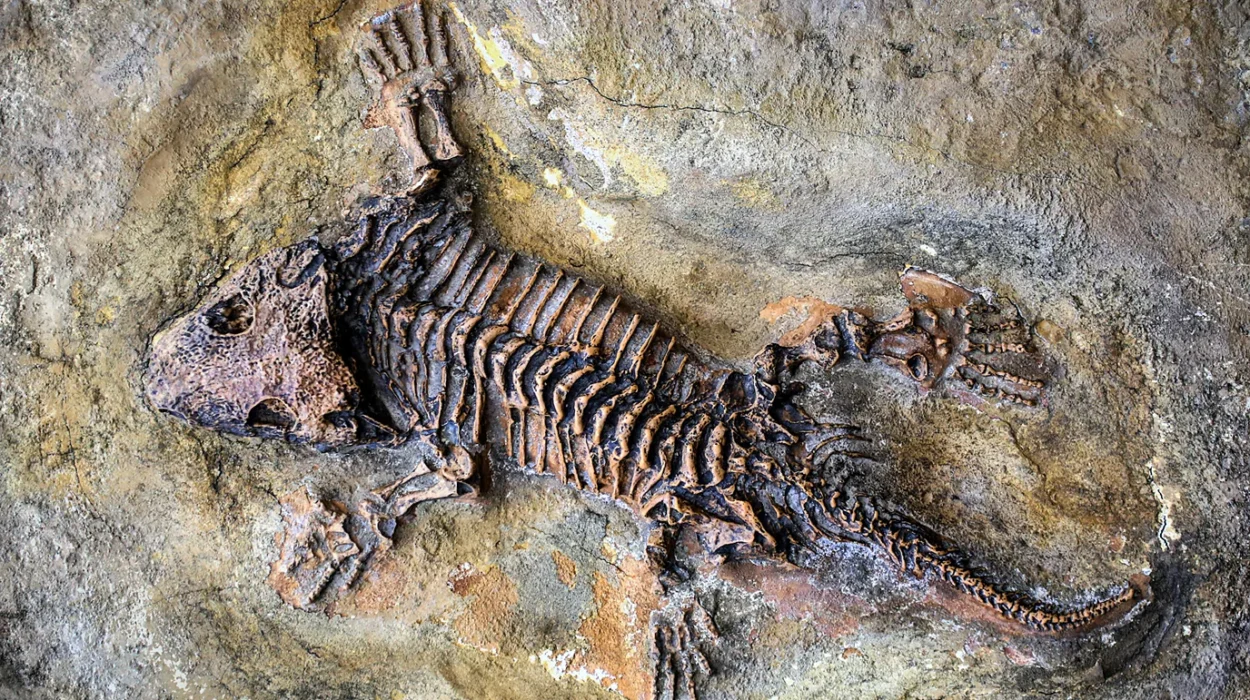
The evidence comes from a partially articulated Chiniquodon theotonicus skeleton known as specimen CRILAR-PV109. It was discovered in the Chañares Formation of northwestern Argentina, in rocks dating to the Carnian stage of the early Late Triassic, about 236 million years ago.
More than 50 Chiniquodon theotonicus specimens have been recovered from the formation. Their skulls range from about 50 millimeters to 160 millimeters long. The studied specimen has a basal skull length of 160 millimeters, making it one of the largest known individuals from the site.
The researchers interpret it as an adult, probably a fully grown animal. Its skull bones are strongly fused, all of its teeth are fully erupted, and its postcranial skeleton is completely ossified, including the wrist and ankle bones.
But the most important evidence was hidden inside two of its limb bones.
Researchers examined thin sections taken from the femur and ulna. Much of the bone is made of densely vascularized fibrolamellar tissue, a type of rapidly formed bone containing numerous blood-vessel channels.
Deep inside both bones, however, the researchers found an abrupt change in the bone tissue. The innermost region had fewer vascular canals, with mostly longitudinally oriented canals. The canals were also smaller, and the arrangement of fibers in the bone matrix was more organized.
The change marks a very early event in the animal’s life. The researchers interpret it as a growth mark associated with birth, known as a neonatal line.
Why a neonatal line matters
A neonatal line records a sudden change in bone growth around the time an animal is born.
Living mammals can preserve similar marks. After birth, bone deposition can accelerate, producing a noticeable change in the microscopic structure of the bone. The transition can involve changes in the organization of bone fibers and in the size and arrangement of vascular canals.
The same type of abrupt change occurs in the femur and ulna of the Chiniquodon specimen.
There is an important limitation, however. A growth mark of this type cannot, by itself, tell researchers whether an animal was born alive or hatched from an egg. Histologically, a neonatal line and a hatching line cannot always be distinguished.
That is why the researchers turned to another clue: the estimated size of the animal at birth.
The fossil was unusually well preserved
The neonatal evidence survived because the long bones of this Chiniquodon had exceptionally small medullary cavities and relatively little secondary remodeling.
Normally, the expansion of the central cavity of a long bone soon after birth can remove much of the embryonic bone tissue. As a result, neonatal lines and similar structures are rarely preserved in older individuals.
In CRILAR-PV109, enough of the embryonic tissue remained to preserve the transition between the early and later bone.
The researchers note that embryonic tissue had not previously been recovered in any of the 25 studied species of non-mammalian cynodonts. Among non-mammalian synapsids, only the much earlier Ophiacodon retroversus had previously been reported to preserve embryonic tissue.
Estimating the animal’s size at birth
The position of the neonatal line provided a measurement of the bone’s circumference at the time of birth.
The researchers used the femoral circumference at mid-shaft to estimate body mass. They applied three equations developed from living carnivorans, including separate equations based on felids and canids.
The estimates for the adult animal were closely similar across the methods. The average estimated body mass at death was 11.99 kilograms.
For the newborn, the average estimate was 1.68 kilograms. That means the estimated mass at birth was about 14% of the maximum body mass reached by the animal.
The researchers also checked the result using skull length as a separate proxy for body mass. That analysis produced results consistent with the femur-based estimates.
The estimated skull length of a newborn Chiniquodon would have been about 40 to 50 millimeters. That is similar to the smallest known Chiniquodon skulls, including specimens the researchers propose were perinates, or animals around the time of birth.
The newborn size looks more like a placental mammal
The researchers then compared the estimated newborn and adult masses of Chiniquodon with data from living amniotes.
Their comparison included 1,869 mammals, 2,619 non-avian reptiles, and 782 birds.
The estimated newborn mass of Chiniquodon was most comparable to living placental mammals of similar adult size. Its estimated newborn-to-adult mass ratio, between 10% and 20%, also fell within the range seen among placental mammals across a broad range of evolutionary groups.
This is important because living mammals do not all begin life at the same stage of development.
Monotremes and marsupials generally have extremely small offspring at birth or hatching compared with the eventual adult body size. In the comparison used by the researchers, most monotremes and marsupials have newborns weighing less than 0.15% of adult body mass.
Placental mammals can produce much larger young. Among similarly sized animals, some placental mammals give birth to young that account for more than 22% of the adult female’s body mass.
The estimated proportion for Chiniquodon therefore falls much closer to the placental pattern than to the pattern seen in monotremes or marsupials.
Statistical analyses supported the same pattern. In both discriminant analysis and a K-nearest neighbors analysis, Chiniquodon was grouped with placental mammals with high probability.
The result challenges a long-standing view of early synapsids
Before this study, the commonly accepted view was that viviparity, or giving birth to live young, was a characteristic that arose within Theria, the group containing modern marsupials and placental mammals.
Non-therian cynodonts were generally regarded as egg-laying. Direct evidence for their reproductive mode, however, has been lacking.
The researchers argue that their findings challenge that assumption.
They interpret the bone growth mark as a neonatal line, and the body-mass comparisons as strong support for that interpretation. Together, they say the evidence provides support for viviparity in Chiniquodon theotonicus.
If that interpretation is correct, live birth was already present in a non-mammaliaform cynodont during the early Late Triassic, around 236 million years ago.
That would place evidence for viviparity roughly 90 to 95 million years earlier than its previously recognized occurrence in the mammalian lineage. The authors specifically describe the finding as evidence that viviparity was not exclusive to therian mammals among synapsids.
The mass estimates have important limits
The researchers acknowledge that estimating the body mass of an extinct animal from the circumference of a bone is not straightforward.
The equations they used were developed from living mammals, particularly carnivorans. Those animals may not be perfect analogues for Chiniquodon because of differences in body proportions and other biological characteristics.
The authors also note that equations based on adult animals may not accurately estimate body mass during early growth because mammals do not necessarily grow in a simple linear way.
Even so, they argue that these equations are the best available proxies for this particular problem. They also expect potential inaccuracies to affect the estimated newborn and adult masses in similar ways, leaving the proportion between the two relatively useful.
The researchers further caution that the relatively high estimated newborn mass may partly result from the equations producing larger predictions for very small individuals.
Despite that concern, the estimated newborn mass remains more comparable to that of living placental mammals than to other living amniotes in their analysis.
Other early mammal relatives give different signals
The researchers also compared several other early synapsids with living amniotes.
For Ophiacodon retroversus, the estimated perinate-to-adult mass ratio was between 2.62% and 7.76%, depending on the equation used. That range overlaps with some placental mammals, birds, and non-avian reptiles, while being much higher than the values typical of similarly sized marsupials and monotremes.
Its hatchling body mass itself was more comparable to some non-avian reptiles than to placental mammals or birds. The statistical analysis classified Ophiacodon alternatively as a non-avian reptile, bird, or placental mammal.
Lystrosaurus, meanwhile, has a much stronger piece of evidence for egg-laying. A previously reported embryo preserved in an in-egg position supports an oviparous reproductive mode.
Yet the body-mass comparisons in the present study placed Lystrosaurus near the boundary between non-avian reptiles, birds, and placental mammals, so the analysis could not determine which group its reproductive strategy most closely resembled.
For Kayentatherium wellesi, the estimated perinate-to-adult body-mass ratio was only 0.01%. That result was most similar to monotremes, marsupials, and non-avian reptiles rather than birds or placental mammals.
The researchers therefore conclude that the available evidence cannot currently determine its reproductive mode.
Two possible histories of live birth
The Chiniquodon finding raises a larger evolutionary question.
The researchers mapped the available evidence onto the synapsid family tree and identified two equally parsimonious scenarios for the evolution of viviparity.
In the traditional scenario, egg-laying remained ancestral in crown mammals. Under that model, viviparity would have evolved independently in Chiniquodon and in therian mammals.
The alternative scenario is more striking. Viviparity could have originated once, early in the mammalian lineage, with the egg-laying condition of modern monotremes representing a reversal to the ancestral reproductive mode. In that scenario, live birth would have been an ancestral condition for crown mammals rather than a feature that first appeared within Theria.
The researchers emphasize that the two scenarios are equally parsimonious. The available evidence cannot determine which is more likely.
The first scenario requires multiple independent origins of viviparity. The second requires a reversal from live birth to egg-laying in monotremes.
The study therefore does not establish that all early mammalian ancestors gave birth to live young. Instead, it provides evidence that at least one non-mammaliaform cynodont, Chiniquodon theotonicus, may have done so during the Triassic.
That distinction matters because the reproductive history of these early synapsids remains incomplete. The researchers themselves describe broader evolutionary scenarios involving Ophiacodon, Lystrosaurus, Chiniquodon, and Kayentatherium as highly speculative, with the available analyses unable to determine the reproductive strategies of several of those animals.
For Chiniquodon, however, the combination of a birth-associated bone growth mark and a newborn body size resembling that of placental mammals provides the evidence behind the study’s central conclusion.
The discovery places evidence for viviparity in the mammalian lineage deep in the Late Triassic, around 236 million years ago, far earlier than previously recognized.
The study was published in Frontiers in Mammal Science.