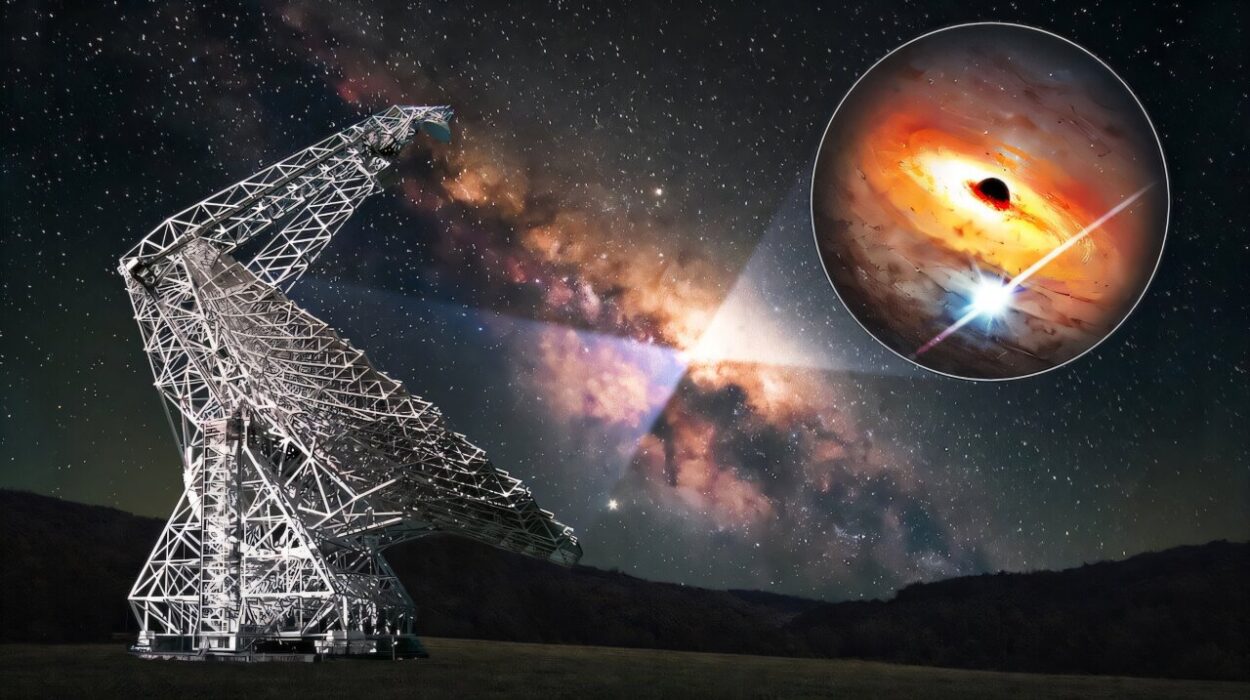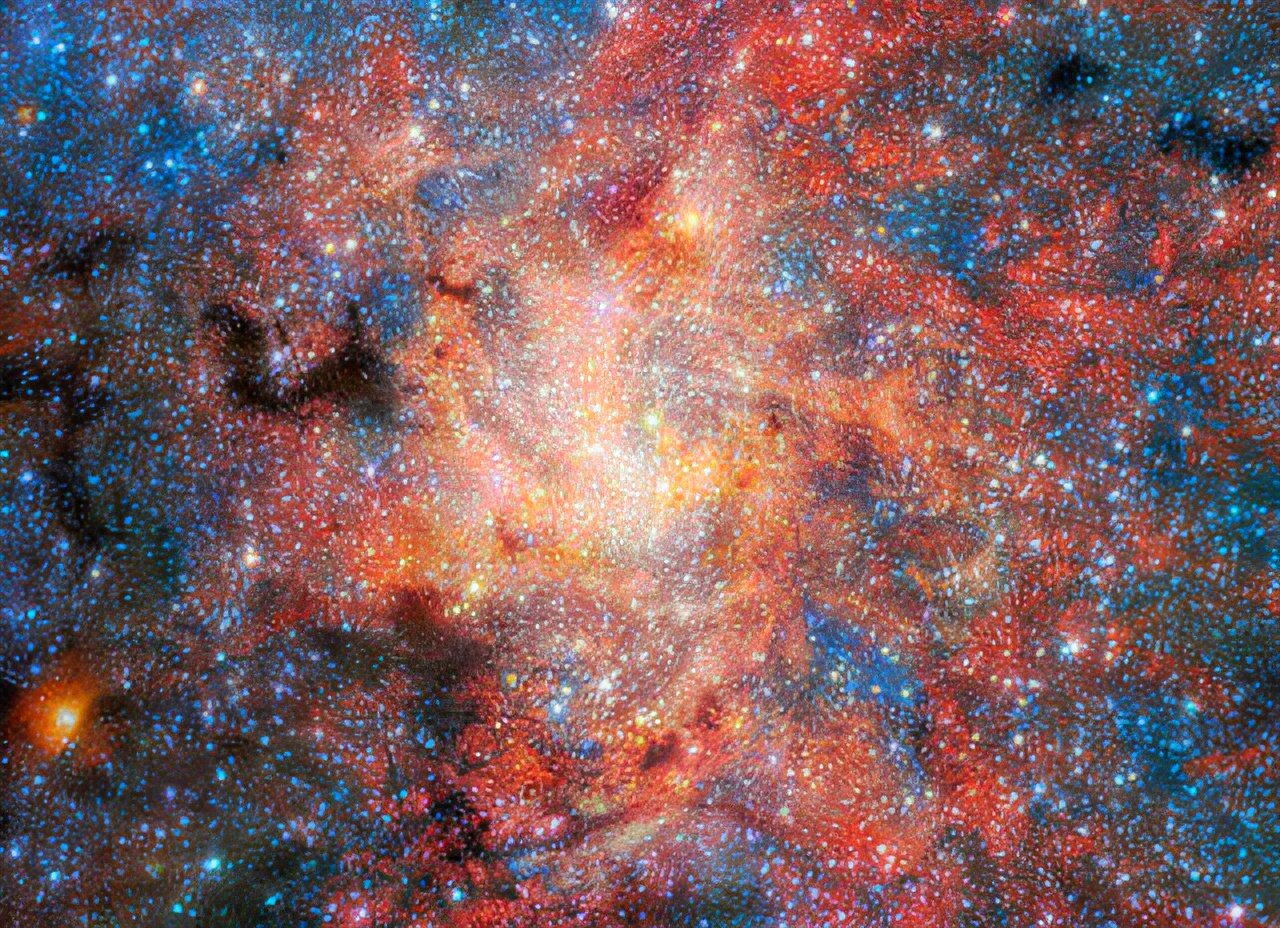
Near the center of the Milky Way, where intense radiation surrounds the supermassive black hole Sagittarius A, an aging star is still sending freshly made material into space. Observations from the James Webb Space Telescope reveal that IRS 3 is producing oxygen-rich dust and that water exists within the cloud of material surrounding it—evidence that some molecular material can persist in this unusually harsh environment.*
IRS 3 is an evolved star approaching the end of its life. It has entered the asymptotic giant branch phase, a stage in which stars become huge, cool and luminous while shedding material through powerful stellar winds.
That process sends gas and dust away from the star. But IRS 3 is not living in an ordinary part of the galaxy. It lies near the Milky Way’s central supermassive black hole, where the surrounding environment is exposed to intense radiation.
That raised a basic question: could a star still manufacture and release dust so close to such an extreme source of radiation?
Webb’s observations provide a clear indication that, in the case of IRS 3, the answer is yes.
Webb uncovers the star’s chemical identity
The observations were made with Webb’s Mid-Infrared Instrument, or MIRI. Infrared light allowed the team to examine the material surrounding IRS 3 in detail.
The data contained two strong infrared signatures associated with silicate dust. Silicates are materials containing silicon and oxygen, and these signatures identify IRS 3 as an oxygen-rich evolved star that is losing material to space.
That result differs from earlier suggestions that the star might be carbon-rich.
The new observations also provided something that had not previously been detected around IRS 3: water.
The paper, published in Astronomy & Astrophysics, reports the first clear detection of water in the star’s surrounding envelope.
A shell of dust surrounds the star
The team did more than identify the material. By combining Webb’s spectrum with simulations of how light would travel through different models of the envelope around IRS 3, the researchers reconstructed its structure.
The result is a layered, shell-like arrangement of dust extending roughly 10,000 astronomical units from the star.
The temperature changes dramatically through these layers. Material close to IRS 3 reaches approximately 1,200 kelvin, or about 1,700 degrees Fahrenheit. Farther out, temperatures fall to around 100 kelvin, or about minus 280 degrees Fahrenheit.
Within this extended envelope, the observations also revealed evidence for water.
That detection is particularly important because it indicates that molecular material can survive despite the intense radiation present near the Milky Way’s central black hole.
The star is shedding material into space
The observations and stellar modeling indicate that IRS 3 has a mass of approximately six times that of the Sun and is around 72 million years old.
The star appears to be undergoing intense mass loss, ejecting material into space and building the extended envelope observed by Webb.
For an aging star, that means its surroundings are not simply a passive cloud left behind by earlier activity. Material is continuing to leave the star and populate its immediate environment.
And that material includes dust and, according to the Webb observations, water.
Dust can endure closer to the black hole than expected
The finding points to a surprisingly persistent process at the heart of the Milky Way.
Galactic centers are extreme environments, and the observations of IRS 3 indicate that evolved stars can nevertheless continue supplying material to their surroundings there. The presence of oxygen-rich dust and water around the star provides direct evidence that these materials can form and survive despite the intense radiation.
For astronomers, IRS 3 therefore offers a close look at how an aging star behaves under conditions that are very different from those found in less extreme regions of a galaxy.
The Webb observations were obtained in 2025 through the Mid-Infrared Characterization of Nearby Iconic galaxy Centers program, using MIRI.
What emerges from the observations is a star nearing the end of its life, surrounded by layers of material stretching thousands of astronomical units into space—while, remarkably, water and newly formed dust remain part of the scene near the Milky Way’s central black hole.