For years, a group of scientists had been searching the night sky for a signal so subtle it bordered on myth. They were hunting for a cosmic twist, a slow and deliberate wobble in spacetime itself, something Einstein predicted more than a century ago but that had never been directly witnessed in quite this way. Then the universe offered them a moment of rare generosity. In the heart of a distant galaxy, a star wandered too close to a supermassive black hole. What happened next became the key to unlocking one of the most elusive predictions in general relativity.
The study, presented in Science Advances, captures the first observations of a swirling vortex in spacetime caused by a rapidly rotating black hole. The effect, known as Lense-Thirring precession or frame-dragging, is the strange phenomenon in which a spinning black hole twists the very fabric of spacetime around it. It is a process so extreme that it can tug nearby stars off their usual paths and send the debris of shredded worlds into a graceful and ghostly wobble.
The Moment a Star Was Torn Apart
The story begins with AT2020afhd, a tidal disruption event born when a star drifted into the lethal embrace of a supermassive black hole. In an instant of cosmic violence, the star was ripped to pieces. Its remains spiraled into a glowing disk around the black hole, a maelstrom of stellar debris heated to extraordinary temperatures. From this disk, jets of matter launched into space at nearly the speed of light.
But it wasn’t the destruction itself that caught the scientists’ attention. It was the performance that followed.
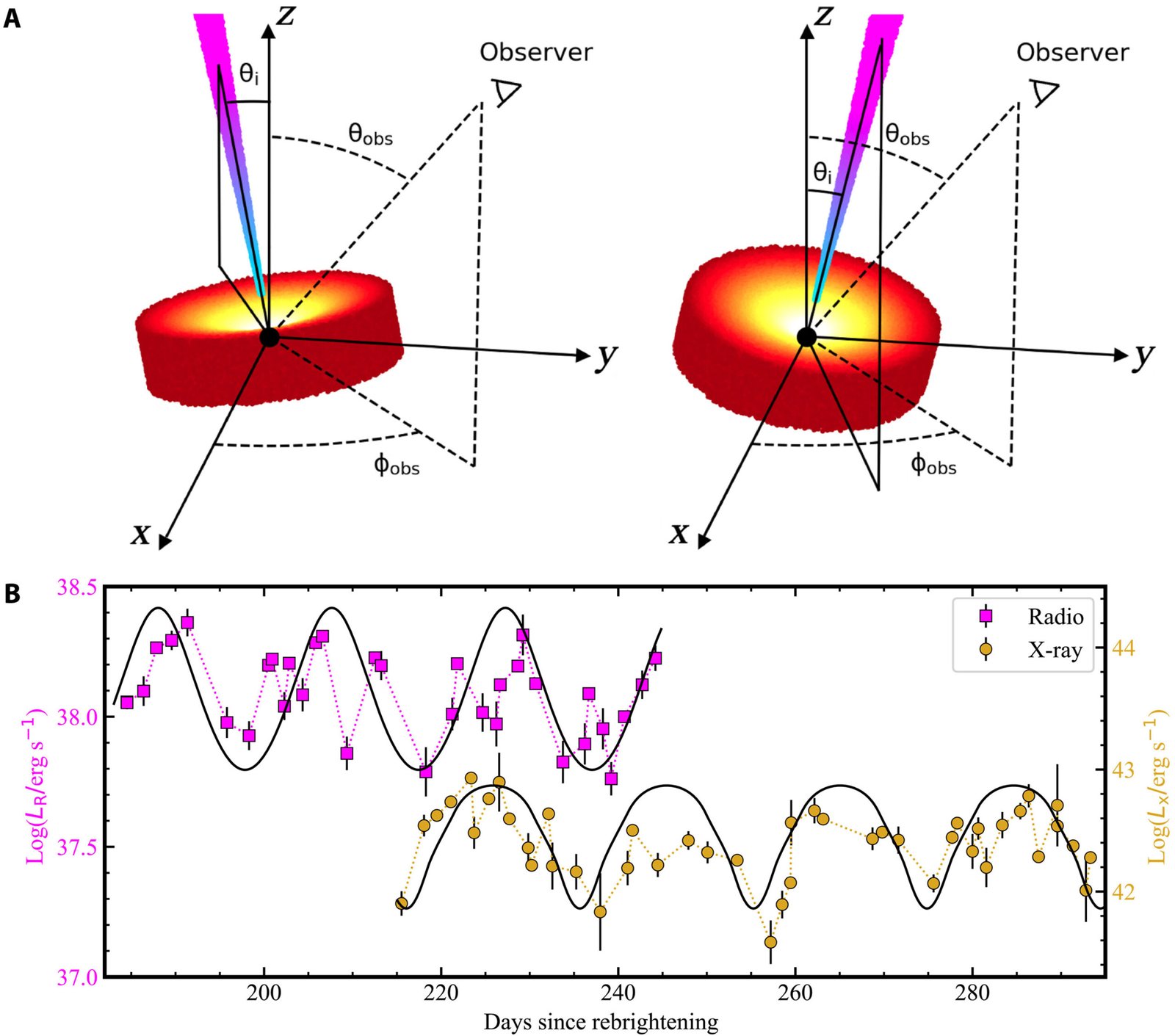
Both the X-ray and radio emissions from AT2020afhd began to rise and fall in a steady rhythm. Every 20 days the signal repeated, as if the disk and the jet were swaying together in a slow, synchronized dance. This unison wobble was the fingerprint the researchers had been searching for. According to Einstein’s theory, a spinning black hole should drag the surrounding spacetime with it, forcing the disk and its jet to precess like a cosmic spinning top.
Now, for the first time, that subtle drag had been caught in the act.
A Prediction From the Past Becomes a Discovery of the Present
Lense-Thirring precession was first introduced through Einstein’s early ideas in 1913, later refined mathematically by Josef Lense and Hans Thirring in 1918. For decades, physicists have tried to detect the swirling effect around black holes, but the signature has always been too faint, too tangled, too easily lost in the chaos of extreme environments.
This time, it was unmistakable.
Dr. Cosimo Inserra, a Reader in the School of Physics and Astronomy at Cardiff University and co-author of the study, captured the excitement clearly. “Our study shows the most compelling evidence yet of Lense-Thirring precession—a black hole dragging space time along with it in much the same way that a spinning top might drag the water around it in a whirlpool.
“This is a real gift for physicists as we confirm predictions made more than a century ago. Not only that, but these observations also tell us more about the nature of TDEs—when a star is shredded by the immense gravitational forces exerted by a black hole.
“Unlike previous TDEs studied, which have steady radio signals, the signal for AT2020afhd showed short-term changes, which we were unable to attribute to the energy release from the black hole and its surrounding components. This further confirms the dragging effect in our minds and offers scientists a new method for probing black holes.”
A cosmic prediction had finally stepped out of theory and into observation.
The Symphony Hidden in the Data
To uncover the effect, the team turned to two of the most powerful observational tools available. They used X-ray data from the Neil Gehrels Swift Observatory and radio data from the Karl G. Jansky Very Large Array. Each instrument captured a different voice in the event’s rising and falling emissions. When the signals were layered together, a pattern became clear.
The disk was wobbling. The jet was wobbling. And both were doing so with the same 20-day rhythm.
Further spectral analysis of the matter swirling around the black hole revealed exactly what the team needed to confirm the discovery. Electromagnetic spectroscopy allowed them to map the composition and structure of the cosmic debris, making it possible to piece together the mechanics of the precession. Every line of data pointed to the same conclusion. The black hole was twisting spacetime.
Dr. Inserra explained the deeper implication. “By showing that a black hole can drag space time and create this frame-dragging effect, we are also beginning to understand the mechanics of the process. So, in the same way a charged object creates a magnetic field when it rotates, we’re seeing how a massive spinning object—in this case a black hole—generates a gravitomagnetic field that influences the motion of stars and other cosmic objects nearby.
“It’s a reminder to us, especially during the festive season as we gaze up at the night sky in wonder, that we have within our grasp the opportunity to identify ever more extraordinary objects in all the variations and flavors that nature has produced.”
Why This Matters for the Future of Black Hole Science
The discovery of frame-dragging in AT2020afhd is more than a confirmation of a century-old idea. It opens an entirely new window into black hole physics. Until now, measuring black hole spin and understanding how jets form has relied heavily on indirect estimates and complex models. But a wobbling disk and a wobbling jet create a measurable signal, a cosmic clock whose rhythm can reveal the black hole’s properties with striking precision.
This observation provides a method that scientists can now apply to other tidal disruption events and active black holes, potentially transforming the way researchers study some of the most extreme objects in the universe. It deepens our understanding of what happens when stars die in the grip of gravity. It illuminates the strange, twisted geography of spacetime near a rapidly spinning black hole. And it pushes Einstein’s predictions even further into the realm of observable truth.
For those who spend their nights staring into the dark, waiting for the universe to whisper its secrets, this discovery is a reminder that nature still has wonders left to share. The cosmos has once again blinked back, offering a glimpse into a realm where space bends, time wobbles, and black holes spin the universe into graceful spirals.
More information: Yanan Wang et al, Detection of disk-jet coprecession in a tidal disruption event, Science Advances (2025). DOI: 10.1126/sciadv.ady9068