The universe is full of giants, but few are as mysterious as the massive galaxy cluster known as SPT-CL J0217-5014. For years, it lingered in astronomical catalogues like a shadowy figure in a distant crowd, recognized but barely understood. That changed when a team led by Dan Hu of Masaryk University turned NASA’s Chandra spacecraft toward it, using the observatory’s Advanced CCD Imaging Spectrometer to peel back the layers of this enormous structure. Their results, published December 4 on the arXiv preprint server, reveal a cluster that is not calm or orderly but shaped by past turmoil.
“This study aims to evaluate its chemical and thermodynamic properties with a dedicated Chandra observation,” the researchers write, and what they uncovered tells a dramatic story of cosmic collisions.
A Turbulent Heart in Deep Space
Galaxy clusters are the universe’s largest gravitationally-bound structures, sometimes containing thousands of galaxies pulled together over billions of years. They grow by drawing in smaller systems, making them perfect laboratories for understanding how galaxies evolve and how cosmic structures take shape. But even among these giants, SPT-CL J0217-5014 stands out.
Sitting at a redshift of 0.53, it carries a stellar mass of about 300 trillion times that of the sun. Its iron levels are higher than what astronomers usually see, hinting at a complex history. Yet, until now, its past had remained frustratingly opaque.
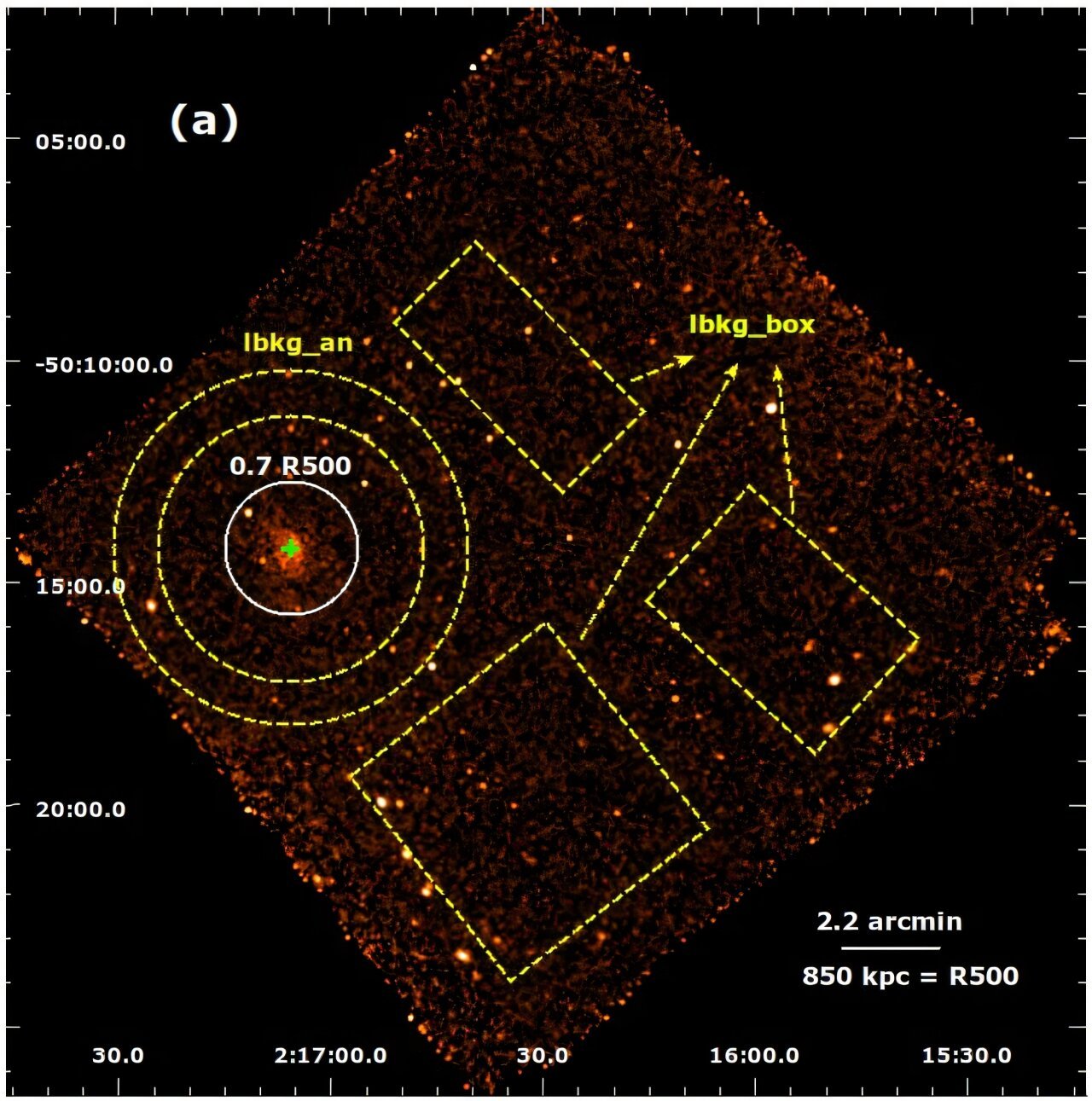
Chandra’s X-ray vision changed that. The spacecraft’s images revealed that the cluster is not a tranquil, relaxed system. Instead, it displays a disturbed morphology that tells a story written in turbulence. A bright edge appears about 330,000 light years west of the cluster’s center, while a long, tail-like structure sweeps off to the east. These features are more than visual quirks. They are the fingerprints of upheaval, clues that the intracluster medium is stirred, twisted, and far from equilibrium.
The team realized they were looking at a cluster that had been shaken—quite literally—by something massive.
Signs of a Lost Cool Core
The evidence pointed to another striking conclusion. SPT-CL J0217-5014 is a non-cool-core cluster, a category defined by its inability to maintain a dense, chilled center of gas. Cool cores form when gas settles quietly over time, allowing metals to concentrate toward the middle. But when something violent happens, that order can vanish.
In this case, Chandra’s data showed a sub-solar abundance of elements, matching what astronomers often see in non-cool-core clusters. The researchers explained that dynamical processes like mergers disrupt the core, stir the metal-rich gas, and mix it with the hotter outer medium. The result is a diluted, chaotic center—one that has clearly forgotten any prior calm.
Power ratio measurements and morphology indices reinforced this picture. SPT-CL J0217-5014 firmly resides in the realm of dynamically disturbed clusters, the kind shaped by large-scale collisions. All signs point to a major event in the cluster’s recent past.
Echoes of Companions and a Larger Cosmic Web
The story does not stop at the cluster itself. During the observation, the astronomers also identified three smaller companions nearby, designated CIG 2, CIG 3, and CIG 4. Though less massive and less enriched than SPT-CL J0217-5014, their presence adds another layer to the narrative.
The main cluster appears to sit at a node of a broader large-scale structure, a busy intersection in the cosmic web where filaments of galaxies converge. In such environments, collisions and infalls are almost inevitable. The researchers suggest a coherent picture that binds all these threads together.
“SPT-CL J0217–5014 likely underwent a relatively energetic, nearly head-on merger that disrupted a pre-existing cool core; ClG 2 and ClG 3 may be lower-mass companions that have merged with or fallen onto the main cluster, while ClG 4 aligns with the extension of the filamentary galaxy distribution, suggesting its association with a broader cosmic web,” the authors conclude.
In this view, SPT-CL J0217-5014 becomes the central figure in a larger drama. It is the heavyweight at a cosmic crossroads, gathering companions, enduring collisions, and reshaping itself through the slow but relentless choreography of gravity.
Why This Discovery Matters
Every galaxy cluster carries a history written in gas, stars, and motion, and SPT-CL J0217-5014 has now begun to tell its own. By revealing its disturbed structure, missing cool core, and surrounding companions, the new Chandra observations open a valuable window into how giant clusters grow, evolve, and interact with their environments.
For astronomers studying cosmology and galaxy evolution, this cluster functions like a natural laboratory. It shows what happens when massive systems collide, how metals disperse, how gas responds to violent shifts, and how surrounding filaments feed material into a gravitational hub. It also strengthens the idea that large-scale structure is not just a static map of galaxies but a dynamic ecosystem shaped by movement, mergers, and turbulence.
In the end, the significance of this study reaches far beyond a single cluster. It deepens our understanding of how the universe builds its largest structures and reminds us that even in the vast stillness of space, the forces that shape reality never truly rest.
More information: Dan Hu et al, A Chandra view of SPT-CL J0217-5014: a massive galaxy cluster at a cosmic intersection at z=0.53, arXiv (2025). DOI: 10.48550/arxiv.2512.04689