Every night, the moon rises with the same familiar face turned toward Earth. Its dark volcanic plains form shapes people have traced into stories for thousands of years. Yet the side we never see tells a very different story, one of rugged mountains, countless craters, and a crust that is noticeably thicker. For decades, this striking imbalance has quietly troubled scientists. How could a single world, born in the same moment, grow into two such different halves?
Now, clues carried home in tiny grains of dust are beginning to speak.
Soil and rock returned from the moon’s far side by China’s Chang’e-6 mission suggest that a single, ancient catastrophe may have reshaped the moon from the inside out. What once looked like a surface mystery is revealing itself as a deep interior story, written in heat, vapor, and time.
The Deep Scar That Changed Everything
The samples came from the South Pole–Aitken basin, a colossal impact crater that covers nearly one-quarter of the moon’s surface. This is not just any crater. It is so vast and so deep that scientists have long wondered whether it punched through the moon’s crust and reached into its mantle, the layer beneath that holds clues to the moon’s earliest history.
Researchers from the Chinese Academy of Sciences focused on this location for a reason. If any event could have disturbed the moon’s interior chemistry, this was it. The basin represents an ancient collision of extraordinary force, one powerful enough to leave a scar that still dominates the lunar landscape billions of years later.
From this site, Chang’e-6 brought back precious material from the far side, a region that has remained largely untouched by direct sampling until now.
Four Fragments and a Careful Comparison
The study centered on just four tiny basalt fragments, each no larger than a grain of gravel. Despite their size, these fragments carried an enormous weight of information. Using high-precision mass spectrometry, the scientists examined the isotopic makeup of the rocks with extreme care.
To understand what made these far-side samples unusual, the team compared them with lunar rocks collected from the near side during the Apollo missions and China’s Chang’e-5 mission. This comparison allowed them to look for subtle differences that could not be explained by chance or ordinary volcanic activity.
Their findings, published in the journal Proceedings of the National Academy of Sciences, revealed a quiet but powerful chemical signal hidden within the atoms themselves.
When Atoms Remember Heat
The key clue lay in isotopes, versions of the same element that differ slightly in mass. In the far-side samples, potassium isotopes were found to be significantly heavier than those from the near side. Iron isotopes, by contrast, were only slightly heavier.
This distinction mattered deeply. Changes in iron isotopes can occur during volcanic processes, something the moon experienced extensively. Potassium, however, behaves differently. It is a moderately volatile element, meaning it vaporizes easily when exposed to intense heat.
When potassium heats up enough to boil, its lighter atoms tend to escape as vapor, while the heavier isotopes stay behind. The abundance of heavy potassium isotopes in the far-side samples told a clear story to the researchers. Something had heated this region far beyond what ordinary volcanism could explain.
The atoms themselves seemed to remember a moment of extreme temperature.
A Collision That Boiled the Moon
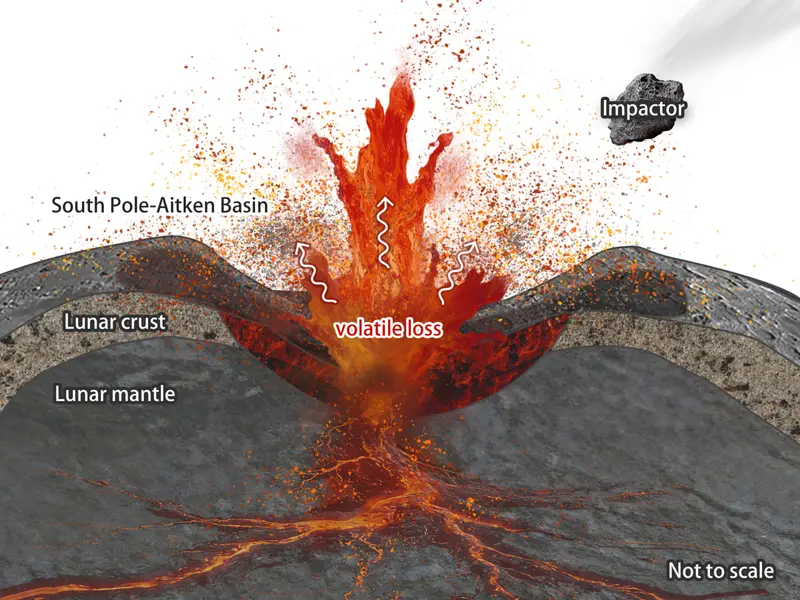
The scientists believe the ancient impact that created the South Pole–Aitken basin reached temperatures of approximately 2,800 Kelvin. This was not a simple surface blow. The heat was intense and deep enough to melt parts of the moon’s interior.
As the collision boiled the lunar mantle, heat-producing elements were displaced. According to the researchers, these elements were pushed toward the near side of the moon, where they later helped fuel widespread volcanism. This could explain why the near side is dominated by dark volcanic plains, formed from ancient lava flows.
The far side, meanwhile, was left depleted. With fewer of these volcanic ingredients, it cooled differently. What remained was potassium marked by a heavier isotopic signature, a chemical echo of the violent heating it once endured.
In this view, the moon’s lopsided appearance is not a coincidence. It is the lasting result of a single, transformative event that reshaped its interior and set its two hemispheres on very different paths.
A Planetary Asymmetry Written in Stone
The idea is both elegant and dramatic. One immense collision, early in the moon’s history, altered the chemistry of its mantle and created the stark contrast we still observe today. Smooth, volcanic plains on one side. Thick crust and rugged terrain on the other.
As the researchers write, “Our results thus provide robust evidence for significant impact-induced modification of the lunar mantle and demonstrate that large-scale impacts may have played a key role in creating lunar asymmetry.”
It is a powerful statement, suggesting that impacts are not just surface events that leave craters behind. They can reach deep into a world, rearranging its internal makeup and shaping its destiny for billions of years.
The Caution Hidden in Four Samples
Yet the scientists are careful not to claim final answers. Their conclusions rest on only four samples, remarkable though they are. The far side of the moon remains largely unexplored at this level of detail, and more material will be needed to confirm whether this massive impact truly explains the moon’s two-faced nature.
Future missions that return additional samples from the far side could strengthen or refine this picture. They may reveal whether the chemical patterns seen here are widespread or limited to this specific region.
For now, the story remains compelling but unfinished, like a chapter written clearly enough to intrigue, yet open enough to invite further exploration.
Why This Discovery Matters
This research matters because it changes how we understand not just the moon, but the forces that shape rocky worlds. It shows that a single, enormous impact can reach deep below the surface, altering a planet or moon from the inside out. The moon’s familiar face, long taken for granted, may be the visible consequence of an ancient moment of unimaginable heat.
By reading the subtle language of isotopes, scientists are learning how to reconstruct events that happened billions of years ago, events no telescope could ever witness. These findings remind us that worlds carry their histories within them, encoded at the atomic level, waiting patiently for the right questions to be asked.
In uncovering why the moon is lopsided, this study brings us closer to understanding how violence and heat can create lasting order in the cosmos. The moon, steady and silent in our sky, is revealing that even its calm presence was forged in fire.
Study Details
Heng-Ci Tian et al, Isotopic evidence for volatile loss driven by South Pole-Aitken basin–forming impact, Proceedings of the National Academy of Sciences (2026). DOI: 10.1073/pnas.2515408123