At first glance, LAMOST J065816.72+094343.1 looked like just another faint point of light cataloged in a massive sky survey. Identified in 2018 by the Large Sky Area Multi-Object Fiber Spectroscopic Telescope, it carried a technical name and a brief description: a hot subdwarf star. Nothing about it suggested drama. Nothing hinted that this star was quietly orbiting something powerful and unseen.
Yet astronomy has a way of turning the ordinary into the extraordinary. When scientists began to look more closely, J0658, as astronomers call it for short, revealed itself not as a solitary star, but as one half of a tightly bound cosmic partnership. Hidden within its subtle movements was the signature of a companion massive enough to challenge the boundaries between known stellar remnants.
What emerged from that investigation is now reported as the discovery of a new and remarkable binary system, detailed in the January issue of the journal Astronomy & Astrophysics.
The Nature of a Hot Subdwarf
J0658 belongs to a rare class of stars known as hot subdwarfs, specifically an sdOB-type star. These objects are small, extremely hot, and far more compact than stars like the Sun. Observations revealed that J0658 is helium-poor, with an effective temperature of about 35,800 K, making it intensely luminous despite its modest size.
Its rotation adds another clue. Astronomers measured a projected rotational velocity of 37 km/s, a detail that hints at interactions with a companion rather than an isolated life. Even so, at the time of its discovery, very little else was known. J0658 was cataloged, classified, and largely left alone.
That changed when a team led by Fabian Mattig of the University of Potsdam decided to revisit the star. The lack of detailed understanding made it irresistible. Sometimes the most revealing discoveries come not from new objects, but from asking better questions about familiar ones.
Listening to a Star’s Subtle Movements
The team began by returning to archival LAMOST spectroscopic data, looking for patterns that might have been overlooked. They then carried out follow-up observations using two powerful instruments: the Southern Astrophysical Research telescope and the Very Large Telescope.
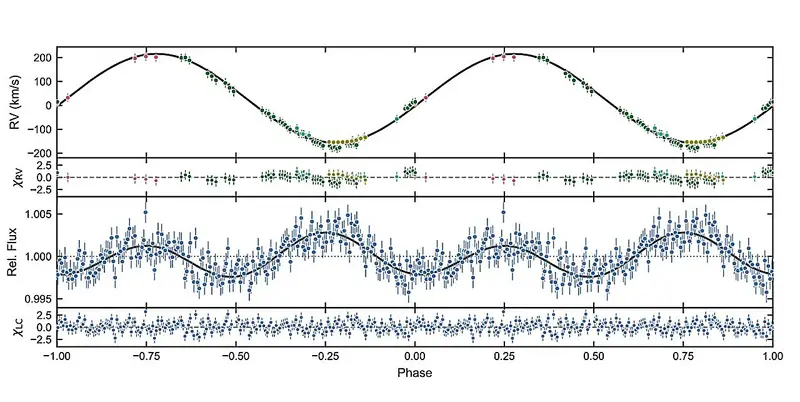
Rather than imaging a companion directly, the astronomers focused on how J0658 behaved over time. As the star moved, its light shifted slightly due to its motion toward and away from Earth. These shifts, recorded as time series spectra and refined through high-resolution spectroscopy, told a story of gravitational influence.
The data revealed periodic changes that could not be explained by a single star. J0658 was wobbling. Something massive was pulling on it.
“To explore the nature and evolutionary future of LAMOST J065816.72+094343.1, we complemented archival spectroscopic data with additional time series spectra as well as high-resolution spectroscopy of the object,” the scientists wrote. “We have identified and characterized J0658 as a new, highly massive short-period hot subdwarf binary.”
A Dance Every Eight Hours
The analysis showed that J0658 is locked in an incredibly tight orbit with its companion. The orbital period is approximately 0.32 days, meaning the two objects complete a full revolution around each other in less than eight hours.
The visible star, the hot subdwarf, has a radius of about 0.31 solar radii and a mass of 0.82 solar masses. By itself, this already places it among the more massive examples of its kind.
The real surprise lies in the companion. Although it remains unseen, its gravitational effect is unmistakable. Calculations indicate that it is approximately 30% more massive than the Sun, making it heavier than many stellar remnants typically observed in such systems.
This mass immediately raises a profound question. What exactly is orbiting J0658?
On the Edge of Stellar Identity
The estimated mass of the unseen companion places it dangerously close to the Chandrasekhar mass limit, roughly 1.4 solar masses. This threshold is famous in astrophysics. It marks the maximum mass a white dwarf can sustain before collapsing under its own gravity.
Because of this, the companion exists in a gray area. It could be a very massive carbon-oxygen white dwarf, or an oxygen-neon white dwarf, both of which are rare at such high masses. But it could also cross into another category entirely: a low-mass neutron star.
The mass overlaps those of the most massive white dwarfs known and extends into neutron-star territory. Without direct observation, the distinction remains uncertain. Yet the difference is far from trivial. Each possibility leads to a dramatically different future for the system.
J0658, it turns out, is not just a binary. It is a crossroads of stellar evolution.
Futures Written in Gravity
If the unseen companion is a carbon-oxygen white dwarf, the system’s future unfolds slowly. Astronomers expect stable helium accretion, as material from the hot subdwarf gradually transfers to the companion. Over an immense timescale of about 30 billion years, the two objects could merge into a double white dwarf system.
That merger may end quietly, leaving behind a detached double white dwarf. Or it may end violently, triggering a Type Ia supernova. Such explosions are among the most important cosmic events, releasing enormous energy and reshaping their surroundings.
If the companion is instead an oxygen-neon white dwarf, the ending changes completely. In that case, continued accretion would push it toward an accretion-induced collapse, transforming it into a neutron star. The result would be the formation of an intermediate-mass binary pulsar, an object that spins rapidly and emits regular pulses of radiation.
The third possibility is that the companion is already a neutron star. In this scenario, the system would first pass through a transient phase as an intermediate-mass X-ray binary, before settling into a similar pulsar outcome.
Each path tells a different story, yet all begin with the same quiet star cataloged years ago.
Waiting for the Final Clue
At present, the data cannot decisively identify the nature of J0658’s companion. The gravitational evidence is compelling, but mass alone is not enough to draw a final conclusion. The authors of the study emphasize that further observations are required to determine which evolutionary pathway this system will follow.
Future measurements may reveal subtle signals that distinguish a white dwarf from a neutron star. Until then, J0658 remains suspended between possibilities, its destiny unwritten but profoundly consequential.
Why This Discovery Matters
The discovery of LAMOST J065816.72+094343.1 as a massive hot subdwarf binary matters because it sits at the intersection of some of the most important processes in stellar evolution. Systems like this help astronomers understand how stars live, interact, and die under extreme conditions.
J0658 challenges existing assumptions about the masses and companions of hot subdwarfs. It offers a rare opportunity to study an object whose future could include a Type Ia supernova, a neutron star, or a binary pulsar, all outcomes with far-reaching implications for astrophysics.
Perhaps most importantly, this discovery reminds us that the sky still holds secrets even in well-studied data. By returning to archival observations with new questions and sharper tools, astronomers uncovered a hidden companion and a story billions of years in the making.
J0658 is no longer just a catalog entry. It is a living experiment in gravity, time, and transformation, quietly orbiting toward a future that may reshape our understanding of how the most extreme stars come to be.
Study Details
Fabian Mattig et al., The massive hot subdwarf binary LAMOST J065816.72+094343.1, Astronomy & Astrophysics (2026). DOI: 10.1051/0004-6361/202557949. On arXiv: DOI: 10.48550/arxiv.2601.03810