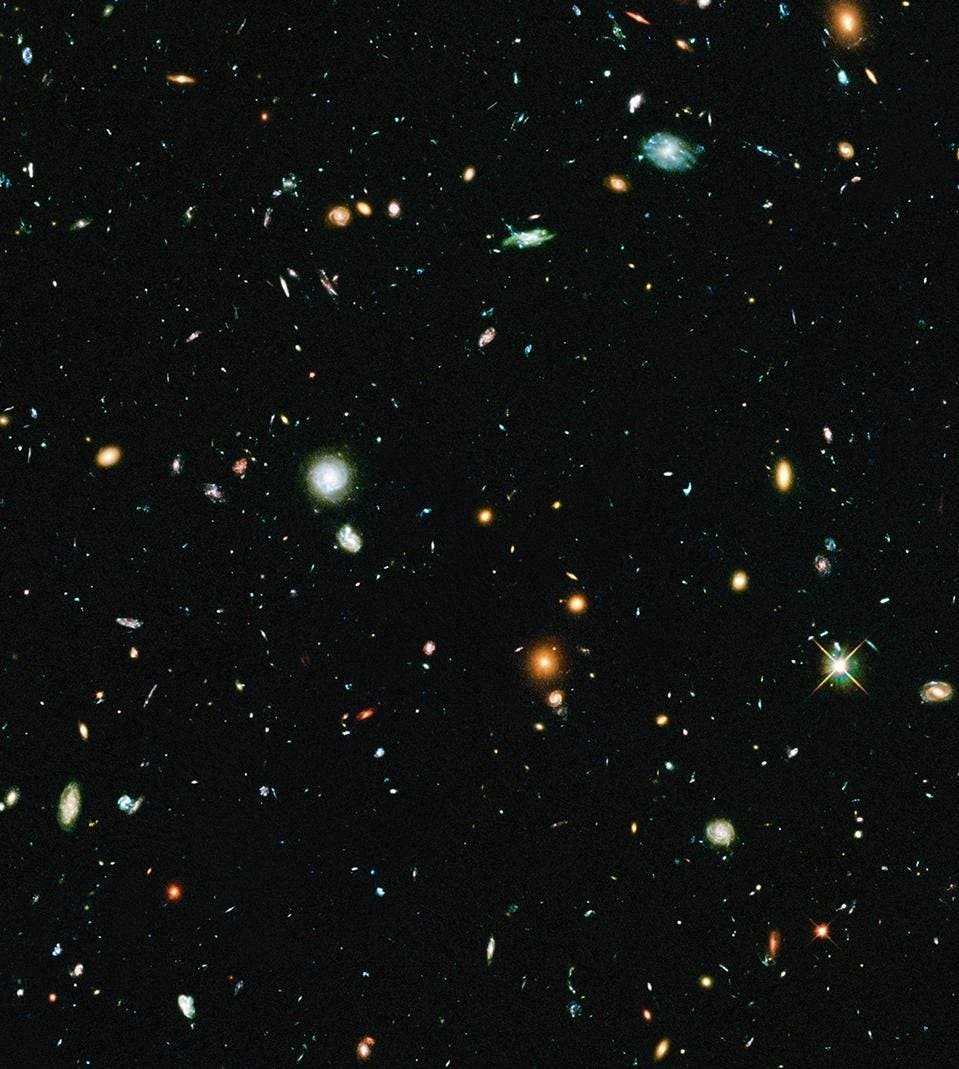
When you look up at the night sky, it feels as though you are seeing the universe in all its glory. Thousands of stars sparkle overhead. The Milky Way stretches like a glowing river across the darkness. Through powerful telescopes, astronomers can observe colorful nebulae, swirling galaxies, and brilliant quasars billions of light-years away.
It seems like we are looking at everything the universe has to offer.
But appearances can be deceiving.
Over the past century, scientists have uncovered one of the greatest mysteries in the history of science: almost everything we can see—the stars, planets, moons, gas clouds, black holes, and even ourselves—makes up only a tiny fraction of the cosmos.
The overwhelming majority of the universe is invisible.
This hidden cosmos consists of two mysterious ingredients known as dark matter and dark energy. Together, they account for about 95 percent of the universe. Ordinary matter—the atoms that build every person, animal, mountain, ocean, and galaxy—represents only about 5 percent of the cosmic total.
That realization is both humbling and breathtaking.
Imagine reading an enormous book while discovering that you have seen only five out of every hundred pages. That is essentially humanity’s current understanding of the universe.
We know an incredible amount about the visible cosmos, yet the greatest part of reality remains hidden.
This is the story of the invisible universe.
What Do Scientists Mean by “Dark”?
The word “dark” often creates confusion.
Dark matter and dark energy are not necessarily black in color.
Scientists use the word “dark” because these mysterious components do not emit, absorb, or reflect light in ways that allow telescopes to see them directly.
They are invisible to ordinary observations.
If you shine a flashlight into a dark room, the light reflects off furniture, walls, and objects, allowing you to see them.
Dark matter behaves differently.
Light passes through it without revealing its presence.
Dark energy is even stranger.
It does not appear to be a material object at all.
Instead, it seems to be a property of space itself that influences how the universe expands.
Neither dark matter nor dark energy has been directly observed in the same way scientists observe stars or planets.
Instead, researchers infer their existence from the effects they have on the visible universe.
In astronomy, this is common.
Wind cannot be seen directly, but moving leaves reveal its presence.
Similarly, invisible cosmic ingredients reveal themselves through gravity and the behavior of galaxies.
The Universe We Can Actually See
Before exploring the invisible universe, it helps to understand the visible one.
Everything familiar belongs to ordinary matter.
The Earth beneath your feet.
The air you breathe.
The Sun.
Every distant star.
Every galaxy.
Every atom in your body.
All of these are made from particles such as protons, neutrons, and electrons.
These particles form atoms.
Atoms combine into molecules.
Molecules create everything we know.
For centuries, scientists assumed that this visible matter represented nearly all of existence.
As telescopes improved, astronomers simply expected to discover more stars and more galaxies.
Instead, they uncovered a shocking surprise.
Something enormous was missing.
The First Clues That Something Was Wrong
The mystery began in the early twentieth century.
Astronomers started measuring how galaxies move.
They expected gravity from visible stars to explain those motions.
Instead, the calculations refused to cooperate.
Galaxies behaved as though much more mass existed than telescopes could detect.
Imagine watching children ride a merry-go-round.
If you know its speed, you can estimate how heavy it must be.
Now imagine discovering that it spins far too quickly for its visible weight.
The only explanation would be hidden weight somewhere inside.
Astronomers encountered the same puzzle.
The universe appeared much heavier than it looked.
Fritz Zwicky’s Surprising Discovery
One of the earliest scientists to recognize this mystery was Swiss astronomer Fritz Zwicky during the 1930s.
He studied clusters of galaxies.
Individual galaxies moved through these clusters so rapidly that gravity from visible matter alone could not hold them together.
According to calculations, the clusters should have flown apart long ago.
Yet they remained intact.
Zwicky proposed that enormous amounts of invisible matter surrounded the galaxies.
He called it “dark matter.”
At the time, many scientists remained skeptical.
His idea seemed too extraordinary.
For decades, it received relatively little attention.
Only later would evidence begin to accumulate.
Vera Rubin and the Rotation of Galaxies
One of the strongest cases for dark matter came several decades later.
Astronomer Vera Rubin carefully measured how stars orbit within galaxies.
Classical physics predicts that stars farther from a galaxy’s center should move more slowly because less visible mass lies inside their orbits.
This is exactly how planets behave in our Solar System.
Mercury races around the Sun.
Neptune moves much more slowly because it is much farther away.
Galaxies refused to behave this way.
Stars near their outer edges moved almost as fast as stars much closer to the center.
The only reasonable explanation was that huge amounts of unseen mass surrounded every galaxy.
Invisible matter formed enormous halos extending far beyond the visible stars.
Rubin’s observations transformed dark matter from an unusual idea into one of modern astronomy’s central mysteries.
What Exactly Is Dark Matter?
The honest answer is surprisingly simple.
Scientists do not yet know.
Dark matter clearly possesses mass.
Gravity affects it.
It influences the motions of galaxies.
It bends light through gravity.
It helped shape the large-scale structure of the universe.
Yet it does not appear to interact strongly with light.
Unlike ordinary atoms, dark matter remains invisible across the electromagnetic spectrum.
It does not glow.
It does not reflect sunlight.
It does not produce familiar chemical reactions.
If dark matter surrounds us—as scientists believe it does—we pass through it every moment without noticing.
How Much Dark Matter Exists?
Modern observations suggest that dark matter makes up roughly twenty-seven percent of the universe.
Ordinary matter contributes only about five percent.
The remaining sixty-eight percent appears to be dark energy.
This means dark matter outweighs visible matter by more than five to one.
Every star.
Every planet.
Every galaxy.
Every person.
Everything familiar exists within a much larger invisible framework.
It is as though the visible universe floats inside a vast unseen ocean.
Dark Matter Is Everywhere
Dark matter does not exist only in distant galaxies.
Scientists believe it fills our own galaxy as well.
In fact, the Solar System is moving through a cloud of dark matter right now.
The particles—whatever they are—probably pass through Earth, your home, and even your body every second.
Yet because they interact so weakly with ordinary matter, they pass almost completely unnoticed.
This remarkable possibility reminds us how incomplete our everyday senses truly are.
Reality contains far more than we can directly perceive.
The Cosmic Web
One of the universe’s most beautiful discoveries is the cosmic web.
Galaxies are not randomly scattered through space.
Instead, they form enormous interconnected filaments stretching across hundreds of millions of light-years.
Between these filaments lie vast empty regions known as cosmic voids.
Computer simulations reveal something fascinating.
The observed cosmic web naturally forms when dark matter provides the underlying gravitational framework.
Ordinary matter then falls into these invisible structures, where galaxies eventually develop.
In this picture, dark matter acts like the scaffolding of the universe.
The visible galaxies are simply the lights decorating an enormous hidden framework.
Gravitational Lensing: Seeing the Invisible
One of the cleverest ways astronomers study dark matter involves gravity itself.
According to Einstein’s theory of general relativity, massive objects bend spacetime.
Light follows these curved paths.
As a result, massive galaxies and galaxy clusters can bend light coming from even more distant objects.
This effect is called gravitational lensing.
Sometimes background galaxies appear stretched into arcs.
Sometimes multiple images appear.
Sometimes their shapes become subtly distorted.
By carefully measuring these distortions, astronomers can map invisible mass.
Again and again, the maps reveal far more matter than telescopes can see.
Dark matter literally reveals itself by bending light.
The Bullet Cluster
One of the strongest pieces of evidence for dark matter comes from an extraordinary cosmic collision.
Two galaxy clusters crashed into each other.
During the collision, the hot gas inside the clusters slowed dramatically because the gas interacted directly.
The galaxies themselves mostly passed through.
When astronomers mapped the gravitational mass using gravitational lensing, they discovered something remarkable.
Most of the mass had moved with the galaxies rather than remaining with the gas.
This separation strongly suggested that invisible matter behaves differently from ordinary matter.
The Bullet Cluster became one of astronomy’s most compelling demonstrations that dark matter is a real physical component of the universe rather than simply a mistake in gravity calculations.
Could Dark Matter Be Ordinary Matter?
Scientists carefully explored this possibility.
Perhaps dark matter consisted of faint stars.
Maybe invisible planets.
Brown dwarfs.
Cold gas clouds.
Black holes.
These possibilities explain only a tiny fraction of the missing mass.
Observations from many independent methods show that ordinary matter simply cannot account for all the gravitational effects.
Whatever dark matter is, it appears fundamentally different from the atoms making up everyday objects.
Possible Dark Matter Particles
Although no dark matter particle has yet been confirmed, scientists have proposed several possibilities.
One popular idea involves Weakly Interacting Massive Particles, often called WIMPs.
These hypothetical particles would possess mass while interacting only weakly with ordinary matter.
Another possibility involves axions, extremely light particles originally proposed for unrelated reasons in particle physics.
Some researchers investigate sterile neutrinos.
Others consider entirely new particles not yet imagined.
Modern particle physics experiments continue searching for answers.
Searching for Dark Matter Underground
Finding dark matter is extraordinarily difficult.
Because it interacts so weakly, scientists build detectors deep underground.
Mountains and thick layers of rock shield these laboratories from cosmic rays and other background particles.
Researchers hope that a dark matter particle will occasionally collide with an atom inside a detector.
Such collisions would produce tiny signals.
So far, no experiment has produced universally accepted evidence of direct detection.
Each unsuccessful search helps scientists eliminate possibilities and refine future experiments.
Searching in Space
Astronomers also search for indirect evidence.
If dark matter particles occasionally collide with one another, they might produce gamma rays, neutrinos, or other particles detectable by telescopes.
Space observatories continually monitor the sky for such signals.
Although intriguing hints occasionally appear, none has yet provided definitive proof.
The mystery remains.
Enter Dark Energy
Just when scientists were becoming comfortable with dark matter, the universe delivered another surprise.
This one proved even more astonishing.
For much of the twentieth century, astronomers assumed gravity should gradually slow the expansion of the universe.
After all, gravity attracts matter.
Galaxies should gradually pull one another back.
Scientists expected cosmic expansion to slow over time.
Instead, observations during the late 1990s revealed the opposite.
The universe’s expansion is accelerating.
Galaxies are moving away from one another faster and faster.
Something appears to be pushing space apart.
Scientists call this mysterious phenomenon dark energy.
How Was Dark Energy Discovered?
Astronomers measured distant exploding stars called Type Ia supernovae.
These stellar explosions serve as excellent “standard candles.”
Because their true brightness is well understood, scientists can determine their distances by comparing actual brightness with observed brightness.
When researchers compared distances with expansion rates, the results were astonishing.
The universe was not slowing down.
Expansion was speeding up.
The discovery shocked the scientific community.
It ultimately earned the Nobel Prize in Physics.
What Is Dark Energy?
No one knows for certain.
Unlike dark matter, dark energy does not seem to behave like invisible particles.
Instead, it appears to be connected to space itself.
As the universe expands, dark energy continues driving that expansion faster.
One possibility is that empty space possesses its own energy.
Even perfect vacuum is not truly empty according to quantum physics.
Tiny fluctuations constantly occur.
Perhaps these contribute to cosmic expansion.
Another possibility is that Einstein’s theory of gravity requires modification over enormous distances.
Researchers continue exploring both ideas.
The Expanding Universe
To understand dark energy, imagine dots drawn on the surface of a balloon.
As the balloon inflates, every dot moves away from every other dot.
No dot occupies the center.
The surface itself expands.
The universe behaves similarly.
Galaxies generally are not flying through space away from a central point.
Instead, space itself expands.
Dark energy appears to accelerate this expansion.
Every billion years, galaxies become increasingly separated.
The universe grows larger and emptier.
How Much Dark Energy Exists?
Current observations suggest dark energy accounts for approximately sixty-eight percent of the universe.
That means it represents the largest known component of reality.
The visible stars filling the night sky account for only a tiny fraction of existence.
This realization dramatically changed cosmology.
Instead of living in a universe dominated by matter, we inhabit one dominated by dark energy.
Dark Matter and Dark Energy Are Different
The names often cause confusion.
Dark matter and dark energy are not different forms of the same thing.
Dark matter behaves gravitationally like matter.
It helps galaxies stay together.
It slows expansion through gravity.
Dark energy does almost the opposite.
It accelerates cosmic expansion.
Dark matter attracts.
Dark energy appears to drive expansion.
They represent two distinct mysteries.
How Scientists Measure the Invisible Universe
Astronomers combine many techniques.
They study galaxy motions.
They observe gravitational lensing.
They examine the cosmic microwave background, the faint afterglow of the Big Bang.
They map the distribution of galaxies.
They observe supernova explosions.
Remarkably, these completely different methods all produce similar results.
Together they paint a consistent picture.
Ordinary matter contributes only a small fraction of the universe.
Dark matter and dark energy dominate everything else.
Could Our Theory of Gravity Be Wrong?
Some scientists have explored an intriguing possibility.
Perhaps dark matter does not exist.
Maybe gravity behaves differently across enormous distances.
Several alternative theories modify Einstein’s equations.
Although some explain certain observations, none currently accounts for all available evidence as successfully as the dark matter model.
Research continues because science welcomes competing explanations.
Only observations decide which ideas survive.
The Fate of the Universe
Dark energy may determine the ultimate destiny of everything.
If acceleration continues forever, distant galaxies will eventually disappear beyond our observable horizon.
Future civilizations may see only their own local galaxy group.
The rest of the universe would become invisible.
Stars will gradually burn out.
New star formation will decline.
The cosmos may slowly approach a cold, dark future sometimes called the “heat death” of the universe.
Other possibilities exist depending on the true nature of dark energy.
The universe’s long-term future remains uncertain.
Why This Mystery Matters
At first glance, dark matter and dark energy may seem like abstract scientific puzzles.
In reality, they challenge our deepest understanding of existence.
Imagine discovering that nearly everything around you belongs to a hidden world you cannot directly perceive.
That is exactly where humanity stands today.
Every advance in science began with mysteries.
Electricity once seemed mysterious.
Atoms once seemed mysterious.
Black holes once seemed impossible.
History teaches us that today’s puzzles often become tomorrow’s ordinary knowledge.
Understanding dark matter and dark energy may trigger the next scientific revolution.
The Next Generation of Discoveries
Powerful new observatories are transforming astronomy.
Modern space telescopes map billions of galaxies.
Ground-based observatories survey enormous regions of the sky.
Particle detectors become increasingly sensitive.
Powerful supercomputers simulate cosmic evolution with remarkable precision.
Each new observation brings scientists closer to understanding the invisible universe.
Perhaps the answer will come from astronomy.
Perhaps from particle physics.
Perhaps from an entirely new branch of science not yet imagined.
What the Invisible Universe Teaches Us
One of the most beautiful lessons of modern astronomy is humility.
For thousands of years, people assumed that what they could see represented reality.
Then telescopes revealed distant galaxies.
Radio telescopes uncovered invisible radio waves.
Infrared observatories exposed hidden star-forming regions.
X-ray telescopes revealed violent cosmic explosions.
Now dark matter and dark energy remind us once again that reality extends far beyond human senses.
The universe is richer than appearances suggest.
Every generation of science expands the boundaries of the known while revealing even greater mysteries beyond.
Conclusion
Dark matter and dark energy have transformed our understanding of the cosmos more profoundly than almost any discovery in modern astronomy. Together, they make up about ninety-five percent of the universe, yet neither has been directly identified. We know they exist not because we can see them, but because their influence is written across the motions of galaxies, the bending of light, the growth of cosmic structures, and the accelerating expansion of space itself.
Dark matter acts as the invisible framework that helps hold galaxies and galaxy clusters together, shaping the vast cosmic web that stretches across the universe. Dark energy, on the other hand, appears to be driving the expansion of the universe ever faster, determining its large-scale evolution and perhaps even its ultimate fate. Although these two mysterious components are very different from one another, they share one remarkable feature: they remind us that the universe is far stranger and far more complex than anyone once imagined.
The search to understand the invisible universe is one of the greatest scientific adventures of our time. New telescopes, space missions, underground detectors, particle accelerators, and increasingly sophisticated computer simulations are bringing us closer to answers that once seemed impossible. Whether the solution lies in undiscovered particles, new laws of physics, unexpected properties of space itself, or ideas that have yet to be conceived, each new discovery will deepen our understanding of reality.
Perhaps the most inspiring lesson is that humanity has already uncovered so much while knowing so little. The stars we admire on a clear night represent only a tiny fraction of existence. Beyond them lies an immense hidden cosmos waiting to be understood. In many ways, the greatest discoveries in astronomy may still be ahead of us, hidden within the silent, invisible universe that surrounds us all.