Long before galaxies fully blossomed and long after the first atoms formed, something subtle was already stretching across the vastness of space. Astronomers have known for quite some time that tiny, highly uniform magnetic fields thread their way through the universe, extending over enormous intergalactic scales. They are faint, almost ghostlike, but persistent. And for decades, their origin has remained one of cosmology’s quiet mysteries.
How did such delicate magnetic fields arise in the first place? What invisible hand set them humming across the emptiness between galaxies?
Now, researchers from McGill University and ETH Zurich believe they may have uncovered a new piece of the puzzle. In a recent study published in Physical Review Letters, they describe a mechanism that could generate these vast, nearly uniform magnetic fields—using nothing more exotic than a subtle interaction between light and a form of ultralight dark matter.
At the heart of the idea lies a quantum field so elusive it barely touches ordinary matter. Yet, according to their calculations, it may have quietly shaped the magnetic personality of the cosmos.
The Mystery That Refused to Fade
Evidence for these weak, homogeneous magnetic fields has existed for a long time. Observations suggest that they stretch across immense cosmic distances, spanning the space between galaxies. They are not chaotic or tangled beyond recognition. Instead, they appear remarkably smooth and coherent.
That smoothness is part of what makes them so puzzling.
For years, scientists struggled to explain how such fields could have formed. Many explanations relied on speculative physics tied to the very early universe—periods so extreme and poorly understood that any conclusions felt fragile.
The new proposal takes a different path. Instead of reaching back to the earliest instants after the Big Bang, the researchers focus on a later cosmic chapter known as recombination, which occurred roughly 380,000 years after the Big Bang. This was the moment when the universe cooled enough for electrons and nuclei to combine into neutral atoms. Light and matter, once tightly coupled in a hot plasma, began to move more independently.
That change mattered. After recombination, theory predicts that magnetic fields could survive for very long periods. The universe had finally become calm enough to preserve them.
If magnetic fields could persist from that era onward, then perhaps their origin also lay there.
The Axion’s Silent Oscillation
The key player in this new mechanism is a proposed form of dark matter known as an axion, a pseudo-scalar field with an extraordinarily tiny mass. Dark matter itself is widely accepted to exist, supported by many astronomical observations. Yet its true nature remains unknown.
In this study, the researchers assume dark matter is ultralight, generated by a pseudo-scalar axion field that was coherently oscillating throughout the universe at the time of recombination. This is not a wild or fringe idea. It is considered a fairly standard assumption in certain theoretical frameworks.
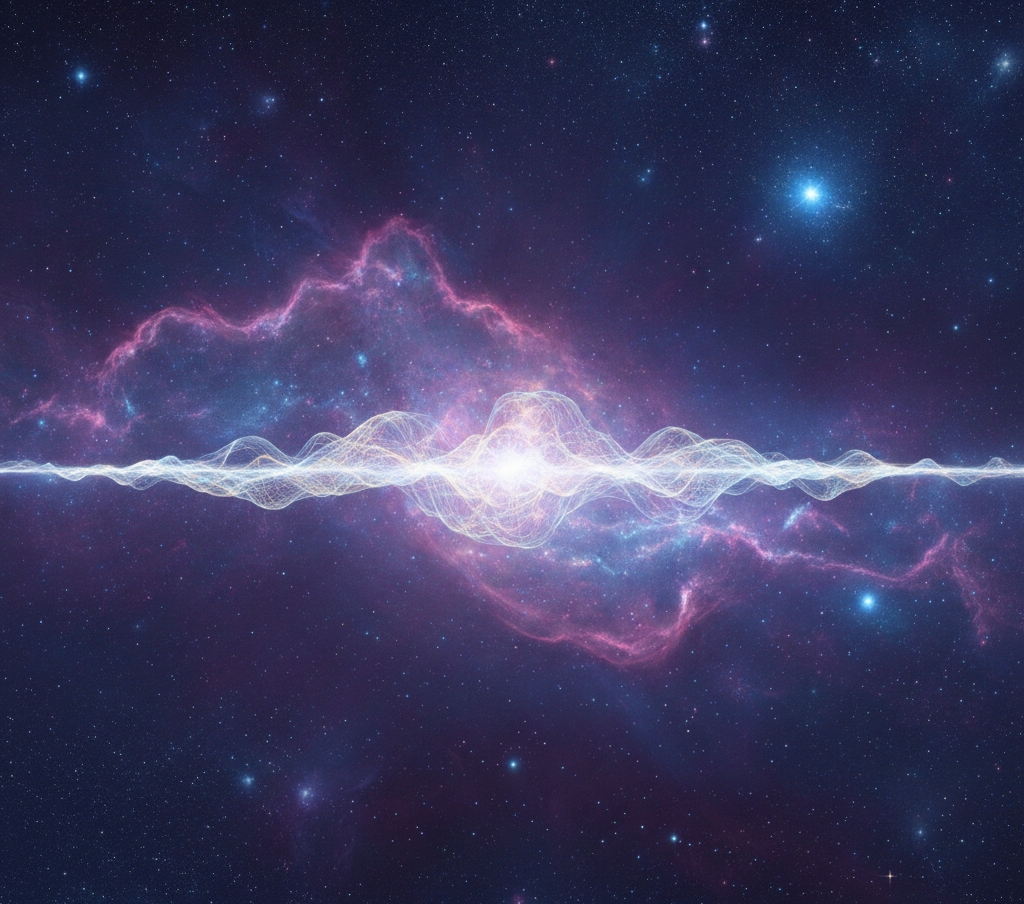
Imagine a field that fills all of space, gently oscillating in unison, like a vast cosmic vibration humming everywhere at once. These oscillations are not chaotic. They are coherent, meaning they move in a synchronized way across enormous distances.
The axion field, in this picture, interacts with the electromagnetic field through a well-known interaction described in axionelectrodynamics. On paper, it is a simple coupling term. But in the evolving universe, it becomes something far more dramatic.
A Resonance That Changes Everything
The researchers build on an idea known as parametric resonance, a phenomenon first discovered in classical mechanics. In such systems, when a field is coupled to an oscillating source, certain modes can grow exponentially. It is as if the oscillation pumps energy into the system, amplifying specific waves.
In this cosmic setting, the oscillating axion field acts as that source. When coupled to the electromagnetic field, it can trigger what the researchers call a pseudo-tachyonic resonance. This is a special instability that allows certain long-wavelength modes of the electromagnetic field to grow rapidly.
Long wavelengths are important. They correspond to structures stretching across vast distances. And when these modes are amplified, they produce magnetic fields that are both tiny and highly homogeneous—exactly the kind observed across intergalactic space.
According to the team’s calculations, this resonance channel is remarkably efficient. The coherent oscillations of the axion field induce a pseudo-tachyonic instability in the electromagnetic field, leading to a rapid amplification of magnetic fields. The resulting fields could be strong enough—within an order-of-magnitude estimate—to account for existing observations.
What makes this proposal especially appealing is its restraint. It does not depend on speculative new physics from the universe’s earliest, least understood moments. Instead, it operates after recombination, during a period that is comparatively well described by established theory.
In other words, the mechanism stands on familiar ground.
From Magnetic Fields to Black Holes
The story does not end with magnetism.
One of the researchers, Hao Jiao, has been exploring how this same mechanism might influence another profound cosmic mystery: the formation of supermassive black holes.
These enormous objects, found at the centers of most massive galaxies, can contain hundreds of thousands to billions of solar masses. Observations have revealed many candidates at high redshifts, meaning they existed very early in cosmic history. Their rapid formation remains difficult to explain.
A key challenge is preventing matter from fragmenting as it collapses. For a black hole seed to grow efficiently, surrounding matter must fall inward smoothly rather than breaking into smaller clumps.
In a follow-up study, the researchers suggest that their mechanism could generate a sufficient flux of Lyman-Werner photons after recombination. These photons are known to influence how gas cools and fragments. If enough of them are present, they can suppress fragmentation, allowing matter to collapse more directly onto black hole seeds.
The effect depends on energy cascading down to shorter wavelengths, a process that can redistribute energy from large-scale oscillations into radiation capable of influencing gas dynamics.
If confirmed and further developed, this line of reasoning could connect three seemingly distant phenomena: ultralight axion dark matter, cosmological magnetic fields, and the early growth of supermassive black holes.
Why This Research Matters
At first glance, tiny magnetic fields might seem like a minor detail in a universe filled with exploding stars and colossal galaxies. But their existence poses a fundamental question about how the cosmos organizes itself.
If these intergalactic magnetic fields truly arise from the oscillations of an ultralight axion field, then we may be witnessing a subtle signature of the nature of dark matter itself. A phenomenon that barely interacts with ordinary matter could still leave a lasting imprint on the structure of the universe.
This research matters because it offers a coherent, physically grounded explanation for a long-standing mystery without leaning on speculative early-universe physics. It ties together well-established theoretical tools, like parametric resonance and axionelectrodynamics, with observable cosmic features.
More profoundly, it hints that dark matter may not be a silent bystander. Instead, through gentle oscillations and delicate couplings, it may have quietly amplified magnetic fields, influenced radiation backgrounds, and even shaped the conditions for the birth of supermassive black holes.
In the vast darkness between galaxies, where magnetic fields stretch thin but unbroken, we may be seeing the faint echo of a quantum field oscillating since the universe was young. And in that whisper of magnetism, the nature of dark matter might finally begin to reveal itself.
Study Details
Robert Brandenberger et al, Cosmological Magnetic Fields from Ultralight Dark Matter, Physical Review Letters (2026). DOI: 10.1103/ys32-853g.