For decades, archaeologists kept encountering the same strange object, again and again, at certain ancient sites and not at others. It was small, conical, made of clay, and oddly consistent in form. These vessels, known as Chalcolithic cornets, seemed to belong to a very specific moment in human history, appearing only during the Chalcolithic period and then vanishing completely. No clear instructions came with them. No ancient texts explained their purpose. They were simply there, clustered in some places, absent in others, silently waiting to be understood.
The question lingered like an unfinished sentence. What were these objects for?
A new study led by Sharon Zuhovitzky, together with Paula Waiman-Barak and Yuval Gadot, offers a careful, evidence-driven answer. Published in Tel Aviv, the research focuses on one of the largest known collections of these vessels, recovered from the Chalcolithic site of Teleilat Ghassul. What emerges is not just a technical explanation, but a story of light, ritual, and human intention shaped in clay.
A Vessel That Appears and Disappears
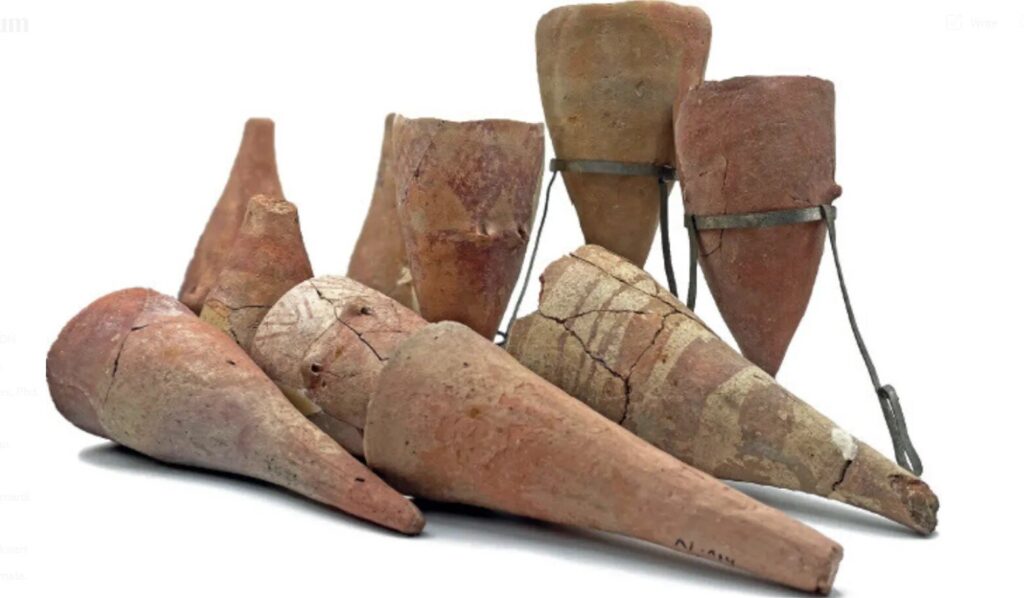
Cornets are instantly recognizable once you know what to look for. They are cone-shaped ceramic vessels, often coated in a light or red slip, and sometimes fitted with two or four small handles. They appear in large numbers at sites such as Ashkelon, ‘En Gedi, Abu Hof, and Grar, yet they are rare or entirely absent at other well-studied Chalcolithic settlements like Safadi, Abu Matar, and Shiqmim.
This uneven distribution has always been puzzling. If cornets were everyday household tools, why were they missing from so many places? And if they were ceremonial objects, why were they sometimes produced in such overwhelming quantities?
Adding to the confusion was their context. Many cornets were found in specific areas sometimes identified as favissae, spaces associated with the storage or disposal of cultic objects. This suggested meaning, but not function. Over the years, theories multiplied. Some researchers proposed that cornets played a role in the early dairy industry. Others pointed to traces of beeswax residue and suggested a connection to lost-wax copper-smelting. Still others imagined them as lamps, though this idea faced skepticism because many vessels showed no obvious soot marks.
The debate stalled, not because ideas were lacking, but because systematic evidence was.
Looking Closely at an Overlooked Collection
The breakthrough came from looking patiently and comprehensively at what had already been excavated. The researchers examined 35 complete cornets and 550 cornet sherds held at the Pontifical Biblical Institute Museum. These objects came from decades of excavations at Teleilat Ghassul, spanning the years 1929 to 1999.
Instead of focusing on isolated examples, the team treated the collection as a whole. They studied the material sources, the morphological characteristics, and the shaping techniques used to create the vessels. In doing so, they identified four main cornet types, most of which were produced locally, likely by the residents of the site themselves.
One group stood out. Type 3 cornets, distinguished by their uniformity and higher-quality craftsmanship, were likely made by specialized potters rather than casual household producers. This hinted at organization and intention. These were not random objects. They were made with purpose.
Ten Minutes to Shape a Cone
Perhaps the most revealing insight came from understanding how the cornets were made. Each vessel was formed from a single lump of clay, shaped using a round-cut stick inserted lengthwise. The base was then hand-pulled to create the distinctive cone shape.
To test whether this process was realistic, the researchers recreated it themselves. The result was striking. Each cornet could be shaped in approximately ten minutes. This was not an arduous or time-consuming task, but it was precise. The speed suggests that cornets could be produced quickly when needed, perhaps in large numbers, without sacrificing consistency.
This matters because it frames the cornets not as rare prestige items, but as objects designed for repeated, possibly communal use. They were easy to make, yet carefully formed. Simple, but not careless.
The First Traces of Fire
The lamp hypothesis had always hovered on the edge of plausibility, but one detail had kept it in doubt. If cornets were lamps, why was there so little evidence of burning?
The answer, it turns out, was hiding in plain sight. Some of the Teleilat Ghassul cornets did, in fact, show soot residue inside their interiors. These traces were subtle, easy to miss, and impossible to dismiss once recognized. Combined with experimental replication, they changed the conversation.
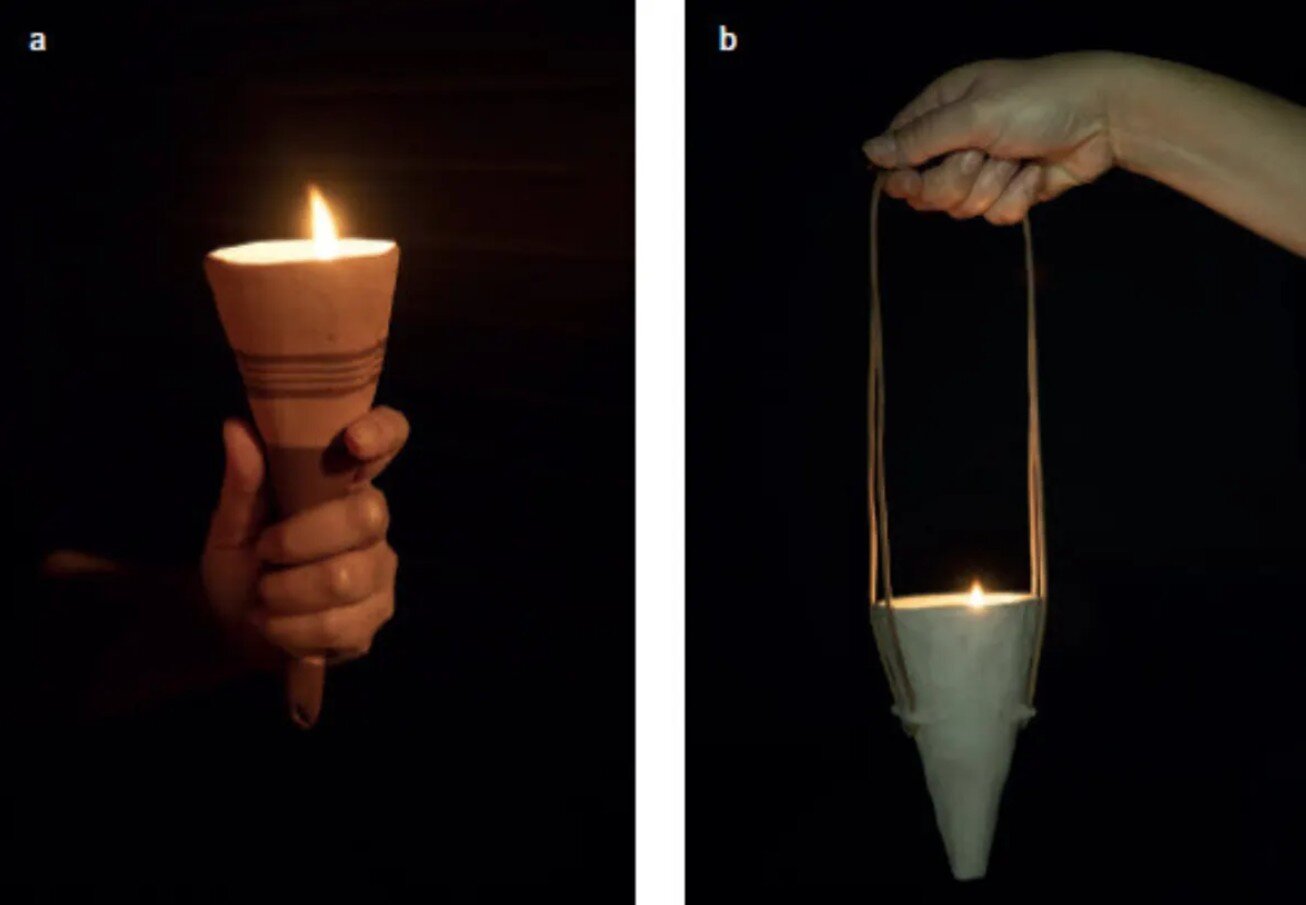
In controlled experiments, Zuhovitzky filled replica cornets with beeswax and lit them. The results were surprisingly dramatic. A beeswax-filled cornet could burn for up to nine hours, depending on the amount and quality of wax used. In the experiments, roughly half the height of the cornet was filled with modern, high-quality beeswax, producing long-lasting, steady light.
The absence of heavy soot now made sense. Beeswax burns cleanly. A lamp fueled this way would leave only modest traces, especially if used carefully and for specific occasions rather than daily illumination.
Making Light from a Precious Material
Beeswax was not an everyday resource in the Chalcolithic world. It is generally assumed to have been harvested from wild hives, a process that is both limited and destructive. This alone suggests that beeswax was valuable, something not wasted casually.
The earliest direct evidence for organized apiculture in the region comes much later, from the Iron Age beehives at Tel Rehov. Yet, as Zuhovitzky notes, there is no technological reason such practices could not have existed earlier. Traditional beehives are often made from unfired clay, which would not survive in the archaeological record. Their absence does not mean they never existed.
To make the most of this precious material, the researchers explored another possibility. The cornets may have been partially filled with clay, with beeswax added on top. This clever adjustment would reduce the amount of wax needed and raise the flame higher, improving the lamp’s effectiveness. Experimental tests confirmed that this method worked well.
Light, in this context, was not just practical. It was intentional.
Light in Painted Rooms
At Teleilat Ghassul, cornets were found in spaces adorned with colorful wall paintings. These paintings depict processions, masks, and animals, scenes that suggest ritual activity rather than everyday life. In such environments, light would have transformed the experience. Flickering flames would animate painted figures, deepen shadows, and heighten emotion.
The placement of the cornets supports this interpretation. After use, many appear to have been deliberately destroyed, as indicated by blow marks and the sheer volume of broken fragments. This was not accidental breakage. It looks intentional, perhaps part of the ritual itself.
The lamps may have illuminated ceremonies, then been broken to mark their completion. Light was summoned, used, and then symbolically extinguished.
Why This Discovery Changes the Story
This research matters because it resolves a long-standing archaeological debate using careful observation, experimentation, and restraint. Without adding assumptions or reaching beyond the evidence, the study shows that Chalcolithic cornets functioned as beeswax lamps, deeply embedded in cultic practices.
It also reminds us that ancient technology does not need to be complex to be meaningful. A vessel shaped in ten minutes could hold hours of light. A small flame could transform a painted room into a sacred space. These cornets were not just containers. They were tools for shaping human experience.
By understanding how these lamps were made, used, and destroyed, we gain insight into how Chalcolithic communities thought about ritual, resources, and light itself. The cornets no longer sit silently in museum drawers. They speak of gatherings in dim rooms, of flickering flames against painted walls, and of people who understood that light, even in its simplest form, carries power.
In bringing these objects back into the glow they once cast, the study does more than solve a mystery. It reconnects us with a moment when clay, fire, and belief met, and briefly illuminated the ancient world.
Study Details
Sharon Zuhovitzky et al, The Cornets of Teleilat Ghassul as a Vigil Object, Tel Aviv (2025). DOI: 10.1080/03344355.2025.2546274