For decades, two mysterious blue worlds at the edge of the solar system have been tucked into a tidy category. Uranus and Neptune, the so-called ice giants, were thought to be loaded with frozen material such as water, forming deep, icy interiors beneath their thick atmospheres. But a team of researchers from the University of Zurich and the NCCR PlanetS has now cracked open that familiar narrative, revealing a more complicated and far more intriguing story. Their work suggests that these distant planets may be much more rocky and much less icy than anyone expected, and that the long-accepted labels we apply to our planetary neighbors might be far too simple to capture their truth.
The Moment the Old Categories Begin to Melt
In the classic view of the solar system, everything falls neatly into place. Mercury, Venus, Earth and Mars form the terrestrial rocky group. Jupiter and Saturn shine as the gas giants. And then come Uranus and Neptune, crowned as ice giants due to their supposed abundance of frozen volatiles. Yet the new study from Zurich finds that the last category may not hold up. According to the team, Uranus and Neptune might actually be much more rock-heavy than anticipated.
Published in Astronomy and Astrophysics, the research does not try to replace one rigid identity with another. Instead, it opens the door to a broader landscape of possibilities. The scientists argue that the planets do not have to be purely icy to match the data we see, and that a range of compositions could be equally valid. This view also echoes discoveries elsewhere in the solar system, such as the finding that Pluto, once assumed to be ice-rich, is actually dominated by rock.
A New Way to Imagine a Planet’s Interior
To explore the hidden layers of Uranus and Neptune, the team designed a simulation approach unlike anything used before. It bridges the gap between two earlier methods. “The ice giant classification is oversimplified as Uranus and Neptune are still poorly understood,” explains Luca Morf, Ph.D. student at the University of Zurich and lead author of the study. “Models based on physics were too assumption-heavy, while empirical models are too simplistic. We combined both approaches to get interior models that are both ‘agnostic’ or unbiased and yet, are physically consistent.”
The researchers began by generating a random density profile for each planet, a kind of hypothetical cross-section. From there, they calculated the gravitational field required for that internal structure to match the observations astronomers have collected. After inferring one possible composition from this gravitational field, they repeated the process again and again, narrowing toward the best fit.
The method is simple in concept but powerful in practice. It allows Uranus and Neptune to reveal not a single answer, but a spectrum of possible identities.
When the Inside Refuses to Be What We Expected
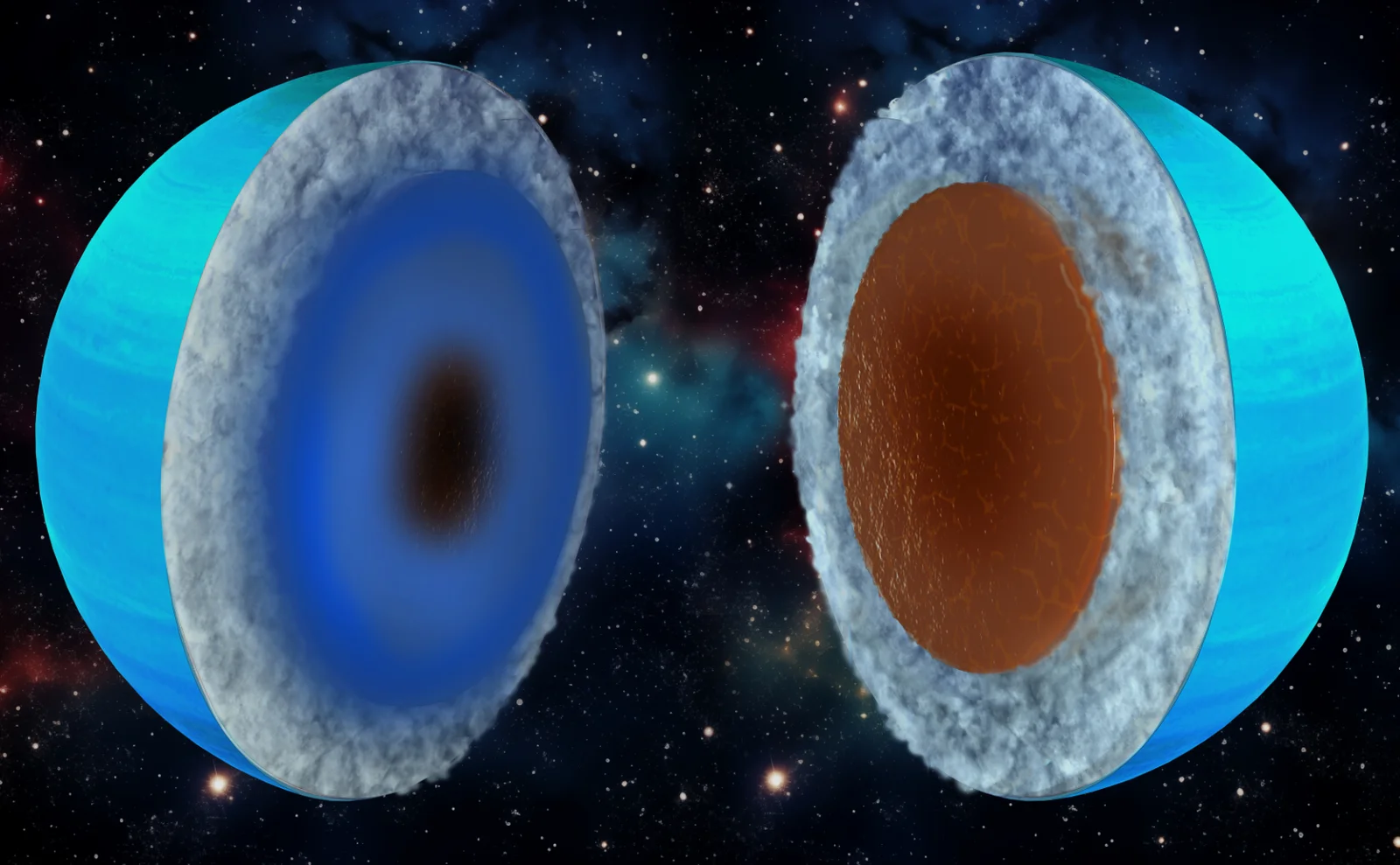
With their agnostic and fully physical model, the Zurich team discovered something striking. The inner composition of the so-called ice giants is not constrained to ice at all. In fact, both planets can be understood just as well if they are far more rocky. “It is something that we first suggested nearly 15 years ago, and now we have the numerical framework to demonstrate it,” says Ravit Helled, Professor at the University of Zurich and initiator of the project.
Instead of being locked into one definition, Uranus and Neptune appear capable of wearing multiple masks. Their interiors might be rich in water or rich in rock, depending on which of the physically consistent models is used. This flexibility reshapes decades of thinking and reveals just how much more we have yet to understand about these remote worlds.
The research even reframes the long-standing puzzle of their magnetic fields. Earth’s magnetic field has two poles, clean and well behaved. Uranus and Neptune do not follow that rule at all. Their fields twist and branch into more than two poles, defying simple explanations. The team’s findings suggest a reason for this complexity. “Our models have so-called ‘ionic water’ layers which generate magnetic dynamos in locations that explain the observed non-dipolar magnetic fields. We also found that Uranus’s magnetic field originates deeper than Neptune’s,” Helled explains.
The Mystery Grows Deeper and More Beautiful
Yet this new clarity also exposes fresh uncertainties. To model a planet’s interior, scientists must understand how materials behave under unimaginable pressures and temperatures. That is a frontier of physics still filled with unknowns. “One of the main issues is that physicists still barely understand how materials behave under the exotic conditions of pressure and temperature found at the heart of a planet. This could impact our results,” says Morf, who hopes to develop even more advanced models in the future.
Despite the unknowns, the work pushes the field forward. By showing that Uranus and Neptune could plausibly be either rock giants or ice giants, the study challenges old assumptions and opens pathways for new research into the behavior of materials under extreme conditions. It reframes the two planets as enigmas that cannot be decoded without far better clues.
Why the Next Journey Must Go Further
In the end, the researchers arrive at one unavoidable conclusion. The only way to truly understand Uranus and Neptune is to go back to them. Current data is simply not enough. “Both Uranus and Neptune could be rock giants or ice giants depending on the model assumptions. Current data are currently insufficient to distinguish the two, and we therefore need dedicated missions to Uranus and Neptune that can reveal their true nature,” Helled concludes.
Why This Research Matters
This new work does more than rewrite two planetary biographies. It rewrites how we think about categories themselves. It reminds us that the universe often refuses the neat labels we create. More importantly, it reveals that the outer planets of our solar system may hold secrets far more complex and compelling than anyone imagined. Understanding what lies inside Uranus and Neptune will reshape our picture of planetary formation, guide materials science into new frontiers, and help us understand worlds circling distant stars.
Above all, this research matters because it reignites one of science’s oldest forces. Curiosity. The two blue giants at the edge of our solar system still hold their mysteries close, but with each new model, each new insight, the veil grows thinner. And the story of our solar system becomes richer, stranger, and more beautiful than ever before.
More information: Luca Morf et al, Icy or rocky? Convective or stable? New interior models of Uranus and Neptune, Astronomy & Astrophysics (2025). DOI: 10.1051/0004-6361/202556911