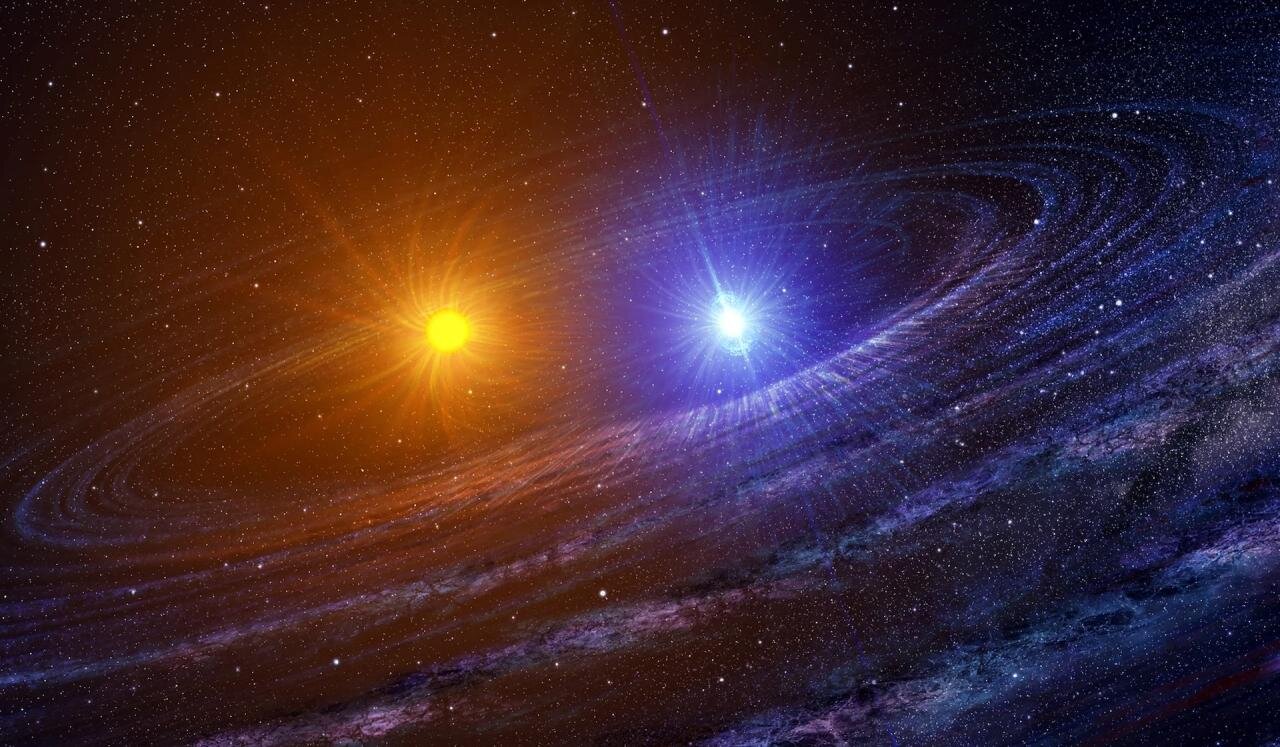
For years, KIC 5623923 was little more than a faint speck in the sky, one of thousands captured by NASA’s prolific Kepler space telescope. It gleamed at about 16.5 magnitude—far too dim for the naked eye and easy to overlook amid the cosmic crowd. Yet this unassuming point of light held a secret rhythm, a heartbeat of starquakes and eclipses that Chinese astronomers have now brought into focus. Their new analysis, published on November 24 on the arXiv pre-print server, reveals that this system is not only an eclipsing binary but also a pulsating one, alive with the rapid oscillations of a Delta Scuti star.
The Star System That Wouldn’t Sit Still
KIC 5623923 has intrigued astronomers ever since 2014, when it was first classified as a Delta Scuti star inside a contact binary system. That meant two stars orbit so close together that they share their outer atmospheres—an arrangement as dramatic as it sounds. The system also seemed to throb with a regular 50-minute pulsation, but only when one star wasn’t blocking the other. Because the pulsations faded during the system’s secondary eclipse, astronomers initially assumed the variability must be coming from the less dominant secondary star.
But that conclusion never fully satisfied scientists. Something about the timing, the pattern, and the subtle light variations hinted that more was happening beneath the surface.
A team led by Tao-Zhi Yang of Xi’an Jiaotong University decided it was time to look again—and more closely. “In this paper, we present a detailed analysis of the light variation of KIC 5623923 using high-precision time-series data from the Kepler mission,” the researchers wrote. With Kepler’s exquisite long-duration monitoring, the team could track the star system’s flickering in unparalleled detail, catching every tiny rise and dip in brightness.
Listening to the Pulses of a Binary Heart
Once the data were analyzed, the team extracted 41 significant frequencies—an auditory map of the system’s internal and orbital choreography. These included the orbital frequency itself and dozens of pulsational frequencies, most clustered between 20.0 and 35.0 cycles per day. Seven of these pulses stood out clearly as independent p-modes, the pressure-driven vibrations that define Delta Scuti stars.
Three groups of these frequencies formed elegant quintet-like structures, a sign of complex oscillations interacting with the star’s rotation. Yet the most dominant frequency refused to join any pattern, standing apart like a soloist whose voice rings louder than the chorus.
The researchers also measured the orbital period at 1.21 days—a swift, intimate dance consistent with a tidally synchronized system, where each star always shows the same face to its partner. The light curve’s distinctive shape reinforced this conclusion, revealing the telltale symmetry of stars locked in gravitational harmony.
A Tale of Two Stars
With Kepler’s precision, the astronomers could also refine key physical characteristics of both stars. The primary star burns hot at 8,348 K, radiating with a luminosity equivalent to 22.4 Suns. The secondary, cooler and more modest, glows at 4,753 K with a luminosity of just 2.29 Suns.
Together they form a faint eclipsing binary, but their inner lives are dramatically different. The primary star sits squarely inside the classical pulsating instability strip—the region on the Hertzsprung–Russell diagram where Delta Scuti stars naturally arise. This revelation flips the earlier assumption on its head: despite earlier hints that the weaker companion might be responsible for the pulsations, the new analysis shows the variability almost certainly originates from the primary star.
In other words, the bigger, brighter star is the one trembling with rapid-fire pulsations, not the underdog secondary.
Why This Quiet Binary Matters
KIC 5623923 may be faint, but its story echoes far beyond its pixel-sized footprint in Kepler’s catalog. Delta Scuti stars are invaluable cosmic laboratories. Their pulsations—those fast, regular thrum of radial and non-radial oscillations—allow astronomers to probe their inner structures in ways that would otherwise be impossible. Each frequency is a clue, a seismic whisper from deep within the star.
This system, with its eclipses, its tight gravitational embrace, and its rapid pulsations, offers a rare chance to study how close binary interactions shape stellar evolution and internal dynamics. Yet puzzles remain. As the researchers note, radial velocity measurements are still needed “to constrain the absolute parameters of the system, such as the masses and surface gravities of the two stars.” Without those measurements, the story of KIC 5623923 is compelling—but incomplete.
Even so, this new analysis transforms the system from a faint, easily overlooked object into a vibrant astrophysical puzzle. Its heartbeat is now heard more clearly, its pulses charted, its identity reframed. In studying it, astronomers take another step toward understanding the inner workings of stars—those brilliant engines whose rhythms, however faint, shape the universe around us.
More information: Tao-Zhi Yang et al, KIC 5623923: A Faint Eclipsing Binary Consisting of δ Scuti pulsations, arXiv (2025). DOI: 10.48550/arxiv.2511.19685