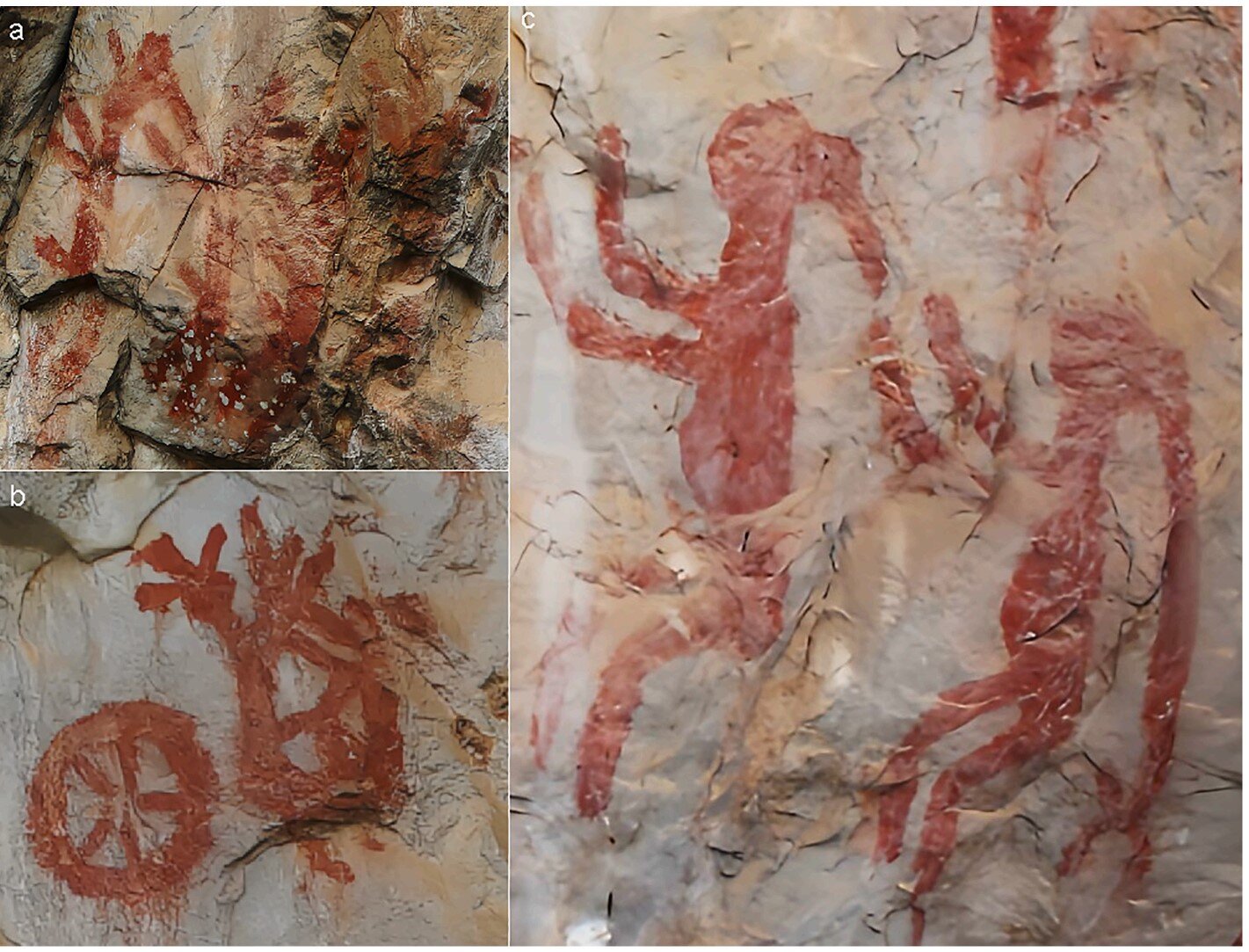
Ancient paintings covering towering river cliffs in southern China may owe some of their remarkable durability to an unusual ingredient: blood mixed with lime mortar. A new analysis of fallen fragments from the Huashan rock art landscape found human serum proteins in the paint, along with evidence that the blood and lime formed a hard mineral layer around the red pigment.
The Huashan rock art landscape lies in southern China near the border with Vietnam. It contains thousands of painted images spread across more than 80 locations along about 260 kilometers (162 miles) of river cliffs.
The paintings include people, boats, musical instruments, animals, weapons and other figures. They were created at least 2,000 years ago and have remained in surprisingly good condition despite the region’s harsh subtropical monsoon climate, which brings intense summer heat, heavy rain and frequent typhoons.
To investigate how the paintings were made and why their pigments have endured, researchers studied fallen pieces of rock from the base of three sites. This allowed them to examine the artwork without taking samples directly from the surviving paintings.
Using scanning electron microscopy, spectroscopy and tests for ancient organic binders, the team examined the structure and chemical makeup of the paint.
The red pigment appeared to have come from local red clay containing microscopic iron oxide particles known as nano-hematite. But the pigment was not simply sitting on the surface of the rock.
Instead, the particles were found encapsulated within the outer layer of a man-made mortar containing lime and blood.
How blood may have hardened the paint
The presence of blood raises both a practical and a symbolic possibility.
On the practical side, the researchers suggest that blood may have acted as a natural chemical hardener. When blood is mixed with lime, proteins in the blood can trigger a reaction that produces calcium carbonate around the pigment particles.
That process may have helped lock the pigment directly onto the cliff surface.
The researchers describe the resulting material as a stable organic-inorganic composite bonding system, pointing to the complex technology involved in making the paintings.
The evidence does not establish exactly why blood was added, however. The researchers speculate that it may have served both practical and symbolic purposes.
A possible connection to fertility
The artists who created the Huashan paintings belonged to the Luoyue people, described in the study as a matriarchal society.
Because the analysis detected human serum proteins, the researchers suggest that the blood could have come from females who had given birth. They propose that this may have carried a symbolic connection to life and renewal within the community’s worship of female fertility.
That interpretation remains a suggestion rather than a direct identification of whose blood was used or why it was included.
More than a matter of manpower
The scale of the Huashan paintings has long pointed to an enormous physical undertaking. Creating the artwork required people to work on high and dangerous cliffs while transporting large quantities of paint.
The new findings add another dimension to that effort.
Rather than viewing the creation of the rock art mainly as a labor-intensive project, the researchers argue that it was also technically intensive. Preparing a paint containing local red clay, lime and blood and producing a stable composite around the pigment required a level of technical processing that is not apparent from the finished images alone.
The study therefore presents the Huashan paintings not simply as large-scale works requiring many people, but as products of a complex process involving the deliberate preparation of their materials.
The study was published in the Journal of Archaeological Science.