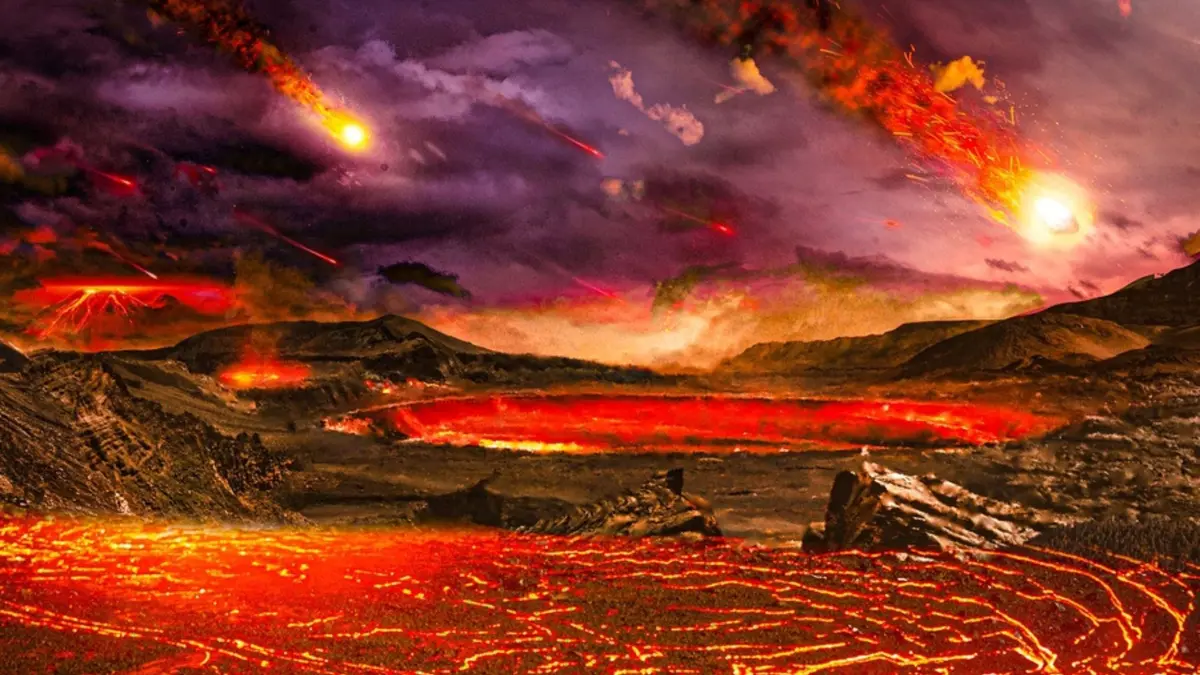
Long before the blue marble we call home existed, before oceans shimmered under sunlight or mountains rose toward the sky, there was proto-Earth—a molten, chaotic world taking shape from the dust and debris left behind by a newborn Sun. This primitive planet, formed roughly 4.5 billion years ago, was destined for greatness—and for destruction.
In a cataclysmic moment of cosmic violence, a Mars-sized body—known today as Theia—collided with proto-Earth, melting and reshaping its surface. From that colossal impact emerged not only the Earth as we know it, but also the Moon, our constant celestial companion. Scientists have long believed that this event wiped away any trace of the planet’s original composition. Proto-Earth, it seemed, was lost forever.
But new research from scientists at the Massachusetts Institute of Technology (MIT) and their collaborators across the globe suggests that fragments of that ancient world may still be hidden beneath our feet. These traces, preserved deep within the planet’s mantle, offer a direct window into Earth’s earliest history—an echo of the planet that came before.
The Discovery That Shakes the Foundations of Planetary Science
The study, published in Nature Geosciences, reveals that certain rocks from Greenland, Canada, and Hawaii contain subtle but striking chemical signatures—anomalies in potassium isotopes—that set them apart from nearly all other materials on Earth.
To the untrained eye, these rocks look unremarkable: dark, dense, ancient pieces of the planet’s crust and mantle. But to geochemists like MIT’s Nicole Nie, they are nothing short of extraordinary. “We see a piece of the very ancient Earth,” Nie explains. “Even before the giant impact. This is amazing because we would expect this early signature to be slowly erased through Earth’s evolution.”
What Nie and her team have uncovered might be the first direct evidence that pieces of proto-Earth—material older than the Moon itself—still exist today.
The Birth of Worlds
To understand the significance of this discovery, we must return to the dawn of the solar system. About 4.6 billion years ago, the Sun formed from a collapsing cloud of gas and dust. The leftover material flattened into a swirling disk, where countless grains of dust collided, clumped, and grew into rocks, and eventually, planets.
These early worlds—proto-planets—were built from whatever raw ingredients surrounded them. Some formed closer to the Sun, where metals and silicates dominated; others, farther out, where ice and gas prevailed. Proto-Earth was one of these rocky bodies, slowly growing through relentless bombardment.
For tens of millions of years, it endured a cosmic hailstorm of impacts. Then came Theia. The collision between Theia and proto-Earth was so violent that it melted the planet’s surface and mixed its internal layers like ingredients in a cauldron. Most scientists assumed this “giant impact” erased any record of what proto-Earth was originally made of.
But maybe, just maybe, not everything was lost.
The Hidden Signature of Potassium
At the heart of this revelation lies a tiny atomic fingerprint—potassium. This element, common in both rocks and living organisms, exists in three stable forms, or isotopes: potassium-39, potassium-40, and potassium-41. Each isotope has the same number of protons but a different number of neutrons, giving them slightly different masses.
Every planet and meteorite carries its own unique balance of these isotopes, shaped by its formation conditions. By studying the ratios of potassium isotopes in meteorites and Earth’s rocks, scientists can trace how materials in the early solar system came together.
In earlier work, Nie and her colleagues examined dozens of meteorites that had fallen to Earth, representing the chemical diversity of the early solar system. They found that each type of meteorite carried a distinct potassium isotopic “signature.” This discovery suggested that potassium could serve as a powerful tracer—a chemical memory of planetary origins.
When the researchers turned their attention to Earth’s oldest rocks, they found something unexpected: a small but measurable deficit in potassium-40. This isotope, though rare to begin with, was even scarcer in these particular rocks than in almost any others on the planet.
The difference was minute, almost imperceptible—like noticing one grain of sand missing from a beach. Yet in the world of isotope geochemistry, such subtleties can reveal entire planetary histories.
Remnants of a Lost World
Could these potassium-40–poor rocks be relics of proto-Earth itself? To test this idea, the team simulated what would happen to a planet’s chemical makeup after multiple high-energy impacts, including the giant collision that created the Moon.
Their models showed that any material originally deficient in potassium-40 would gradually gain more of it through mixing, melting, and bombardment. After billions of years, only a few untouched pockets might remain—buried deep within Earth’s mantle, preserved like fossils of the ancient world.
The chemical composition of the rocks from Canada, Greenland, and Hawaii matched this prediction perfectly. They appear to be untouched by the chaotic events that reshaped the planet, making them some of the oldest surviving pieces of proto-Earth ever found.
A Puzzle Older Than the Moon
What makes this discovery even more mysterious is that the potassium signature found in these rocks doesn’t match any known meteorites. Meteorites are often used as cosmic reference points—remnants of the same early materials that built the planets. If none of them resemble proto-Earth, it means that our planet’s building blocks may have come from a source not yet represented in our meteorite collections.
“Scientists have been trying to understand Earth’s original chemical composition by combining the compositions of different groups of meteorites,” Nie says. “But our study shows that the current meteorite inventory is not complete, and there is much more to learn about where our planet came from.”
This tantalizing clue suggests that some of the earliest materials in the solar system are still missing from our understanding. Somewhere—perhaps in distant asteroids or yet-unrecovered meteorites—lies the true chemical match to proto-Earth.
Deep Time and Deep Earth
To uncover these hidden signatures, Nie and her collaborators analyzed rocks from regions known for their ancient geological history. In Greenland and Canada, some crustal rocks date back nearly four billion years, offering rare glimpses into the planet’s infancy. Meanwhile, volcanic materials from Hawaii provide samples brought up from the deep mantle—Earth’s internal archive of its earliest chapters.
Extracting potassium from these rocks was no easy feat. The researchers carefully dissolved powdered samples in acid, then isolated the potassium atoms and measured their isotopic ratios using an extraordinarily sensitive mass spectrometer. The precision required for such measurements is almost unimaginable—detecting differences on the order of a few parts per million.
Yet from this painstaking work emerged one of the most profound discoveries in planetary science: that not all of proto-Earth was destroyed. Some pieces endured, silently waiting billions of years to tell their story.
What It Means for Science—and for Us
Finding traces of proto-Earth changes the way we understand our planet’s history. It reveals that the story of Earth is not one of total destruction and rebirth, but of resilience—of continuity through chaos.
These ancient remnants are like time capsules, carrying within them the original recipe from which our world was forged. By studying them, scientists can refine models of planetary formation, shedding light not only on how Earth came to be but also on how other rocky planets—Mars, Venus, and those beyond our solar system—might have formed.
On a deeper level, the discovery invites reflection on our place in the cosmos. The atoms in our bodies—the calcium in our bones, the potassium in our cells—once belonged to ancient worlds, to stars that lived and died before our Sun was even born. And now, buried deep within our planet, are whispers of the world that existed before Earth itself.
A Universe That Remembers
Science often advances in small steps, but occasionally it takes a leap that reshapes our understanding of everything. The discovery of proto-Earth remnants is one such leap. It tells us that even in the violent infancy of the solar system, nature preserved fragments of its past.
Perhaps that’s the most poetic truth of all: the universe never truly forgets. Just as fossils preserve the memory of extinct creatures, and starlight carries echoes of the distant past, the atoms beneath our feet remember the world that came before ours.
Nie and her team have given humanity a rare gift—a glimpse into deep time, into the very foundations of existence. Somewhere in the deep mantle, hidden in rocks untouched for eons, lies the last heartbeat of proto-Earth, still pulsing faintly through the planet we now call home.
More information: Da Wang et al, Potassium-40 isotopic evidence for an extant pre-giant-impact component of Earth’s mantle, Nature Geoscience (2025). DOI: 10.1038/s41561-025-01811-3