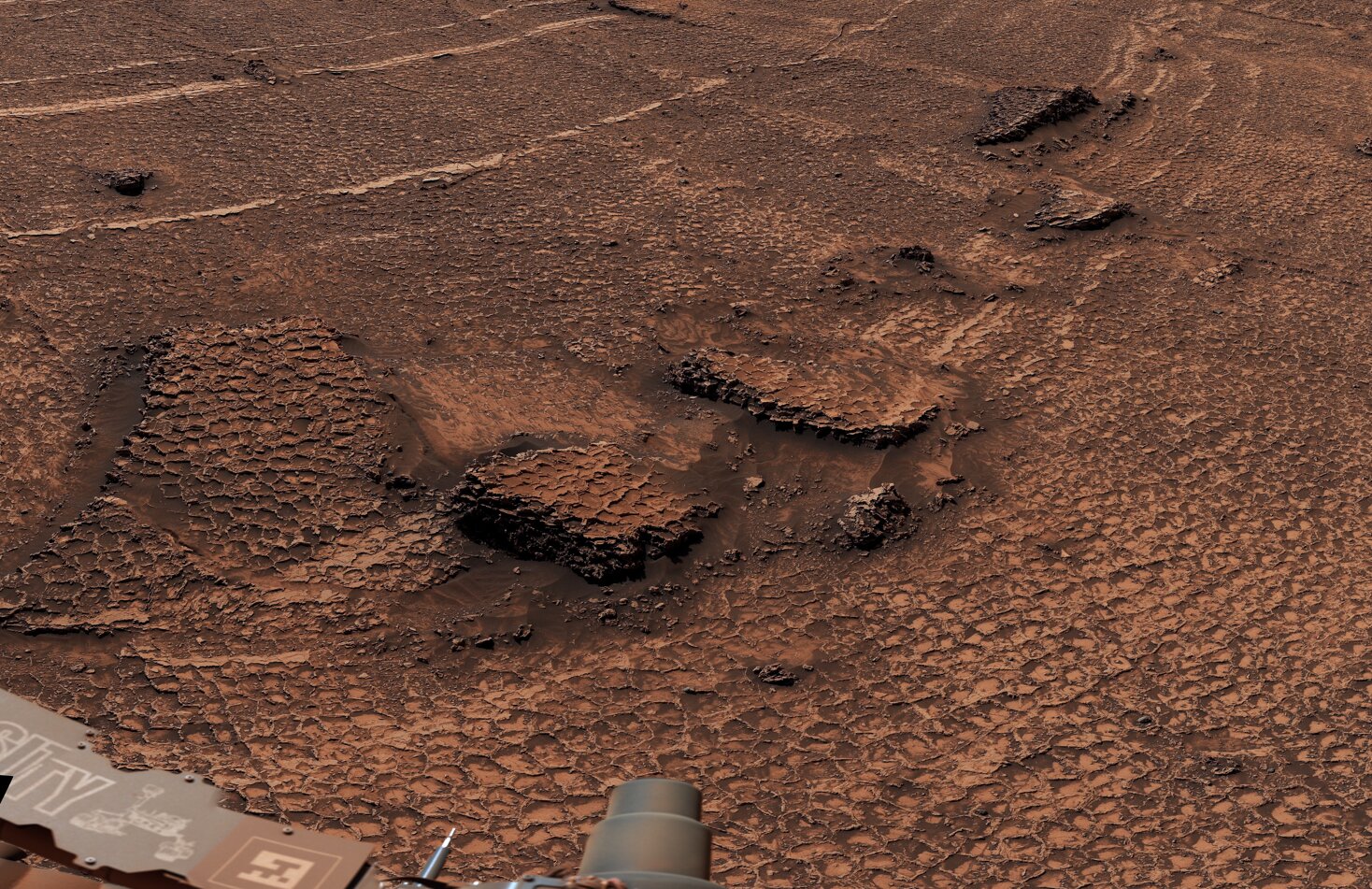
Curiosity has reached a part of Mars where geometric fractures stretch across the landscape farther than the rover can see, wrapping around a 20-foot-tall butte and creating the largest field of these polygonal shapes the mission has encountered. The rover is now using their shapes and chemistry to investigate how this unusual terrain formed.
For years, Curiosity has occasionally encountered small clusters of cracks on the Martian surface that resemble a giant honeycomb. But as the rover began climbing a valley nicknamed “Valle Grande,” the familiar pattern suddenly appeared on an entirely different scale.
Images taken on June 19 and 20 captured the scene during Curiosity’s 4,930th and 4,931st Martian days, or sols, on Mars. When combined into a 360-degree panorama, they showed polygonal fractures extending in every direction across the landscape, as far as Curiosity could see.
The geometric patterns were also visible around the sides of a nearby butte called “Miraflores.” The formation rises 20 feet (6 meters) above the surrounding terrain and carries a thick layer of sand across its top.
Each polygon measures roughly 1.5–3 inches (4–8 centimeters) across.
For the mission team, the sheer extent of the pattern made the discovery stand out from the smaller patches Curiosity had encountered before.
“We’ve seen a lot of fascinating landscapes through Curiosity’s eyes, but this sea of polygons took our breath away,” said Ashwin Vasavada, the mission’s project scientist at NASA’s Jet Propulsion Laboratory in Southern California.
The rover is examining the shapes and their chemistry in detail, looking for evidence that could help explain the process that produced them.
The cracks may have more than one possible origin
Polygonal fractures can form through different processes, so their appearance alone does not provide a simple answer.
Some of the polygonal patterns Curiosity has encountered previously clearly formed as mud cracks. As wet sediment dries, it can contract and break apart into interconnected shapes, producing the kind of geometric pattern visible in the rover’s images.
But mud cracking is not the only possibility.
Cycles of warming and cooling can also contribute to polygon-like textures. Another possibility involves sediment being buried and compressed, forcing water out and leaving behind fractures as the material changes.
That range of possible explanations makes the chemistry and detailed geometry of the Valle Grande polygons particularly important. Curiosity’s measurements may help determine which process—or processes—best explain this enormous field.
The mission team is therefore not treating the striking appearance as an answer in itself. Instead, the polygons provide a new geological puzzle for the rover to investigate as it continues upward.
Curiosity is exploring a landscape shaped by ancient water
The discovery comes in a region where the rover’s broader journey has already revealed evidence of a very different Mars from the cold, dry world seen today.
Curiosity landed on Mars on Aug. 5, 2012, and has been climbing Mount Sharp since 2014. The mountain rises about 3 miles (5 kilometers) high, and billions of years ago, lakes and streams occupied parts of its lower foothills.
As Curiosity has traveled through this ancient terrain, it has found chemical evidence left behind by Mars’ watery past.
The rover has also encountered sulfur crystals, shiny meteorites and other unusual geological features. Together with its investigation of the ancient environment, those discoveries have helped build a picture of a Mars that once possessed conditions potentially suitable for microbial life.
Among the most important findings are carbon-based molecules that scientists believe could be precursors to RNA and DNA, the nucleic acids that carry genetic information.
Their presence, however, does not establish that life produced them.
The source of the molecules remains uncertain because they could have been created through biological processes or through geological processes. Both possibilities remain open.
What their discovery does establish within the mission’s findings is that ancient Mars had the water, chemistry and nutrients needed to support microbial life.
Now, the vast polygon field in Valle Grande offers another opportunity to read the planet’s geological history from the surface itself.
The strange honeycomb landscape is not simply another striking view from Curiosity’s cameras. Its shape, distribution and chemistry may preserve clues about what happened to the Martian sediments long after the ancient lakes and streams disappeared.