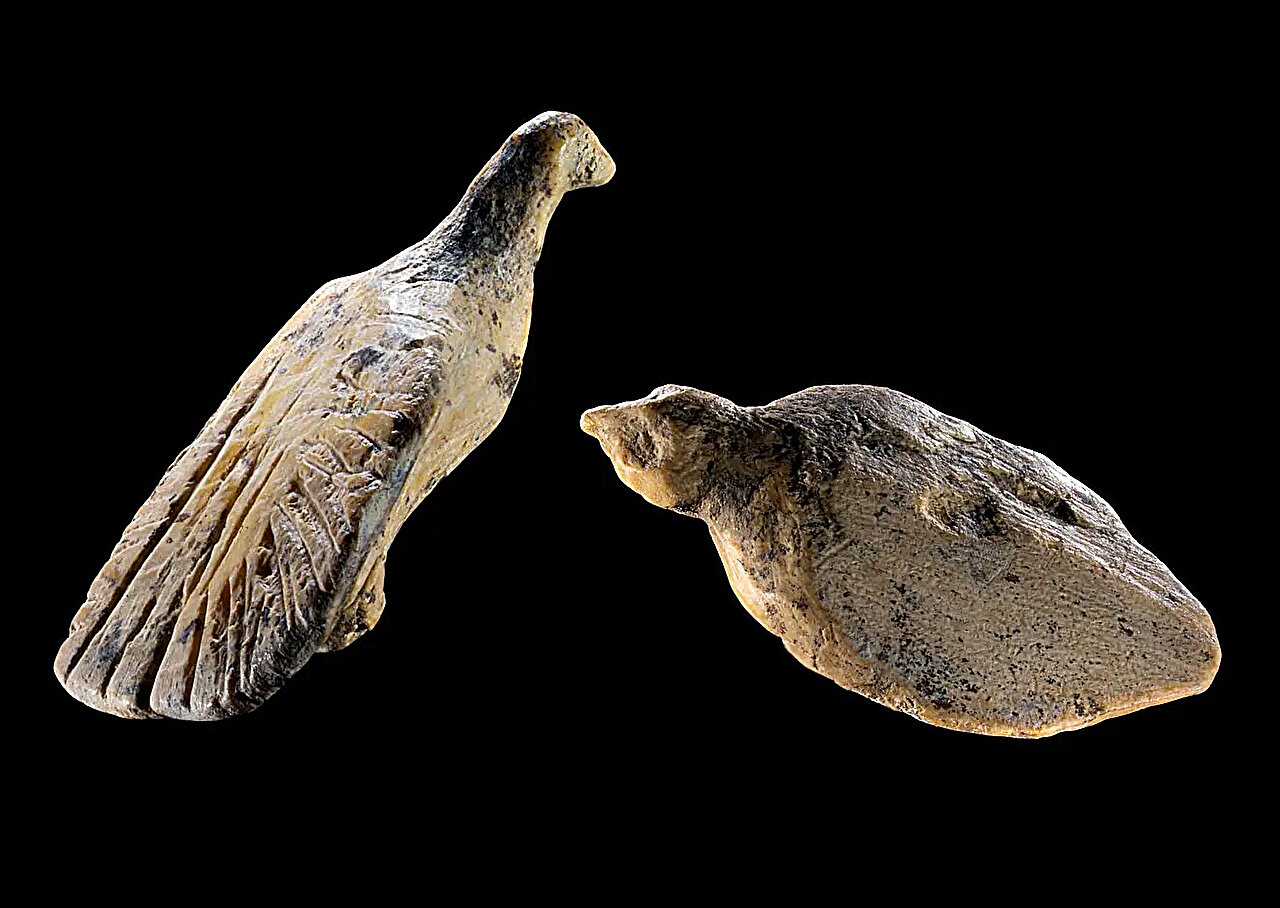
Two mammoth-ivory birds recovered from Hohle Fels Cave in southwestern Germany are the smallest figurative carvings yet found from the period, measuring only about 2 centimeters long but preserving remarkably detailed features. Their carefully chosen poses may offer a rare glimpse of how Ice Age artists observed birds and what these miniature objects may have meant to the people who made them.
Deep within the rich Aurignacian layers of Hohle Fels Cave, two remarkably small birds spent roughly 40,000 years hidden in the ground.
Archaeologists recovered both figurines in 2025, just about 1.5 meters (5 feet) apart. They are similar in age and may even have been carved by the same person.
The two sculptures are extraordinary not simply because they survived for so long, but because of how much an ancient artist managed to put into such a tiny space.
Each is only approximately 2 x 1 x 0.5 cm (0.8 x 0.4 x 0.2 inches). One is complete and appears to show a bird resting or lying on the ground. The other is incomplete, with its wings stretched outward in a pose that could represent flight, landing or possibly courtship.
Their present weights are just 1.3 and 0.7 grams (0.05 and 0.02 ounces).
That makes them the smallest and finest depictions known from this period.
Most other figurines from the same period are considerably larger, measuring roughly 3–9 cm (1–4 inches). Yet the tiny birds are not crude miniatures. Their surfaces preserve distinctive features that allow the figures to be considered as particular kinds of birds and, perhaps, particular moments in their behavior.
An artist working at the scale of a thumbnail
The complete bird has prominent eyes and appears to be resting on the ground. Its posture has led to the possibility that it represents a bird brooding over its eggs.
The second carving is more difficult to interpret because it is incomplete, but its outstretched wings and distinctive beak give it a very different appearance. Clear markings represent feathers, while the position of the wings suggests movement rather than simple stillness.
The carvings therefore leave room for several interpretations.
The resting bird appears to be a ptarmigan, a species represented in the faunal material recovered from Hohle Fels. The bird with spread wings could also be a ptarmigan, but it might instead represent another member of the grouse family or even a bird of prey.
That uncertainty is part of what makes the carvings interesting. The figures are detailed enough to preserve clues about what the artist was observing, while still leaving questions about exactly which species and behavior were intended.
“The carvings are not highly stylized but instead include many specific and unique features,” says Nicholas Conard. “Here the artist has recorded detailed observations that allow us to consider what kind of bird is represented and what the bird could be doing.”
The poses also distinguish the birds from much of the other early ivory art found in the caves of the Swabian Jura. Many of those animal figures depict creatures in static positions with considerable tension. These two birds, by contrast, seem to capture specific postures.
One appears to be settled on the ground. The other seems caught with its wings extended.
Whether either represents a precise behavior cannot be established from the carvings alone.
The tiny sculptures raise a much bigger question
The technical achievement becomes even more striking when their size is considered.
At less than a few centimeters across, the figurines required an artist to create recognizable anatomical and surface details on a scale little larger than a thumbnail.
“The figurines demonstrate that the earliest artists were skilled ivory carvers who could depict delicate motifs in miniature form,” Conard says.
The discoveries also raise questions that the carvings themselves cannot answer.
Why make a bird this small?
What did the figure mean to the person who carved it, or to someone who carried it?
The source leaves several possibilities open. The birds could have served as personal talismans or as symbols connected with the identity of the person who carved or carried them.
Their purpose remains unknown.
What is clearer is that birds occupied a distinctive place in the artistic record of Hohle Fels.
Hohle Fels has become a special place for bird imagery
The two new figurines bring the total number of carefully made bird carvings from Hohle Fels to three.
That concentration is striking because no other site in the region has produced even a single bird figurine.
Birds are not the only animals represented at Hohle Fels. Other Ice Age carvings include mammoths and lions, which are the most frequently depicted animals, along with smaller numbers of bears, horses, fish and bison.
The pattern has led Conard to emphasize the individuality of the sites that preserve this early figurative art.
“Each of the four World Heritage sites that have yielded figurative art is unique and documents a link between the site and its specific geographic and social context,” he says.
The two miniature birds therefore add more than another pair of animals to the archaeological record. They strengthen the distinctive artistic identity already associated with Hohle Fels.
The cave lies within the UNESCO World Heritage area of the Swabian Jura, where Aurignacian layers preserve some of the oldest known figurative art associated with the initial arrival of modern humans in the Upper Danube region.
A landscape filled with birds
The connection between the birds and their surroundings also remains part of the story.
Stefanie Kölbl, managing director of the Museum of Prehistory and Ice Age Art in Blaubeuren, points to the continuing abundance of birds in the surrounding landscape. Nearby Lake Schmiechen is now a bird sanctuary, while birds were also present in the region 40,000 years ago.
Their presence would have been experienced not only visually.
Bird calls could signal warnings, while seasonal migrations brought some species into the region at particular times of the year. The people living there also used hollow bird bones and mammoth ivory to make flutes.
That means birds were part of a landscape that could be seen, heard and interacted with in different ways.
But whether the two tiny ivory carvings were intended to represent a particular species, behavior, identity or something else entirely remains unresolved.
The birds can now be seen again
The newly recovered figurines are being displayed at the Museum of Prehistory and Ice Age Art in Blaubeuren (urmu) in a special exhibition titled “Feather light, research heavy: Discover the miniature birds in Ice Age Art.” The exhibition runs until April 4, 2027.
The museum is located among the caves of the Swabian Jura that were inscribed as UNESCO World Heritage Sites in 2017 under the title “Caves and Ice Age Art of the Swabian Jura.”
For more than 60 years, the research museum of the University of Tübingen has housed Paleolithic discoveries from southwestern Germany, including figurative art and musical instruments dating back 40,000 years.
Among its collections is the Venus of Hohle Fels.
Now, alongside those celebrated Ice Age objects, two nearly weightless birds provide an unusually intimate view of the skill and attention of an artist working on a miniature scale.
Their size may be tiny, but the questions they leave behind are not.