Long before written history, humans shared their world with a creature so striking that it demanded to be remembered in art. On cave walls and carved into bone, antler, ivory, and wood, the image appears again and again: the woolly rhino, scientifically known as Coelodonta antiquitatis. To the people who lived alongside it, this animal was not an abstract idea. It was a living presence on the open lands of Europe and Asia, a towering figure moving across the cold grasslands.
The woolly rhino lived on the steppes and tundra for thousands of years, enduring ice, wind, and scarcity while humans slowly spread across the same landscapes. Today it is gone, often spoken of as a tragic casualty of climate change and human pressure. For a long time, scientists believed they understood how its final chapter unfolded. But a fragment of tissue, hidden for millennia inside the stomach of a wolf, has begun to tell a different story.
Built for a Frozen World
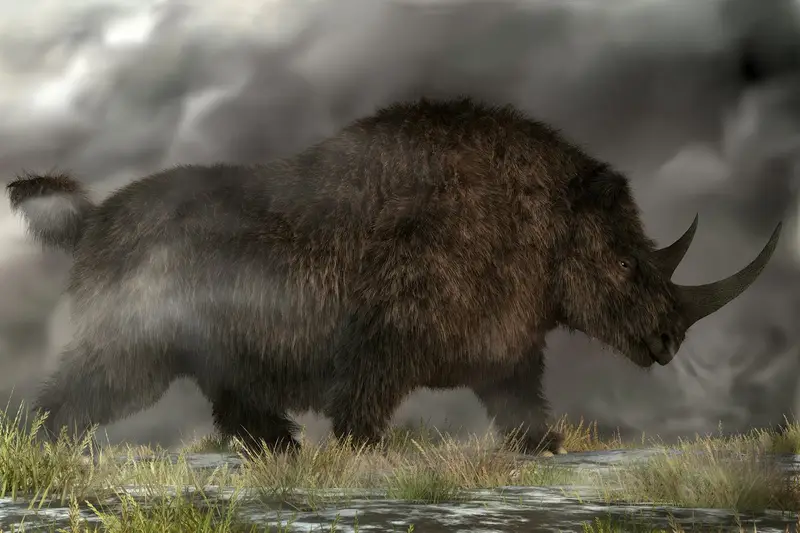
The woolly rhino was not just large. It was immense. Evolving in the middle of the Pleistocene era around half a million years ago, it could weigh up to three tonnes, rivaling the largest rhino species alive today, including the white rhino of Africa and the one-horned rhino of India.
Every part of its body spoke of survival in an unforgiving climate. Beneath its skin lay a thick layer of fat, insulation against relentless cold. Over that grew a dense, warm fleece, while its ears and tail remained small, carefully shaped by evolution to reduce heat loss. A prominent shoulder hump stored fat, allowing the animal to endure times when food was scarce.
Then there were the horns. Like most rhino species, the woolly rhino had two. In rare cases, the front horn could reach an astonishing 1.6 metres in length. Scratches and abrasions on fossilized horns have led biologists to believe these animals used that front horn to sweep aside snow, exposing the grasses and shrubs beneath. This was not a creature barely clinging to life. It was a master of its environment.
A Vast Kingdom of Cold and Grass
At its peak, the woolly rhino occupied an enormous range. From the Iberian Peninsula in the west to northeastern Siberia in the east, it thrived wherever cold conditions and grasslands overlapped. As long as the climate stayed frigid and open habitats remained, the species seemed secure.
But the world did not stay the same. As temperatures rose, the mammoth steppes that supported the woolly rhino began to disappear. Grasslands gave way to shrubs, and shrubs eventually yielded to forests. Suitable habitat shrank year by year. Humans, meanwhile, occasionally hunted the animals, adding pressure to populations already under stress.
By around 14,000 years ago, the woolly rhino was gone. The prevailing view was that its extinction had been slow and painful, a long decline marked by dwindling numbers and genetic weakness. That assumption seemed reasonable. In many species, extended population decline leaves clear traces in DNA.
What Extinction Usually Looks Like in Genes
When populations shrink over long periods, genetic diversity tends to erode. With fewer individuals breeding, closely related animals are more likely to mate. Over generations, inbreeding increases, and the genetic signals of that process accumulate in the genome.
Because the woolly rhino was thought to have declined gradually, scientists expected that individuals living close to the end, perhaps 15,000 years ago, would show unmistakable signs of inbreeding. These animals, it was assumed, would be the genetic shadows of their former species, born into small, isolated populations with little diversity left.
That expectation framed decades of thinking about the woolly rhino’s demise. Then came the wolf.
A Wolf Pup’s Last Meal
In the frozen ground near the village of Tumat in northeastern Siberia, researchers discovered the remains of an ice age wolf, preserved by permafrost. When scientists examined the body, they found something remarkable. Inside the wolf’s stomach lay a small fragment of preserved tissue.
That fragment turned out to belong to a woolly rhino.
The wolf was a pup, and both predator and prey died roughly 14,400 years ago, just a few centuries before the woolly rhino vanished completely. A healthy adult rhino would have been far too large for wolves to kill, suggesting the meal was either scavenged or came from a baby. Whatever the circumstances, the tissue provided an extraordinary opportunity.
Led by Solveig Guðjónsdóttir, the research team carefully extracted and sequenced DNA from this unlikely source. It was a technical challenge, but the reward was a genome from a woolly rhino living near the very end of the species’ existence.
A Genome That Refused to Tell a Sad Story
When the researchers analyzed the rhino’s DNA, they expected to see the familiar warning signs of extinction. Instead, they found something surprising. The animal was not inbred.
Its genome showed a level of genetic diversity inconsistent with the idea of a tiny, failing population. To understand what this meant, the team turned to a statistical approach known as Pairwise Sequentially Markovian Coalescent modelling, or PSMC.
This method compares the two strands of DNA each individual carries, one inherited from each parent. By examining how different these strands are, scientists can estimate how closely related the parents were and, by extension, how large the breeding population might have been. Greater differences suggest parents from a larger, more diverse population.
The wolf-stomach rhino genome was compared with two older woolly rhino genomes that had already been published. Together, they painted a consistent picture. While woolly rhino populations had declined from their peak, they were still large enough to maintain genetic diversity far later than scientists had expected.
Rethinking the Final Days of the Woolly Rhino
These findings challenge a deeply held assumption about how the woolly rhino disappeared. Yes, its range contracted as the climate warmed. Yes, its numbers fell. But genetically, it may not have become the impoverished relic scientists imagined.
The extinction may have been driven more by rapid environmental change and habitat loss than by a slow collapse into inbreeding. The woolly rhino, it seems, held onto its genomic diversity until very near the end.
This does not mean the species was safe. Losing habitat and facing human hunters would still have been devastating. But it does mean that genetic weakness may not have played the role once assigned to it.
Why This Research Matters
This study matters for two powerful reasons. First, it shows how DNA recovered from the most unexpected places, even the stomach contents of a long-dead predator, can illuminate events that unfolded thousands of years ago. The past is not silent. Sometimes it just hides its evidence in uncomfortable places.
Second, it urges scientists to rethink how they interpret genetic data from extinct species. If a large animal like the woolly rhino could maintain genetic diversity despite declining numbers and shrinking range, then the models used to infer population collapse may need refinement. Long-extinct species might not always follow the genetic rules we expect.
The woolly rhino’s story now feels more complex and more human. It was not necessarily a doomed shadow limping toward extinction, but a resilient giant holding on longer than anyone realized. Understanding that resilience deepens our grasp of extinction itself, reminding us that the end of a species is not always written plainly in its genes.