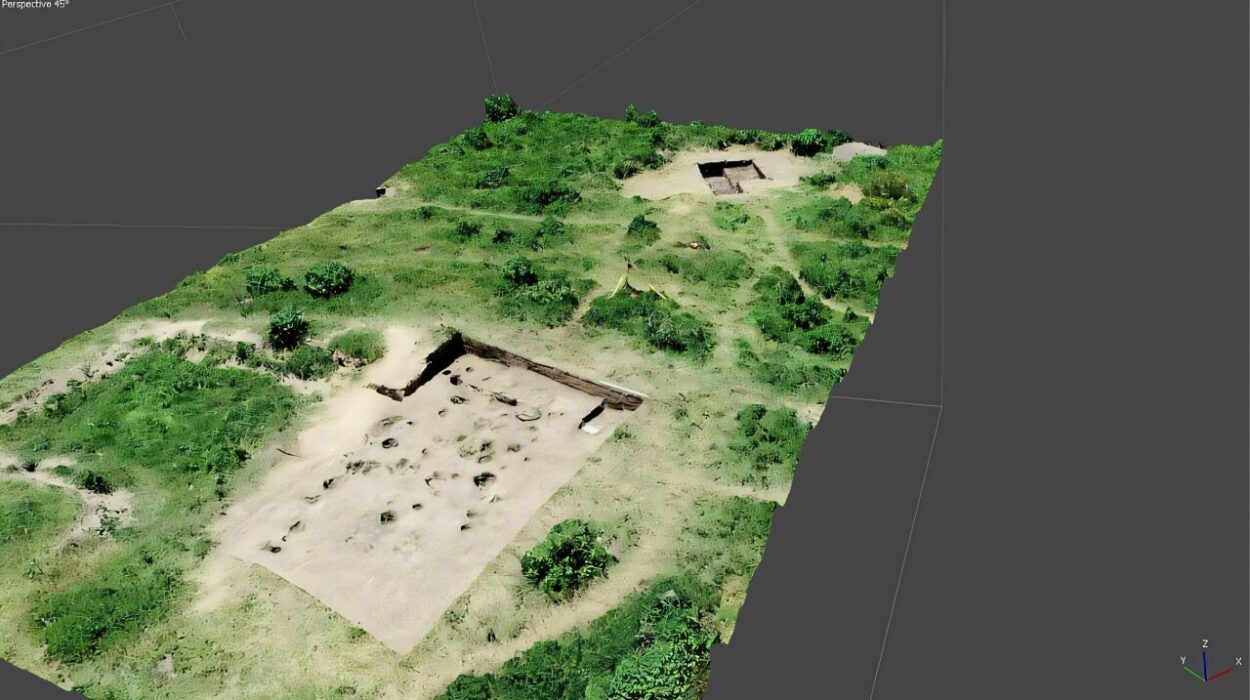
Long before written history shaped memory, a vast stone monument rose from the landscape of what is now Antequera, Spain. Known as the Menga dolmen, it was built in the fourth millennium BCE, a time when communities expressed their deepest beliefs through stone, earth, and ritual. For thousands of years, people returned to this place. They buried their dead here. They marked moments of transition here. And even as religions, rulers, and cultures changed, the monument remained, quietly absorbing layer after layer of human meaning.
Today, the Menga dolmen stands as part of a UNESCO World Heritage site, but its greatest value may lie not in its preservation, but in its persistence. A new study published in the Journal of Archaeological Science: Reports looks deep into that persistence, using DNA evidence, radiocarbon dating, and archaeological context to trace how this ancient structure continued to matter to people living thousands of years after it was built.
When the Past Keeps Calling People Back
The Menga dolmen was originally constructed as a collective burial site for a Neolithic community. Its long chamber and access corridor, covered by an earthen mound, were designed for ritual and remembrance. But it did not remain sealed in time.
Previous research had already shown that the dolmen was reused repeatedly. Pottery, human remains, and faunal evidence point to intense funerary activity between the 2nd and 4th centuries AD, followed by a settlement phase between the 5th and 7th centuries AD. Each era left its own quiet imprint, turning the monument into a layered archive of belief.
The new study focuses on two much later moments, separated by centuries but united by place. These are two medieval burials, dated by radiocarbon analysis to around the 8th century AD and the 11th century AD. By this time, the dolmen was already ancient beyond imagination. Yet someone chose it again as a place for the dead.
Two Burials, Centuries Apart, One Shared Silence
The skeletal remains from these medieval burials were poorly preserved, a reminder of how fragile biological traces can be across time. The researchers found no genetic relationship between the two individuals, which is not surprising given the roughly two-hundred-year gap between their deaths.
What is striking, however, is not who these individuals were to each other, but how they were placed. Both bodies were positioned in a remarkably similar way. Each had their head resting on the right side, pointing toward the southwest, aligned with the axis of symmetry of the Menga dolmen itself. Their faces were turned toward the southeast.
These similarities suggest deliberate choices. Someone took care to align these burials with the monument, respecting its structure and orientation. Even after millennia, the dolmen still guided human action.
Faith at a Crossroads of Stone
During the medieval period when these burials occurred, the region was under Islamic rule. At the same time, Christian, Jewish, and possibly pagan communities were also living in the area. It was a multicultural and multi-faith society, and burial practices could reflect that complexity.
The researchers note that the position and orientation of the bodies, together with the radiocarbon dates, could suggest Islamic burials. Yet the interpretation is not straightforward. The symbolic alignment of the bodies with the dolmen’s axis contrasts with what is known from Islamic necropolises in the region. This tension makes the burials difficult to classify.
As the authors explain, “The position and orientation of the remains, together with the radiocarbon dates, could be indicative of Islamic burials. However, the apparent symbolic alignment of the inhumations with the axis of symmetry of the Menga megalithic monument contrasts with Islamic necropolises in the area, and complicates interpretation of these burials, especially in such a multicultural and multi-faith society such as medieval Iberia.”
In other words, these burials resist easy labels. They sit at the intersection of faith, tradition, and place.
A Single Genome Speaks Across the Mediterranean
DNA analysis offered another way to listen to the past. The researchers attempted genetic testing on both individuals, but usable data could only be obtained from one, referred to as Menga1.
The genetic results tell a story of movement and connection. Menga1 was identified as a male with a European Y-chromosome lineage. His mitochondrial DNA lineage is shared with some modern North African populations. When the researchers examined his autosomal DNA, a more complex picture emerged.
The analysis revealed a mix of ancestries: approximately 44% Iberian, 18% North African, and 37% Levantine. This genetic blend reflects a history of interaction rather than isolation.
The study authors explain that North African-related ancestry, along with some Levantine-related ancestry, had been present across southern Iberia since at least the third or fourth century CE. This pattern likely reflects regular movement of people across the Mediterranean, enabled by long-standing trade networks and later political structures. With the beginning of the Islamic period in 711 CE, contacts with North Africa probably became even more frequent, shaped by shared governance and cultural practices.
The genome of Menga1 becomes, in this context, a quiet witness to centuries of human interconnectedness.
The Dolmen as a Living Symbol
What makes these findings especially powerful is not just what they reveal about ancestry or ritual, but what they reveal about memory. The Menga dolmen was not simply reused because it was there. It was chosen.
As the study authors write, “Whoever these two individuals were—and regardless of what faith they practiced—the fact that they were both given inhumations aligned with the axis of a megalithic monument, in a site of remarkable prominence in the landscape of Antequera, approximately two centuries apart, highlights the continuity of Menga as a symbolic location for over 5000 years—and possibly even longer—well beyond the Neolithic period.”
This continuity suggests that the monument carried meaning that transcended specific religions or cultural systems. It remained a place where the living connected with the dead, where orientation and alignment still mattered, where ancient stone continued to shape human decisions.
Why This Research Matters
This study matters because it reminds us that history is not a sequence of clean breaks. Cultures do not simply replace one another, and beliefs do not vanish overnight. Instead, people inherit landscapes filled with meaning and reinterpret them in new ways.
By combining DNA analysis with archaeological context, the research reveals medieval Spain as a deeply interconnected world, shaped by movement, diversity, and shared spaces. At the same time, it shows how a Neolithic monument could remain spiritually relevant across vastly different eras.
The Menga dolmen stands as evidence that places can carry memory longer than any written record. Stones do not speak, but when science listens carefully, they tell stories of continuity, diversity, and humanity’s enduring desire to belong to something older and larger than itself.
Study Details
Marina Silva et al, Genetic and historical perspectives on the early medieval inhumations from the Menga dolmen, Antequera (Spain), Journal of Archaeological Science: Reports (2026). DOI: 10.1016/j.jasrep.2025.105559