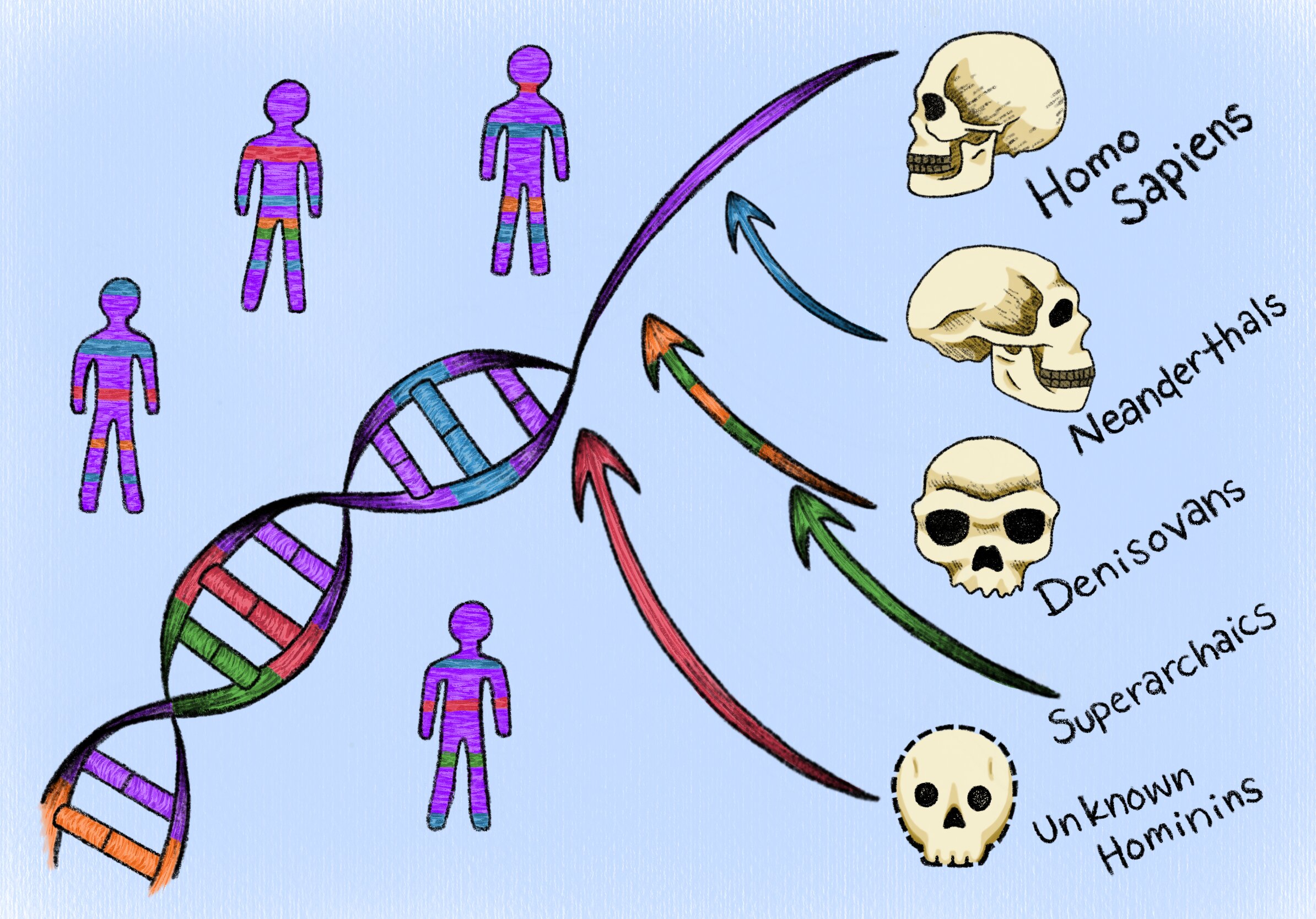
Hidden deep within the genomes of people living today, fragments of DNA have quietly preserved the memory of ancient encounters that no fossil genome has ever captured. By reconstructing enormous evolutionary family trees directly from modern human genomes, scientists have uncovered evidence that an unidentified archaic human population contributed genetic material to the ancestors of all living people before humans spread out of Africa, while also finding new clues that an even older lineage may have reached us indirectly through Denisovans.
For more than a decade, the sequencing of Neanderthal and Denisovan genomes has transformed scientists’ understanding of human evolution. Those discoveries showed that ancient human groups did not simply replace one another as populations expanded across continents. Instead, they met, interbred, and left lasting genetic legacies that remain visible in people today.
Yet those remarkable discoveries came with an unavoidable limitation. Scientists can only compare modern DNA with ancient genomes that have actually been recovered, and only a handful of high-quality archaic human genomes exist. Most come from Eurasia, while ancient DNA from much older populations—especially in Africa—is extraordinarily difficult, and often impossible, to recover.
That has left an obvious question hanging over the field: what if other ancient human populations exchanged genes with our ancestors but disappeared without leaving behind any recoverable DNA?
The new study tackles that problem from an entirely different direction.
Looking for ancient ancestors without needing their DNA
Rather than searching for matches to known Neanderthal or Denisovan genomes, the researchers developed a computational approach called TRACE, short for TRacking Archaic Contributions via ARG Estimation.
Instead of relying on ancient reference genomes, TRACE reconstructs what are known as ancestral recombination graphs. These are extraordinarily detailed evolutionary family trees that describe how pieces of DNA from many people have been inherited, split apart through recombination, and rejoined across countless generations.
Every stretch of DNA has its own genealogical history. If an ancient population mixed with the ancestors of modern humans after remaining separated for hundreds of thousands of years, that event should leave distinctive patterns inside those family trees.
The researchers focused on two signals.
The first involves unusually deep branches. DNA inherited from a long-isolated population remains genetically distinct for a very long time before eventually merging with other human lineages in the reconstructed genealogy.
The second involves unusually long inherited segments. Because interbreeding happened much more recently than the original evolutionary split between populations, those inherited DNA fragments have not yet been completely broken apart by recombination.
By combining these characteristics within a statistical framework, TRACE classifies regions of the genome as either ordinary modern human ancestry or probable archaic ancestry—all without requiring DNA from the extinct population itself.
Extensive testing showed the method could reliably detect ancient introgression
Before applying TRACE to real genomes, the researchers tested it using large numbers of simulated human populations whose evolutionary histories were already known.
These simulations recreated events such as the Out-of-Africa bottleneck and approximately 2% Neanderthal ancestry entering non-African populations.
When supplied with the true ancestral genealogies from the simulations, TRACE identified archaic DNA with roughly 92% accuracy and 71% recall, while producing an extremely low false discovery rate below 0.25% after filtering longer ancestry segments.
The researchers also compared TRACE with existing approaches.
Many current methods require either an ancient reference genome or a population assumed to contain no archaic ancestry. TRACE avoids both requirements. In simulations where even small amounts of archaic ancestry entered the supposed reference population, some existing reference-free methods became biased, whereas TRACE maintained high sensitivity and specificity.
The team also evaluated TRACE using ancestral recombination graphs reconstructed by current computational methods rather than perfect simulated genealogies. Although detection became less sensitive under these more realistic conditions, precision remained high, giving the researchers confidence to analyze real human genomes.
Modern human genomes contained more than just Neanderthal and Denisovan ancestry
The researchers next analyzed 503 phased whole-genome sequences from the 1000 Genomes Project.
Using only modern human genomes to reconstruct ancestral relationships, TRACE successfully recovered the well-established signatures of archaic ancestry.
Individuals from Europe, East Asia, and South Asia carried approximately 0.8% to 1% Neanderthal ancestry on average. Denisovan ancestry appeared at very low levels in Europeans, around 0.03%, and somewhat higher in East and South Asians, approximately 0.10% each.
Those findings closely matched results from established methods, despite TRACE recovering fewer total archaic segments because of the limitations of currently inferred genealogical trees.
But those expected results were only part of the story.
Across every population examined, TRACE consistently detected additional segments that did not closely resemble either Neanderthal or Denisovan DNA.
Instead, these segments appeared to come from an unknown archaic lineage.
The mysterious DNA appears in both Africans and non-Africans
Perhaps the most striking observation was how widespread these unidentified segments proved to be.
Across populations, individuals carried roughly 0.5% to 1.1% ghost ancestry.
Most of the ghost ancestry found outside Africa was shared with sub-Saharan African populations, while African populations possessed greater diversity of unique ghost segments. That pattern fits expectations from the dramatic loss of genetic diversity that occurred when a relatively small group of humans expanded out of Africa.
The reconstructed genealogies also showed that these mysterious DNA fragments were almost equally related to both Neanderthals and Denisovans rather than matching either group closely.
Using the inferred genealogical trees, the researchers estimated that these ghost lineages coalesced with modern human ancestors approximately 0.83 million years ago, with a 95% confidence interval of 0.83 to 0.84 million years.
Several additional observations strengthened the interpretation.
Ghost ancestry occurred in genomic regions with elevated genetic diversity, similar to known Neanderthal and Denisovan segments. The ghost fragments were generally shorter than Neanderthal and Denisovan fragments, consistent with an older episode of interbreeding. Simulations that omitted ghost introgression produced almost no such signals, whereas simulations including an unknown archaic lineage closely matched the patterns observed in real human genomes.
Taken together, the researchers conclude that the evidence is most consistent with at least one episode of introgression from an unidentified archaic human population into the ancestors of all modern humans before the Out-of-Africa migration.
The unknown ancestry is scattered across much of the human genome
After identifying ghost ancestry, the researchers examined where those ancient DNA fragments occur across the genome.
Collectively, ghost ancestry covered approximately 1,548.75 million base pairs, representing about 71.5% of the accessible human genome when all identified segments across populations were combined.
Its distribution was far from random.
Ghost ancestry became less common near functional genomic regions and in areas with low recombination rates, patterns similar to those previously observed for Neanderthal and Denisovan ancestry. According to the authors, these trends are consistent with natural selection gradually removing some introgressed DNA over evolutionary time.
The team identified 1,932 genomic regions where ghost ancestry appeared at unusually high frequency, substantially more than the comparable peaks identified for Neanderthal or Denisovan ancestry.
Several genes overlapped these regions, and functional enrichment analyses highlighted genes involved in immune function and metabolic complexes, including components of the major histocompatibility complex and lipoprotein complex.
Ancient DNA also appeared where scientists once thought archaic ancestry was absent
Some regions of the human genome have long been described as Neanderthal and Denisovan ancestry deserts because they contain very little DNA inherited from those groups.
These deserts have often been interpreted as regions where natural selection favored uniquely modern human genetic variants or removed archaic DNA because it was harmful.
TRACE complicated that picture.
Although the researchers confirmed very low Neanderthal and Denisovan ancestry in several previously described deserts, they found substantial ghost ancestry within all five regions they examined.
One notable example lies on chromosome 7, where the well-known FOXP2 region contains a ghost ancestry peak reaching 13.3% frequency. Another region on chromosome 3 contains a ghost ancestry peak approaching 20% frequency overlapping CSNK2A2IP.
These findings suggest that the absence of Neanderthal and Denisovan ancestry does not necessarily mean those genomic regions were universally resistant to archaic introgression. Instead, the researchers propose that selection may have acted differently against different archaic lineages.
Oceanians preserved clues to an even older human lineage
The study also explored an even deeper chapter of human history.
Previous work had suggested that Denisovans themselves may have inherited DNA from a much older population sometimes called super-archaic humans.
To investigate this possibility, the researchers analyzed 92 high-coverage genomes from Oceanian populations, including individuals from Papua New Guinea, Vanuatu, and the Santa Cruz Islands.
Within these genomes, TRACE detected approximately 0.73% Neanderthal ancestry, 0.66% Denisovan ancestry, and 0.33% ghost ancestry.
The researchers then searched specifically for exceptionally ancient genealogical branches embedded within Denisovan-derived DNA.
Those extremely deep lineages appeared significantly more often inside Denisovan ancestry than inside Neanderthal ancestry, matching predictions from simulations that included super-archaic introgression into Denisovans.
Using several genetic characteristics—including unusually deep coalescence times, long genomic segments, and weak similarity to both Neanderthal and Denisovan reference genomes—the researchers identified probable super-archaic fragments.
These fragments typically measured 20 to 83 kilobases, averaging 37.6 kilobases, and represented about 0.3% of the Denisovan ancestry detected in Oceanian genomes. The authors emphasize that this is a conservative lower estimate because their analysis excluded several categories of potentially undetectable super-archaic DNA.
From the reconstructed genealogies, they estimated that this super-archaic lineage diverged from modern human ancestors roughly 1.77 million years ago, with a 95% confidence interval of 1.69 to 1.83 million years.
Several genomic regions carrying these fragments overlap genes such as RNF39, PPP1R11, POLR1H, and CYP24A1, while enrichment analyses highlighted pathways involving the major histocompatibility complex and the activity-related cytoskeleton.
The work opens new windows into human evolutionary history
The researchers emphasize that TRACE depends heavily on the quality of reconstructed ancestral recombination graphs. Current genealogy reconstruction methods still miss some true archaic segments, reducing sensitivity even though detected segments remain highly reliable.
Important questions also remain unanswered.
The study supports at least one ghost introgression event before the Out-of-Africa expansion, but the exact number, timing, and locations of such events are still uncertain. The identity of the mysterious ghost population also remains unknown. Based on estimated divergence times, the authors suggest that Middle Pleistocene Homo groups or African Homo heidelbergensis populations are plausible candidates, while Homo erectus is discussed as one possible source for the inferred super-archaic ancestry, although the study does not establish either identification.
Future discoveries—including additional ancient genomes and continued improvements in reconstructing ancestral genealogies—may help resolve those uncertainties.
For now, the study paints a more intricate picture of human evolution than previously recognized. Rather than preserving memories of only Neanderthals and Denisovans, modern human genomes appear to contain genetic echoes from multiple extinct lineages, including populations whose DNA has never been directly recovered. By learning to read the branching history written into living genomes themselves, researchers have uncovered evidence that some of humanity’s oldest evolutionary encounters may still be hidden in plain sight.
Publication details
Yulin Zhang et al, Recovering signatures of archaic hominin introgression using ancestral recombination graphs, Science (2026). DOI: 10.1126/science.aef8874. www.science.org/doi/10.1126/science.aef8874