For years, Tabby’s star has seemed to dim without warning, plunging by as much as 20 percent in strange, irregular episodes that resisted every simple explanation. Then, hidden among observations from NASA’s Transiting Exoplanet Survey Satellite, a single smooth, nearly symmetrical eclipse appeared—lasting almost an entire day. That unexpected event has now become the centerpiece of a new investigation arguing that the famously mysterious star may host a massive companion capable of sending dusty bodies hurtling toward the star, while still leaving many of the system’s biggest mysteries unresolved.
Tabby’s star, formally known as KIC 8462852, has fascinated astronomers ever since NASA’s Kepler mission recorded a series of extraordinary drops in its brightness between 2009 and 2013. Some dimming events reached roughly 15 to 22 percent, varied widely in duration and depth, and showed no obvious repeating pattern.
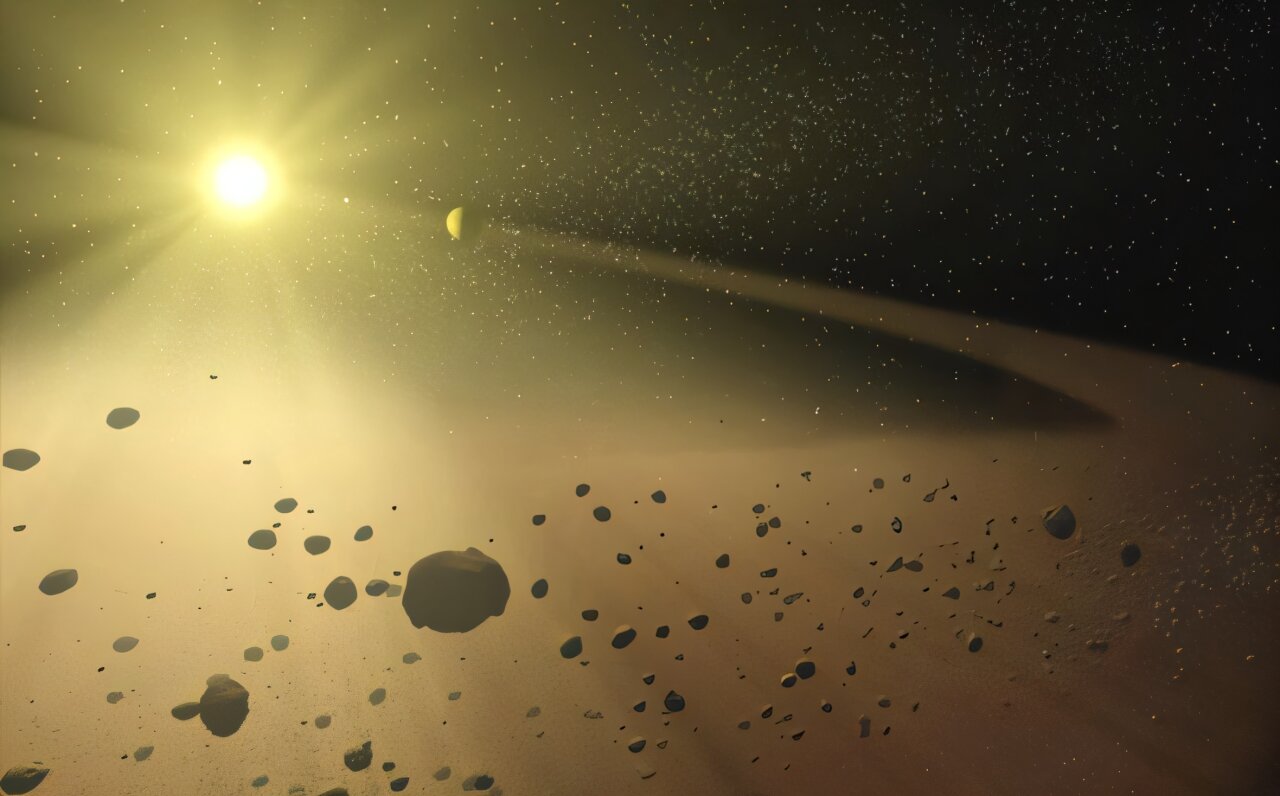
Follow-up observations over the past decade gradually narrowed the range of possible explanations. Measurements at multiple wavelengths indicated that the irregular dips are most consistent with clouds of dust passing in front of the star. At the same time, the absence of a detectable mid-infrared excess argued against explanations involving a large protoplanetary disk, an accretion disk, or collisions within an asteroid belt. The leading idea became that families of exocomets or fragments of larger bodies were repeatedly breaking apart close to the star, producing dusty clouds that crossed Earth’s line of sight.
That explanation, however, leaves an important question unanswered: what keeps sending those bodies toward the star?
The newly analyzed TESS observations introduced a possible clue.
Across roughly 160 days of TESS observations spanning seven observing sectors, the researchers found one previously unreported transit that looked unlike the chaotic events seen by Kepler. The event occurred on September 3, 2019, during TESS Sector 15.
Instead of an irregular, asymmetric dip, this one lasted about 21 hours, blocked approximately 1.1 percent of the star’s light, and traced out a rounded, remarkably symmetric profile.
The team ruled out an asteroid crossing the telescope’s field of view by examining the spacecraft’s background measurements and finding no evidence that the signal resulted from contamination.
Its shape immediately distinguished it from the strange dimming episodes that made Tabby’s star famous.
Turning one transit into an orbital puzzle
Finding only a single transit creates an immediate challenge.
Normally, astronomers determine an orbit by watching repeated transits. Here, only one event was available.
The researchers first modeled the transit itself to estimate what kinds of orbits could produce an eclipse with the observed duration, accounting for the known properties of the star. That initial analysis favored an orbital period of about 1,103 days, although with substantial uncertainty.
The investigation then became considerably more ambitious.
The team combined the TESS transit with years of radial velocity observations—measurements that detect the tiny motion of a star as an unseen companion tugs on it gravitationally.
Most of the archival measurements had relatively large uncertainties because Tabby’s star rotates rapidly, broadening its spectral lines and making precise velocity measurements difficult.
To improve matters, the researchers reanalyzed observations from the SOPHIE spectrograph, applying a different technique better suited to such a rapidly rotating star. That reduced the average uncertainty from roughly 730 meters per second to about 130 meters per second.
They also obtained 20 additional SOPHIE observations between July 2024 and February 2025, ultimately producing a final radial velocity dataset containing 29 daily measurements after quality filtering and binning.
Combining those velocity measurements with the TESS transit produced an estimated orbital period of about 1,211 days. But that value alone was not enough.
Kepler dramatically narrowed the possibilities
Kepler’s nearly continuous monitoring became an unexpected advantage.
If the newly observed TESS transit belonged to a regularly orbiting object, earlier transits should also have occurred during the Kepler mission—unless they happened during data gaps or coincided with the deep, irregular dimming episodes that already obscured portions of the light curve.
Using that reasoning, the researchers eliminated nearly every possible orbit.
Only five narrow orbital windows remained compatible with both the TESS event and the historical Kepler observations, corresponding to periods near 1,030, 1,035, 1,302, 1,345, and 1,368 days.
The most probable solution centered near 1,302 days.
The team also searched observations from several additional photometric surveys—including ZTF, SuperWASP, Las Cumbres Observatory, TiMo, AAVSO, and the Hereford Arizona Observatory—but none contained another transit matching the TESS event.
New observations ruled out part of the puzzle—but not all of it
Rather than waiting years for another possible transit, the researchers targeted the earliest two orbital windows with dedicated observations from Las Cumbres Observatory.
Using multiple 0.4-meter telescopes distributed across Tenerife, Texas, and Hawaii, they monitored Tabby’s star for approximately 25 hours during the first window and nearly 21 hours during the second.
Weather interruptions and unavoidable gaps prevented continuous coverage.
As a result, the observations could eliminate some possible orbital periods but not all of them. In some cases, an entire transit could still have occurred during one of the observational gaps.
The follow-up therefore reduced the number of viable orbital solutions without identifying a unique orbit.
Could the transit still have been caused by exocomets?
Because exocomets remain the leading explanation for Tabby’s famous irregular diming events, the researchers tested whether multiple comet transits could collectively mimic the smooth TESS eclipse.
They approached the question using two independent exocomet transit models.
One model was fitted using anywhere from one to twenty exocomets. Statistically, the best fit involved three exocomets. However, achieving that fit required physically unrealistic parameter values. The only model with physically realistic parameters—a single exocomet—failed to reproduce the observed transit shape, particularly during egress, and could not account for the observed depth.
The second model again found the best statistical fit using three exocomets, but likewise failed to produce a physically convincing explanation.
Interestingly, the same modeling approach successfully reproduced one of the more symmetric dips in the original Kepler data using six exocomets.
That contrast strengthened the authors’ interpretation that the TESS transit likely differs in origin from the irregular Kepler dimming events.
The shape of the eclipse became another important clue
The team also examined the transit’s symmetry directly.
Using Gaussian process regression, they constructed a bisector through the transit profile—a technique that reveals whether the eclipse is symmetric or skewed.
The TESS event produced an almost perfectly vertical bisector, deviating only slightly in a way the researchers attributed to observational noise.
By comparison, one of Kepler’s more symmetric dips still displayed substantially greater asymmetry.
That result further weakened explanations involving irregular dust clouds or multiple asymmetric bodies crossing the star at nearly the same time.
According to the paper, the observed transit shape more closely resembles the passage of a rounded object.
A tentative planetary signal emerges
After combining the TESS photometry, radial velocity measurements, and new Las Cumbres observations, the researchers derived physical properties for the proposed companion.
The object would have a radius of 1.7 ± 0.1 Jupiter radii.
Its estimated mass is 9.4 Jupiter masses, with uncertainties of +4.9 and −4.1 Jupiter masses. The authors emphasize that this represents only a 2.3-sigma detection, with a 3-sigma upper limit below 28 Jupiter masses, meaning the radial velocity evidence remains tentative and cannot yet confirm that the observed signal truly belongs to the proposed companion.
If real, the companion would orbit approximately 2.35 astronomical units from Tabby’s star with a slightly eccentric orbit of 0.09 ± 0.05 and an equilibrium temperature of about 268 ± 13 kelvin.
Its estimated density of 2.2 grams per cubic centimeter falls within the range occupied by giant planets.
The mass, however, places it close to the debated boundary separating giant planets from brown dwarfs.
The authors therefore conclude that the object would occupy the transition region between those categories. They also note that, under the International Astronomical Union working definition based on mass ratio, the object would qualify as an exoplanet.
One companion could explain much more than a single transit
The possible importance of the companion extends well beyond its own existence.
For years, one of the strongest explanations for Tabby’s irregular dimming has involved families of exocomets or fragmented bodies repeatedly passing close to the star.
Previous studies had already proposed that a massive companion might gravitationally perturb those bodies, sending them onto highly elongated orbits where they fragment and generate the dusty clouds responsible for the famous dips.
The new transit provides a candidate object capable of playing exactly that role.
At the same time, the paper carefully avoids claiming that the mystery has been solved.
The companion itself has not yet been confirmed.
The orbital period remains uncertain within several narrow windows.
The radial velocity detection remains below the level normally regarded as definitive.
And while the TESS transit appears difficult to explain using chains of exocomets, the authors do not conclude that the companion directly caused the Kepler dimming events. Instead, they argue that its gravitational influence could provide the mechanism that sends dusty bodies inward.
Other explanations remain possible but appear less consistent with the observations
The researchers also examined several alternative scenarios.
An eclipsing binary involving the nearby M dwarf companion could potentially account for some observations, but the transit’s U-shaped profile, the absence of a corresponding secondary eclipse, Gaia astrometric measurements, and other characteristics all argue against that explanation.
A dust cloud or debris field by itself also appears unlikely because the transit is highly symmetric and the preferred radial velocity model contains a non-zero signal that a freely drifting dust cloud would not produce.
The team also noticed a gradual brightening centered on the transit that does not appear in other TESS sectors. If that brightening is astrophysical rather than instrumental, they suggest it could arise from forward scattering by dust surrounding the companion itself. Future observations would be needed to test that possibility.
The next transit may decide the case
For now, the proposed companion remains a compelling but unconfirmed explanation for one of astronomy’s most enduring stellar puzzles.
Future observations during the remaining predicted transit windows could determine the object’s true orbital period, while additional radial velocity measurements could strengthen—or eliminate—the tentative mass detection.
The authors also point to the forthcoming Gaia Data Release 4 as an opportunity to detect the companion astrometrically and clarify whether the object is ultimately a giant planet or a brown dwarf.
If those future observations confirm the candidate, Tabby’s star would gain something it has never had before: a known transiting companion whose gravitational influence could help explain why one of the sky’s most enigmatic stars behaves so strangely.
Publication details
Cristina Madurga-Favieres et al, Evidence for a giant companion orbiting Tabby’s star, Monthly Notices of the Royal Astronomical Society (2026). DOI: 10.1093/mnras/stag1273