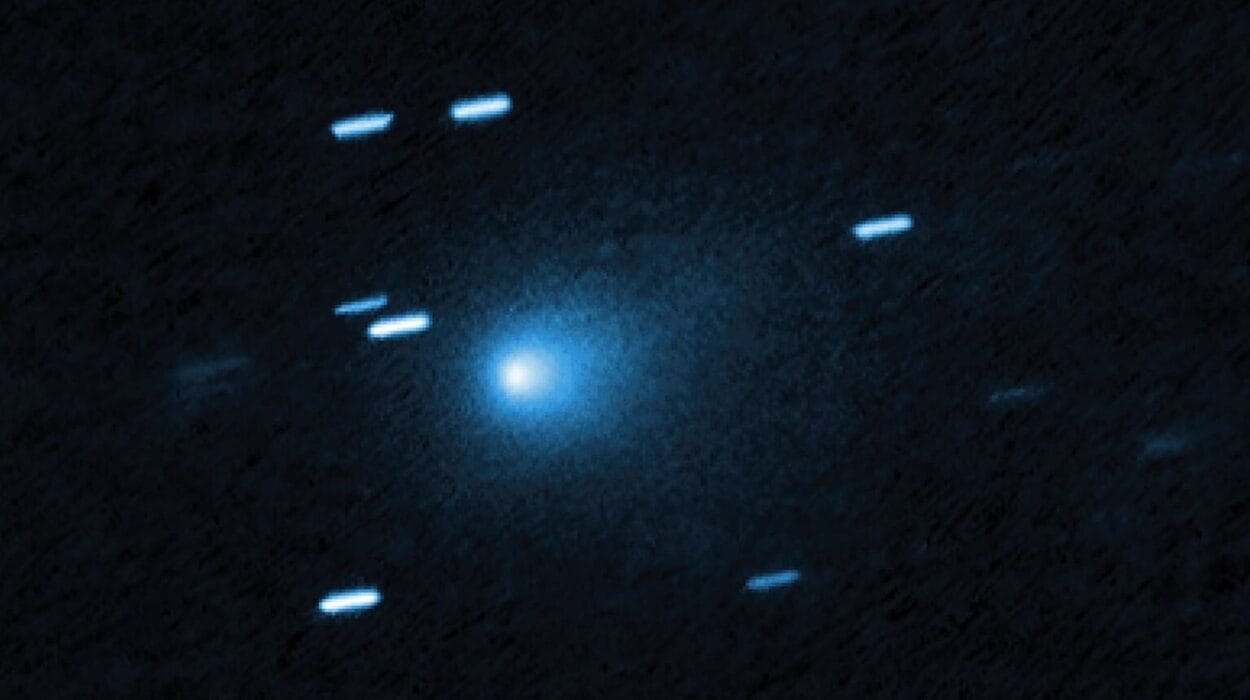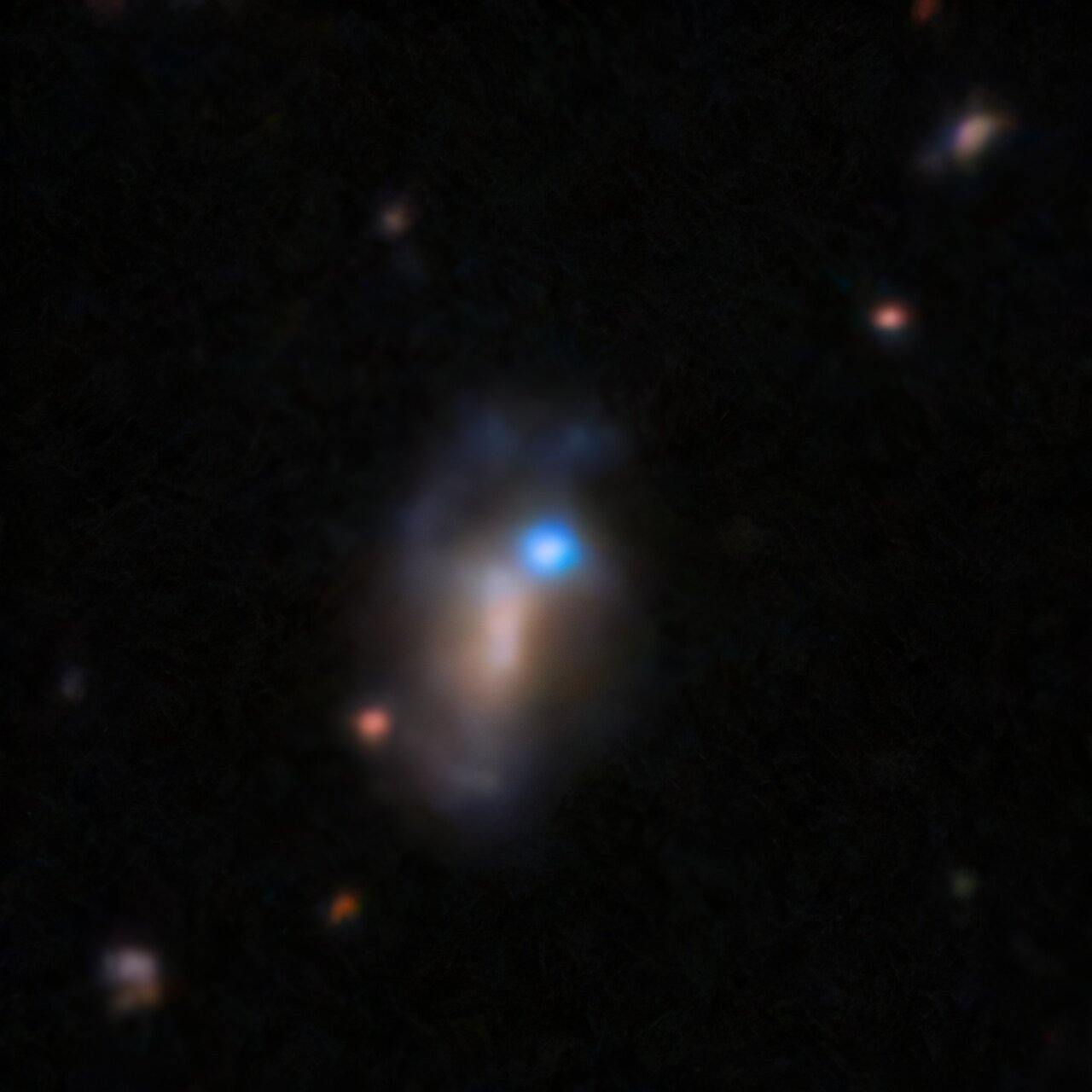
For just a few minutes, a nearby star announced its death with an unusually soft burst of X-rays before fading from view. Days later, the same location began glowing again—not with another high-energy explosion, but with a rapidly brightening supernova whose speed and power closely resembled the stellar blasts normally linked to gamma-ray bursts. The missing gamma rays turned what first looked like a familiar explosion into a far more intriguing cosmic puzzle.
When the Einstein Probe space telescope detected the fast X-ray transient EP260321a on March 21, 2026, astronomers immediately recognized that it was unusually close by cosmic standards. At a redshift of 0.0344—about 158 million parsecs away according to the cosmology adopted in the study—it became the nearest fast X-ray transient yet detected by the mission.
Its first signal was remarkably brief but revealing. The X-ray emission peaked at about 1.0 × 1045 erg per second, and its spectrum was unusually soft, matching thermal emission with a temperature near 130 electron volts. Those properties pointed toward one of astronomy’s rarest directly observed events: shock breakout, the instant when the shock wave from an exploding star reaches the stellar surface and releases a burst of high-energy radiation before the expanding debris becomes visible.
Shock breakout has long been expected to accompany supernova explosions, but it is notoriously difficult to catch because the flash lasts only a short time and radiates mainly in ultraviolet and soft X-rays rather than visible light.
That initial flash was only the beginning.
A supernova emerged from the fading X-ray glow
Within hours, astronomers began observing the source across optical, near-infrared, radio, and X-ray wavelengths. Less than ten hours after the Einstein Probe detection, imaging had already begun, followed by months of observations using multiple ground- and space-based observatories.
As the days passed, a supernova steadily emerged.
The object, designated SN 2026gzf, evolved into a broad-lined Type Ic supernova, a class known for stripped stars whose outer hydrogen and helium layers have already been lost before exploding. These supernovae are distinguished by exceptionally broad spectral features produced by material expanding at enormous speeds.
The research team presents twelve optical spectra collected over the first 55 days after discovery. Those spectra showed the broad absorption features expected from this class of supernova and confirmed that SN 2026gzf belonged among these energetic stellar explosions.
Yet something stood out immediately.
Its overall behavior—including how quickly it brightened, how its light faded afterward, and how rapidly its ejecta expanded—looked strikingly similar to broad-lined Type Ic supernovae that accompany gamma-ray bursts, even though no gamma-ray burst had been detected.
That contrast became the central mystery explored throughout the study, which was published in The Astrophysical Journal Letters.
The explosion behaved like one associated with gamma-ray bursts
The researchers reconstructed the supernova’s light curve using observations in ultraviolet, optical, and near-infrared filters collected over roughly two months.
The supernova reached peak brightness in different filters at different times, with the r-band peaking about 15 days after the Einstein Probe trigger. Its decline after maximum light closely matched other energetic broad-lined Type Ic supernovae.
When the team compared SN 2026gzf with previously studied explosions—including gamma-ray burst supernovae and several recently discovered Einstein Probe events—they found its overall light-curve shape fit comfortably within this energetic family.
Using a semi-analytic model of the bolometric light curve, the researchers estimated that the explosion synthesized approximately 0.45 solar masses of radioactive nickel-56, ejected roughly 2 solar masses of material, and released a kinetic energy of about 9.9 × 1051 ergs.
According to the authors, these values agree well with the average properties previously inferred for gamma-ray-burst-associated broad-lined Type Ic supernovae.
The debris raced outward at extraordinary speeds
The spectra also revealed just how violently the star exploded.
Early observations indicated iron absorption corresponding to expansion velocities of roughly 35,000 kilometers per second only a few days after the explosion. By about eleven days, those velocities had decreased to around 20,000 kilometers per second, remaining relatively steady afterward.
Silicon absorption features likewise showed extremely high initial speeds, declining from approximately 29,000 kilometers per second to around 10,000 kilometers per second over the following month.
Later observations identified calcium moving at about 20,000 kilometers per second as well.
When compared with previously observed broad-lined Type Ic supernovae, these velocities closely matched those seen in gamma-ray-burst-associated explosions. The authors note that the especially high early velocities resemble gamma-ray-burst supernovae more closely than broad-lined supernovae discovered without high-energy counterparts.
Then came an unexpected silence
If SN 2026gzf truly resembled the explosions normally associated with gamma-ray bursts, astronomers expected another signal to appear after the initial X-ray flash.
It never did.
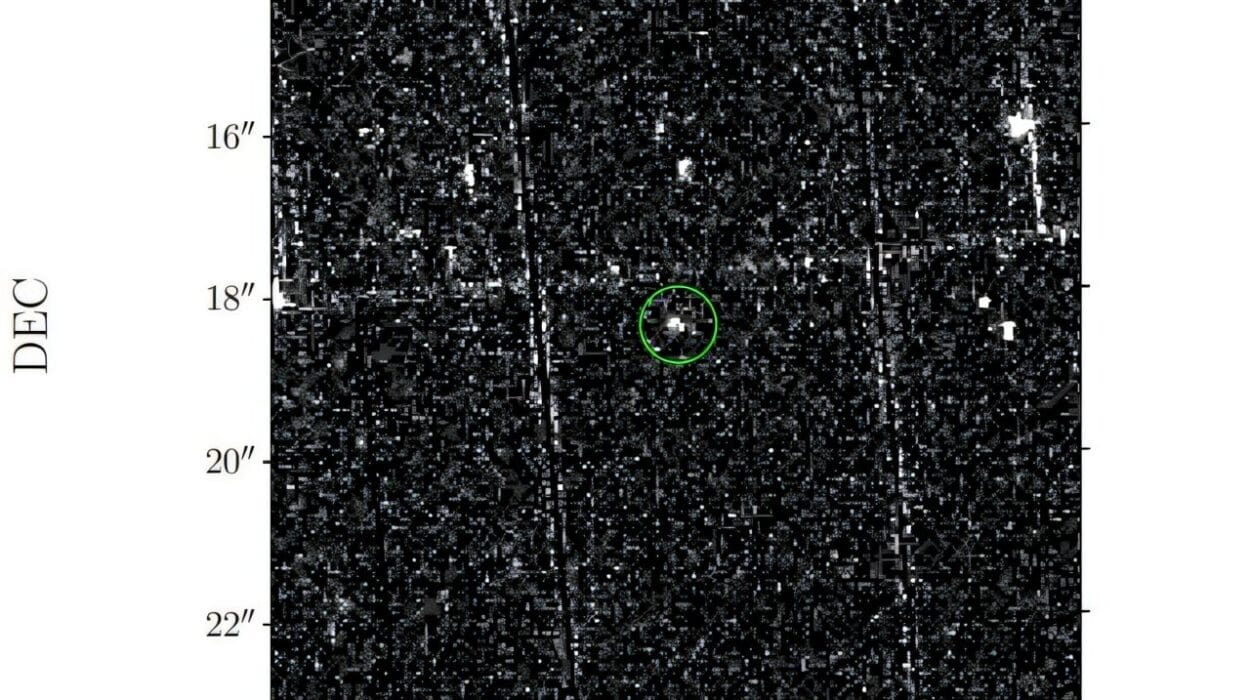
Deep observations with NASA’s Chandra X-ray Observatory were carried out approximately 15 days and 39 days after the explosion.
No X-ray source was detected.
Likewise, radio observations made nearly 60 days after the explosion using the Very Large Array also detected nothing.
Those nondetections became some of the study’s strongest pieces of evidence.
The team modeled thousands of possible afterglow scenarios involving relativistic jets propagating through the surrounding stellar wind. Most combinations of jet energy, density, magnetic field strength, and viewing geometry proved incompatible with the observations.
If a successful relativistic jet had been launched, the researchers conclude it would have needed both a relatively low Lorentz factor below about 30 and a kinetic energy below roughly 1049 ergs for sufficiently dense stellar winds.
Those constraints exclude afterglows similar to those observed from known gamma-ray bursts and previously detected fast X-ray transients.
A weak outflow may have died inside the star
Instead of a successful gamma-ray-burst jet, the authors favor a different interpretation.
They propose that EP260321a originated from a mildly relativistic, weak outflow that became choked inside the progenitor star before fully escaping.
In this scenario, the outflow still generates the observed soft thermal X-ray flash through shock breakout but never develops into the powerful relativistic jet responsible for classical gamma-ray bursts.
According to the researchers, such a model naturally explains several otherwise puzzling observations simultaneously: the relatively low X-ray luminosity, the thermal X-ray spectrum, the absence of prompt gamma-ray emission, and the lack of detectable X-ray or radio afterglow.
The authors emphasize that this remains their proposed interpretation rather than a directly demonstrated fact.
The environment where the star died adds another clue
The team also examined the supernova’s host galaxy in detail.
The explosion occurred about 2.5 kiloparsecs from the galaxy’s center in a region where emission-line measurements indicate that star formation dominates the local environment.
Using multiple metallicity diagnostics, the researchers found the explosion site to be extremely metal-poor, with an oxygen abundance corresponding to roughly 15% to 20% of the Sun’s metallicity. Even the galaxy’s center remained substantially below solar metallicity at about 30% of the Sun’s metallicity.
The study also identified evidence for a metallicity gradient across the host galaxy, with the explosion occurring in the lower-metallicity outer region.
Bridging two kinds of stellar explosions
The authors argue that EP260321a occupies an unusual position between previously known classes of stellar explosions.
Its thermal X-ray flash resembles the famous shock-breakout event associated with SN 2008D, while the supernova itself closely resembles the energetic broad-lined Type Ic supernovae commonly linked to gamma-ray bursts.
Yet unlike those gamma-ray-burst systems, this event lacks detectable gamma rays and shows no evidence for the powerful afterglow expected from a successful relativistic jet.
Taken together, the observations lead the researchers to propose that EP260321a helps fill the observational gap between ordinary stripped-envelope supernovae, low-luminosity gamma-ray bursts, and jet-driven stellar explosions.
Rather than fitting neatly into one established category, the event may represent another point along a broader continuum of ways that massive stripped stars end their lives.
Even so, the paper stops short of claiming that every such explosion follows the same path. The authors conclude that EP260321a demonstrates a greater diversity in the physical properties of stripped stars during their final collapse while leaving open exactly how different kinds of jets and outflows produce the variety of explosive deaths now being uncovered by the Einstein Probe.