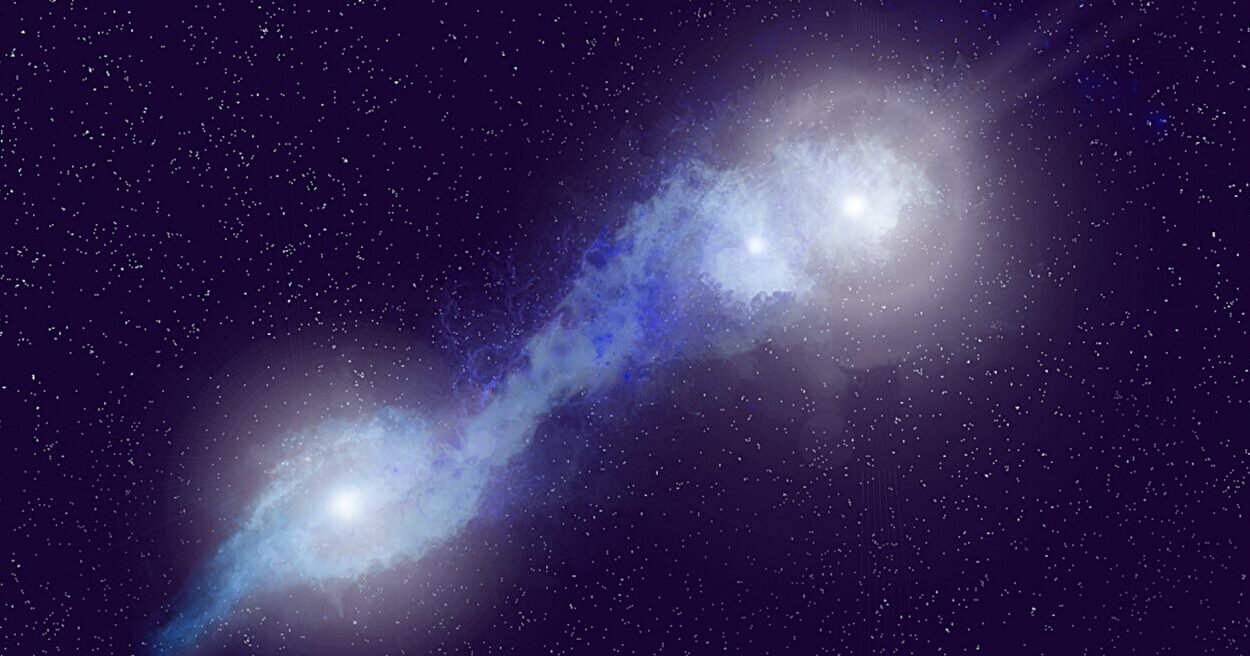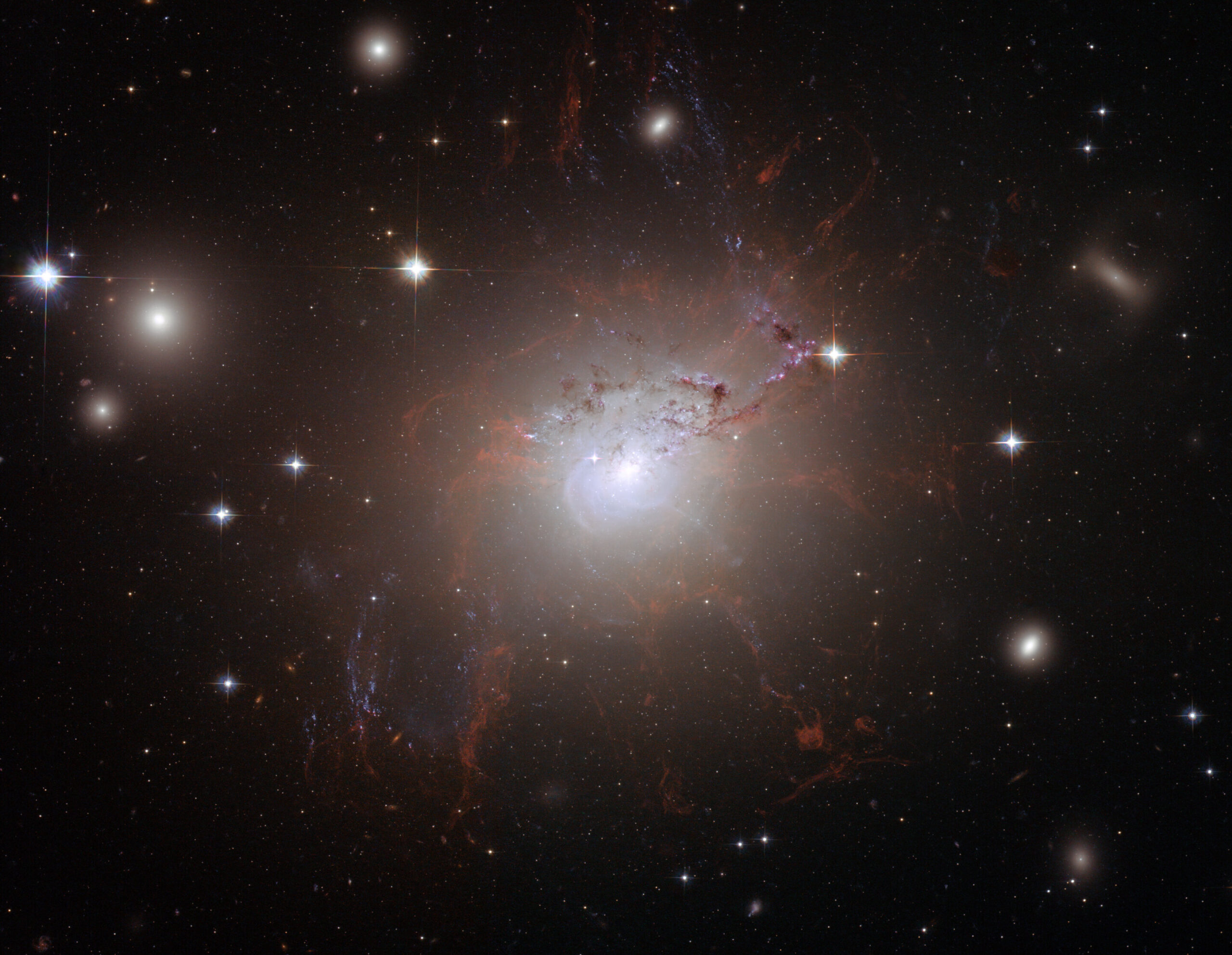
The strongest X-ray flare ever recorded from the supermassive black hole at the center of the Perseus Cluster erupted in 2023, followed 296 days later by a radio flare that may help astronomers trace a connection between activity near the black hole and its powerful jet.
The black hole sits inside NGC 1275, the brightest member of the Perseus Cluster. The galaxy is marked by an ongoing merger and by glowing gas filaments that trail behind bubbles pushed outward by the black hole’s central activity.
Astronomers are interested in NGC 1275 because it provides a setting for studying what is known as disk-jet coupling, the relationship between a black hole’s accretion disk and the jets it launches. Understanding that connection is also important for studying how black holes limit galaxy growth.
Tracking that relationship over time is difficult. NASA’s Chandra X-ray telescope cannot observe the galaxy often enough to follow rapid changes, while estimates of the black hole’s mass differ by nearly two orders of magnitude.
Sarah Ketchum of the University of Michigan and her colleagues instead used observations from NASA’s Swift X-ray Telescope. Swift is less powerful than Chandra but has been available for much more frequent observations. The team assembled almost 20 years of Swift X-ray monitoring to examine how NGC 1275 changed over long periods.
The strongest X-ray flare on record
Around February 2023, the black hole produced the strongest X-ray flare ever recorded from the galaxy. Its X-ray brightness increased by about a factor of two.
The episode lasted less than 60 days and appeared to contain at least two separate bursts. Each burst lasted only about five days.
The researchers considered whether a tidal disruption event could explain the flare. In such an event, a star that passes too close to a black hole can be torn apart, producing a characteristic decline in brightness. But the X-ray flare from NGC 1275 faded more slowly than expected for that explanation.
The team therefore considered other possibilities. The flare could have resulted from a change in how much matter the black hole was consuming, or from a disturbance farther along the jet.
Several observations favored an origin connected to accretion, including the shape of the X-ray spectrum, the rapid changes in brightness and a particular iron emission line. Even so, the researchers could not establish that all of the X-ray emission came from the corona, the region of X-ray-emitting material close to the black hole. Some flares could instead originate farther along the jet.
The radio flare came 296 days later
The timing became more interesting when the X-ray observations were compared with radio monitoring.
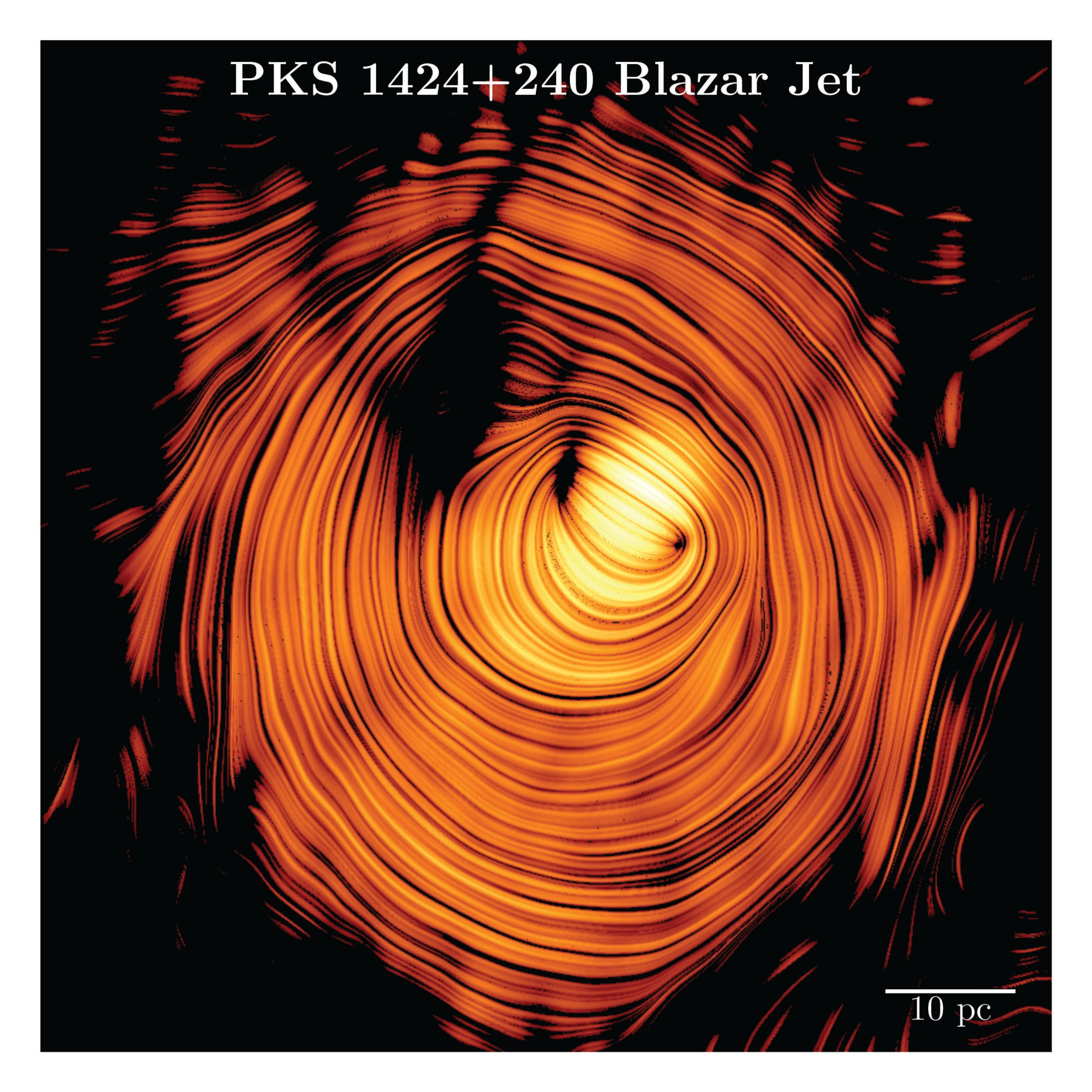
A corresponding radio brightening appeared 296 days after the X-ray flare. The researchers suggest that the delay could represent the time needed for a disturbance to travel from the X-ray-emitting region near the black hole to a radio-emitting region farther out in the jet. Another possibility is that the delay reflects movement between two locations farther downstream in the jet.
That interpretation remains uncertain. The researchers also note that the observed flares are more likely to result from changes in the rate at which matter falls onto the black hole, downstream shocks, or other processes than from a tidal disruption event.
The nearly 300-day separation between the two types of emission nevertheless gives astronomers a timing relationship to investigate. The researchers suggest that coordinated X-ray and radio monitoring could provide a way to follow the connection between accretion and jets as it unfolds in galaxies.
The study was published in The Astrophysical Journal Letters.