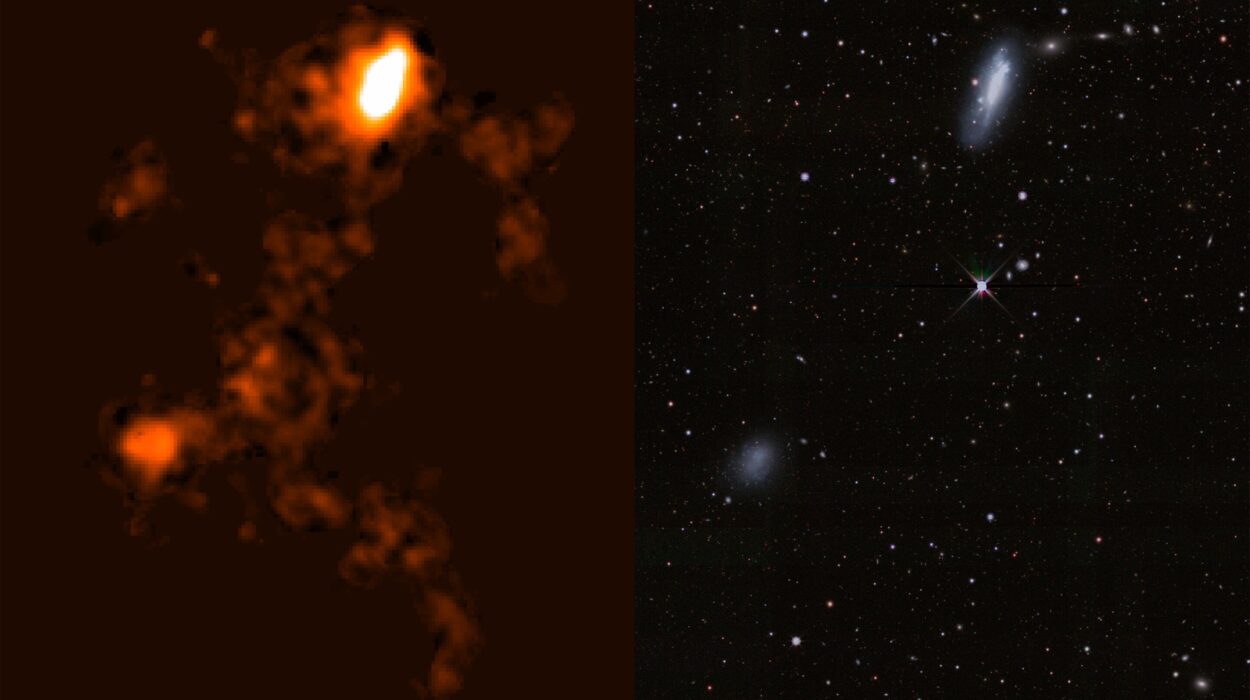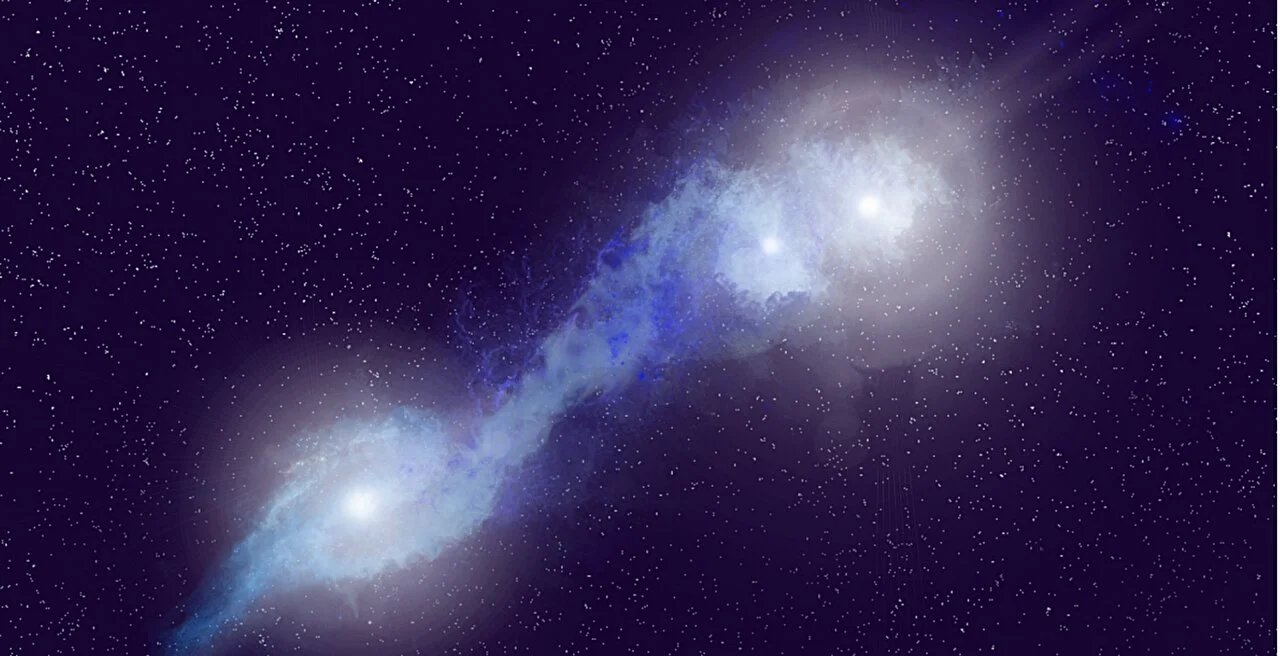
From 1.2 billion light-years away, a faint but persistent radio glow reached Earth, carrying with it a story no one had ever fully confirmed before. Astronomers had seen pairs of galaxies sharing the spotlight, and they had witnessed single galaxies blazing with the energy of feeding supermassive black holes. But this signal hinted at something more crowded, more dramatic, and far rarer.
The system, cataloged as J1218/1219+1035, did not immediately announce itself as historic. At first glance, it appeared to be a group of three interacting galaxies, locked together by gravity and slowly reshaping one another as they moved toward an eventual merger. What made astronomers pause was not just the galaxies themselves, but the possibility that deep in the heart of each one, a supermassive black hole was actively feeding and shining in radio light at the same time.
That possibility has now been confirmed. Astronomers have identified the first known triple system in which all three galaxies host actively feeding, radio-bright supermassive black holes. In doing so, they have transformed a theoretical prediction into a vivid, observable reality.
Three Galaxies, One Violent Dance
J1218/1219+1035 is not a quiet place. The three galaxies are interacting, their gravitational pulls stretching and distorting each other into tidal features that trace their shared motion. They are not drifting independently through space, but forming a dynamically bound group, caught mid-merger.
The distances between their centers tell part of the story. Two of the galactic nuclei are separated by roughly 22 thousand light-years, while the third lies about 97 thousand light-years away. These separations place the galaxies close enough to strongly influence one another, funneling gas, dust, and stars inward as their mutual gravity reshapes them.
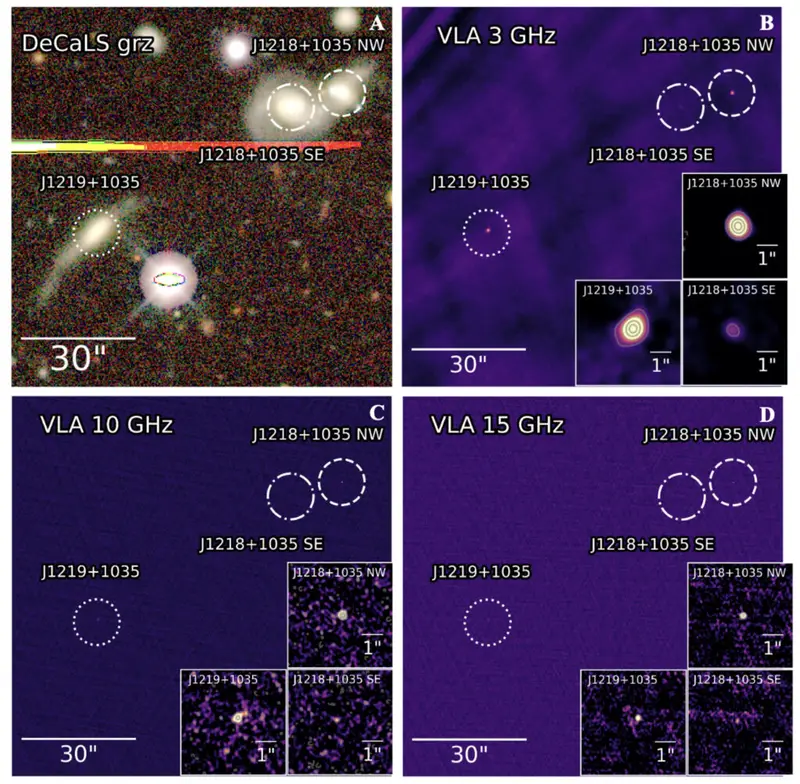
Optical DeCaLS grz images and radio VLA images of J1218/J1219+1035. Credit: The Astrophysical Journal Letters (2025). DOI: 10.3847/2041-8213/ae2002
At the center of each galaxy sits a supermassive black hole. In this system, none of those black holes are dormant. All three are actively accreting material, a process that releases enormous amounts of energy. What makes J1218/1219+1035 truly unique is that all three black holes are shining brightly in the radio regime, revealing themselves through compact radio cores powered by non-thermal processes.
This combination makes the system the first confirmed “triple radio AGN” and only the third known triple AGN system in the nearby universe.
Following the Clues Backward
The discovery did not begin with radio telescopes. J1218/1219+1035 first drew attention through mid-infrared data from NASA’s Wide-field Infrared Survey Explorer, or WISE. That data suggested something unusual: at least two obscured active galactic nuclei seemed to be hiding within an interacting pair of galaxies.
Optical spectroscopy followed, sharpening the picture but not completing it. One nucleus showed clear signs of an active galactic nucleus. Another displayed a “composite” signature, hinting at a mix of black hole activity and other processes. The third galaxy remained frustratingly ambiguous. Its emission could have been produced by star formation or by shocks from galactic interactions, leaving astronomers uncertain about what truly powered its core.
At this stage, the system was intriguing but incomplete. The possibility of three active black holes was there, but the evidence was not yet decisive.
When Radio Eyes Came Into Focus
Clarity arrived with new, ultra-sharp radio imaging from the U.S. National Science Foundation Very Large Array. Observing the system at frequencies of 3, 10, and 15 GHz, astronomers achieved sub-arcsecond resolution, sharp enough to isolate compact radio sources within each galaxy.
What they found was striking. In all three galaxies, the radio emission pinpointed compact cores precisely aligned with the optical centers. These were not diffuse regions of star formation spread across galactic disks. They were concentrated, intense sources consistent with active galactic nuclei.
The radio spectra of these cores added another layer of confirmation. Two of the sources showed steep spectra typical of non-thermal synchrotron emission from AGN. The third exhibited an even steeper spectrum, which may indicate unresolved jet activity emerging from the central black hole.
To push the investigation further, astronomers turned to the Very Long Baseline Array. Although the VLBA did not detect a compact milliarcsecond-scale core in the central galaxy, it provided a crucial constraint: the brightness-temperature limit exceeded what would be expected from star formation alone. This effectively ruled out alternative explanations and strengthened the case for an AGN origin.
Taken together, the radio observations left little room for doubt. All three galaxies in J1218/1219+1035 host actively feeding supermassive black holes that are simultaneously “lit up” in radio light.
A Rare Prediction Comes to Life
Triple AGN systems have long been predicted by models of hierarchical galaxy evolution. In this framework, large galaxies grow by repeatedly colliding and merging with smaller companions. If each merging galaxy contains a central black hole, then systems with two or even three active nuclei should exist.
The challenge has always been finding them. Such systems are expected to be rare and short-lived, appearing only during specific stages of galactic interaction. Dust obscuration, overlapping emissions, and limited resolution have made them difficult to identify, especially when relying on optical or X-ray observations alone.
J1218/1219+1035 provides a rare and valuable snapshot of this process in action. By capturing three actively feeding black holes in the same merging group, astronomers now have an exceptional laboratory for studying how galaxy encounters drive gas into galactic centers and ignite black hole growth.
As Dr. Emma Schwartzman of the U.S. Naval Research Laboratory, lead of the study published in The Astrophysical Journal Letters, put it, “Triple active galaxies like this are incredibly rare, and catching one in the middle of a merger gives us a front-row seat to how massive galaxies and their black holes grow together.”
Jets, Growth, and a New Window
One of the most compelling aspects of this discovery is that all three black holes are radio-bright. Radio emission often traces jets or outflows launched from the vicinity of a feeding black hole, structures that can influence the surrounding galaxy by heating gas or pushing it outward.
“By observing that all three black holes in this system are radio-bright and actively launching jets, we’ve moved triple radio AGN from theory into reality and opened a new window into the life cycle of supermassive black holes,” Dr. Schwartzman said.
The simultaneous activity of all three black holes raises new questions. How does the presence of multiple active nuclei affect the flow of gas during a merger? Do the jets interact with one another or with the shared galactic environment? And how might such interactions influence the eventual fate of the galaxies and their black holes?
J1218/1219+1035 does not yet answer these questions, but it offers the opportunity to ask them with unprecedented clarity.
Sharpening the Picture Even Further
To characterize the system, the research team used the VLA in its highest-resolution A configuration, carefully isolating each radio core across multiple frequencies. The complementary VLBA observations added constraints on compactness and brightness temperature, ensuring that the radio emission could not be easily explained by processes unrelated to black hole activity.
This multi-instrument approach was essential. Without it, the system might have remained ambiguous, its true nature hidden behind overlapping signals and competing explanations.
Future observations are already planned. Near-infrared imaging will help map the galaxies’ tidal structures in greater detail, revealing how the merger is reshaping them. X-ray observations will probe the high-energy output of each AGN, adding another layer to the understanding of how these black holes are feeding and interacting with their environment.
Each new wavelength will add depth to the story, turning a remarkable detection into a richly detailed portrait of a cosmic encounter.
Why This Discovery Matters
With only two other confirmed triple AGN systems known locally, every new example carries outsized importance. Expanding the sample of such systems is crucial for understanding how often multiple black holes interact and how those interactions shape the growth of galaxies over cosmic time.
J1218/1219+1035 demonstrates the power of combining mid-infrared selection with sensitive, high-resolution radio imaging. It shows that complex AGN systems may be hiding in plain sight, their true nature obscured or ambiguous at optical and X-ray wavelengths. Radio observations, with their ability to pierce dust and pinpoint compact cores, provide a critical key.
More broadly, this discovery strengthens the link between theory and observation. Hierarchical galaxy evolution predicts that systems like this should exist. J1218/1219+1035 proves that they do, and that they can be found and studied in detail.
At a deeper level, the system reminds us that galaxies do not grow quietly or alone. Their histories are written in collisions, mergers, and moments of intense activity at their cores. By catching three supermassive black holes feeding at once, astronomers have captured a fleeting chapter in that story.
It is a chapter that shows how the most massive structures in the universe are built not through isolation, but through interaction. And it offers a powerful glimpse into the dynamic processes that continue to shape the cosmos, one merger at a time.
More information: Emma Schwartzman et al, The First Triple Radio Active Galactic Nucleus in an Ongoing Galaxy Merger, The Astrophysical Journal Letters (2025). DOI: 10.3847/2041-8213/ae2002