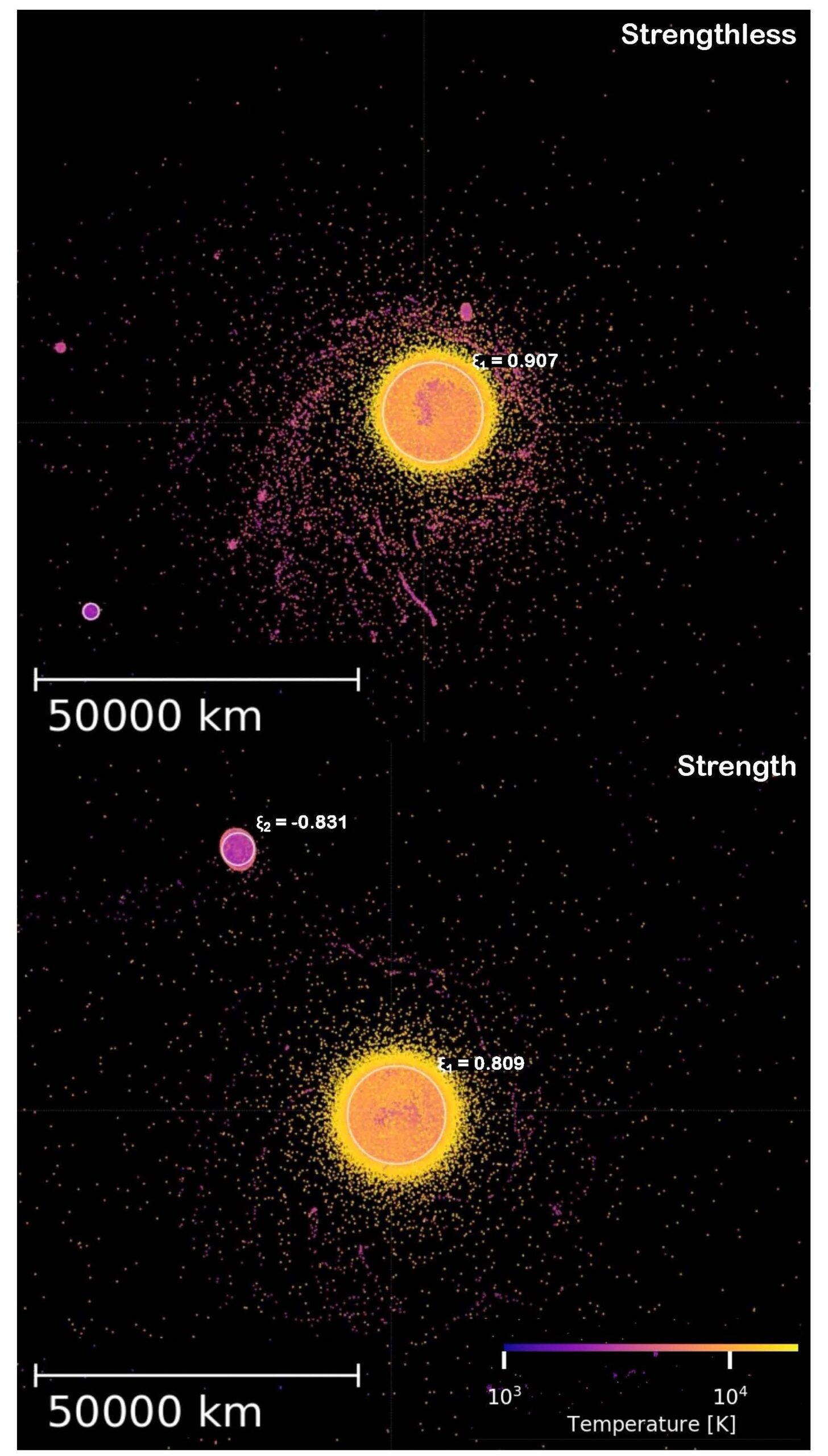
The way the moon formed may have depended not only on the force of the collision that created the Earth-moon system, but also on the temperatures and geological strength of the two bodies involved. New computer simulations suggest that a hotter collision can produce very different results from a cooler one, including either an intact moon or a disk of debris that later forms the moon.
The simulations modeled the giant impact in which a Mars-sized body called Theia struck the early Earth. Earlier versions of this model treated the colliding planets as lacking material strength because that property was considered unimportant in such a high-energy collision.
The new work included temperature-dependent geological strength in the calculations. That allowed the researchers to test whether the physical state of Earth and Theia before the collision affected what happened afterward.
It did.
The team found that hotter bodies were weaker and that moon formation was sensitive to the temperatures of both colliding bodies. In some simulations, a moon emerged essentially intact within hours of the impact. In others, the collision destroyed Theia and created a large disk of debris around Earth. The moon then formed from that material over time.
Denton and her team found one particularly clear difference when they reproduced the temperature structures used in the original impact modeling. With equal temperature structures inside Earth and Theia, an intact moon appeared within about five hours.
With different thermal conditions, the outcome could instead be a massive debris disk that eventually assembled into the moon.
The result connects the collision to the moon’s early state
The researchers say the finding creates a possible connection between the timing of the giant impact and the moon’s initial condition.
Protoplanets generally begin hot and cool as they age. That means the thermal state of Earth and Theia could provide information about when the collision occurred, depending on which kind of moon-forming outcome took place.
The study also raises a possible connection between the conditions of the impact and physical properties of the moon today. Robin Canup, whose earlier work helped establish the giant-impact scenario and who was not involved in the new study, said those properties could include the moon’s volatile content.
That possibility, in turn, could help scientists better constrain when the moon-forming event happened.
Earth and the moon’s composition remains an open question
The new simulations do not resolve another longstanding problem with the giant-impact scenario: why Earth and the moon have such closely related compositions.
One possible explanation is that Theia and the early Earth formed in the same region of the protoplanetary disk. Mars, which is compositionally distinct from Earth and the moon, may have formed farther away.
The new modeling focused instead on how the geological properties and temperatures of the colliding bodies affected the mechanics of moon formation. The simulations used methods developed at the University of Bern and the University of Arizona.
The study was published in The Astrophysical Journal Letters.