In the quiet depths of the Milky Way’s oldest star clusters, time is supposed to move in only one direction. Stars are born together, burn their fuel, and gradually fade, following predictable paths laid down by well-tested theories of stellar evolution. Yet scattered among these ancient populations are stars that seem to have missed the memo. They shine bluer, hotter, and brighter than their neighbors, standing out like energetic youths in a crowd of elders. For more than seven decades, these objects, known as blue straggler stars, have challenged astronomers’ understanding of how stars age.
Their presence is unsettling precisely because it should not be possible. All the stars in a globular cluster are thought to have formed billions of years ago, from the same reservoir of gas, at roughly the same time. And yet blue stragglers appear more massive and younger than stars that should have exhausted their nuclear fuel long ago. They look like cosmic time travelers, stubbornly refusing to grow old.
Now, new observations from the NASA/ESA Hubble Space Telescope are finally clarifying how these stars come to be and why they are more common in some stellar neighborhoods than others. The results, published in Nature Communications, suggest that the secret to eternal youth in the cosmos lies not in violent chaos, but in quiet companionship.
A Mystery That Would Not Fade
Blue straggler stars were first recognized more than 70 years ago, and from the beginning, they raised uncomfortable questions. According to standard models, stars in old clusters should all lie along well-defined evolutionary tracks. Blue stragglers, however, sit apart, hotter and more luminous than expected. Their position implies that they somehow gained extra mass, allowing them to burn brighter and appear younger than their peers.
Two competing ideas emerged to explain this paradox. One possibility was brute force: in the crowded cores of star clusters, stars might collide, merging into more massive objects that shine with renewed vigor. The other explanation was more subtle, involving binary star systems, in which two stars orbit each other closely. In such systems, one star can transfer material to its partner or merge with it entirely, effectively giving the recipient star a fresh supply of fuel.
For decades, astronomers debated which of these processes dominated. Collisions seemed plausible in dense clusters, where stars are packed tightly together. Binary evolution, on the other hand, required fragile stellar partnerships to survive for billions of years. Without a sufficiently large and diverse dataset, it was difficult to tell which scenario truly shaped the blue straggler population.
Hubble Opens a New Window
The new study changed this situation dramatically by turning to Hubble’s unique capabilities. An international research team analyzed ultraviolet observations of 48 globular clusters in the Milky Way, constructing the largest and most complete catalog of blue straggler stars ever assembled. In total, the sample included more than 3,000 of these enigmatic objects.
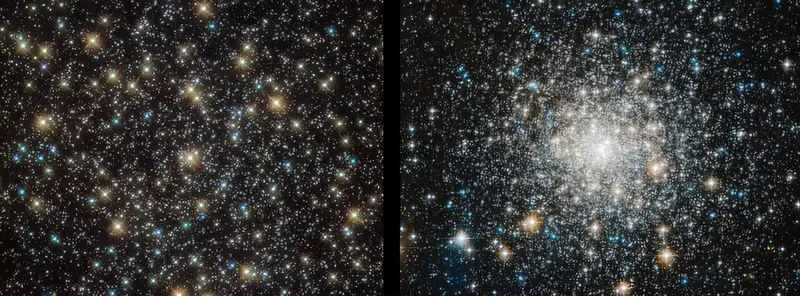
Crucially, the clusters in the study spanned the full range of possible environments. Some were dense, crowded systems where stars constantly jostle for space. Others were much looser, calmer environments where stars drift more freely. This diversity allowed astronomers to test, for the first time on such a large scale, how blue straggler populations depend on their surroundings.
The expectation seemed straightforward. If stellar collisions were the primary mechanism, then dense clusters should be teeming with blue stragglers. After all, more stars in less space should mean more opportunities for violent encounters. But when the researchers examined the data, the universe had a surprise in store.
The Surprise Hidden in Quiet Places
Instead of finding more blue stragglers in crowded clusters, the team observed the opposite pattern. Dense environments host fewer blue straggler stars, while low-density clusters contain them in greater numbers. The stars that look youngest are not thriving in cosmic traffic jams, but in quieter neighborhoods where space is plentiful.
This unexpected result immediately cast doubt on the collision-driven explanation. If collisions were the dominant process, the densest clusters should be rich in blue stragglers. The fact that they are not points strongly toward another origin story.
The data revealed a close connection between blue stragglers and binary star systems. In low-density environments, binary stars are more likely to survive for long periods without being disrupted by close encounters with other stars. These stable partnerships provide the conditions needed for one star to draw material from its companion or for two stars to merge, creating a more massive, brighter star that masquerades as young.
Francesco R. Ferraro, the study’s lead author and a professor at the University of Bologna, emphasizes the importance of environment in shaping stellar lives. According to him, blue straggler stars are “intimately connected to the evolution of binary systems,” but their survival depends on where they live. Low-density clusters offer a safe haven where binaries and their by-products can persist, allowing some stars to appear far younger than expected.
When Companionship Matters More Than Chaos
The role of binary systems emerges as central in this new picture. In a binary pair, two stars orbit each other closely enough that their gravitational interaction can dramatically alter their evolution. Over time, one star may siphon material from its partner, growing more massive and hotter. In some cases, the two stars may merge entirely, producing a single rejuvenated object.
However, such delicate processes require stability. In densely packed clusters, stars frequently pass close to one another. These encounters can easily disrupt binary systems, tearing them apart before they have time to evolve into blue stragglers. As a result, dense clusters end up with fewer binaries and, consequently, fewer blue straggler stars.
Enrico Vesperini of Indiana University, a co-author of the study, describes crowded clusters as hostile environments for stellar partnerships. Where space is tight, binaries are more easily destroyed, and stars lose their chance to reset their evolutionary clocks. Calm surroundings, by contrast, allow these partnerships to endure.
A New Perspective on Stellar Lives
This study marks the first time such a clear and counterintuitive relationship has been observed between blue straggler populations and their environments. The findings confirm that blue stragglers are a direct by-product of binary evolution, not primarily the result of stellar collisions. Just as importantly, they demonstrate that a star’s fate is not determined by its internal physics alone, but also by the broader context in which it resides.
Barbara Lanzoni, another co-author from the University of Bologna, highlights the broader implications of this insight. The work provides a new way to understand how stars evolve over billions of years, showing that their life stories are shaped by their surroundings in ways that echo the influence of environment on living systems on Earth.
Hubble’s ability to resolve individual stars in crowded clusters and observe them in ultraviolet light was essential to uncovering this pattern. Without such precise observations, the subtle relationship between stellar youthfulness and environmental calm might have remained hidden.
Why This Discovery Matters
Solving the mystery of blue straggler stars is more than an exercise in classification. These stars serve as natural laboratories for studying stellar evolution, binary interactions, and the influence of environment on cosmic timescales. By showing that blue stragglers flourish in low-density clusters and are closely tied to binary systems, this research resolves a long-standing debate and replaces speculation with evidence.
More broadly, the findings remind us that the universe is shaped as much by relationships as by isolated processes. Even stars, governed by nuclear reactions and gravity, are profoundly influenced by their neighbors and surroundings. Understanding these connections helps astronomers build more accurate models of how star clusters evolve and how complex stellar populations emerge over time.
In revealing why some stars appear forever young, Hubble has shown that cosmic youth is not about defying time, but about finding the right environment in which to endure, adapt, and quietly begin again.
Study Details
Francesco R. Ferraro et al, A binary-related origin mediated by environmental conditions for blue straggler stars, Nature Communications (2026). DOI: 10.1038/s41467-025-68159-5