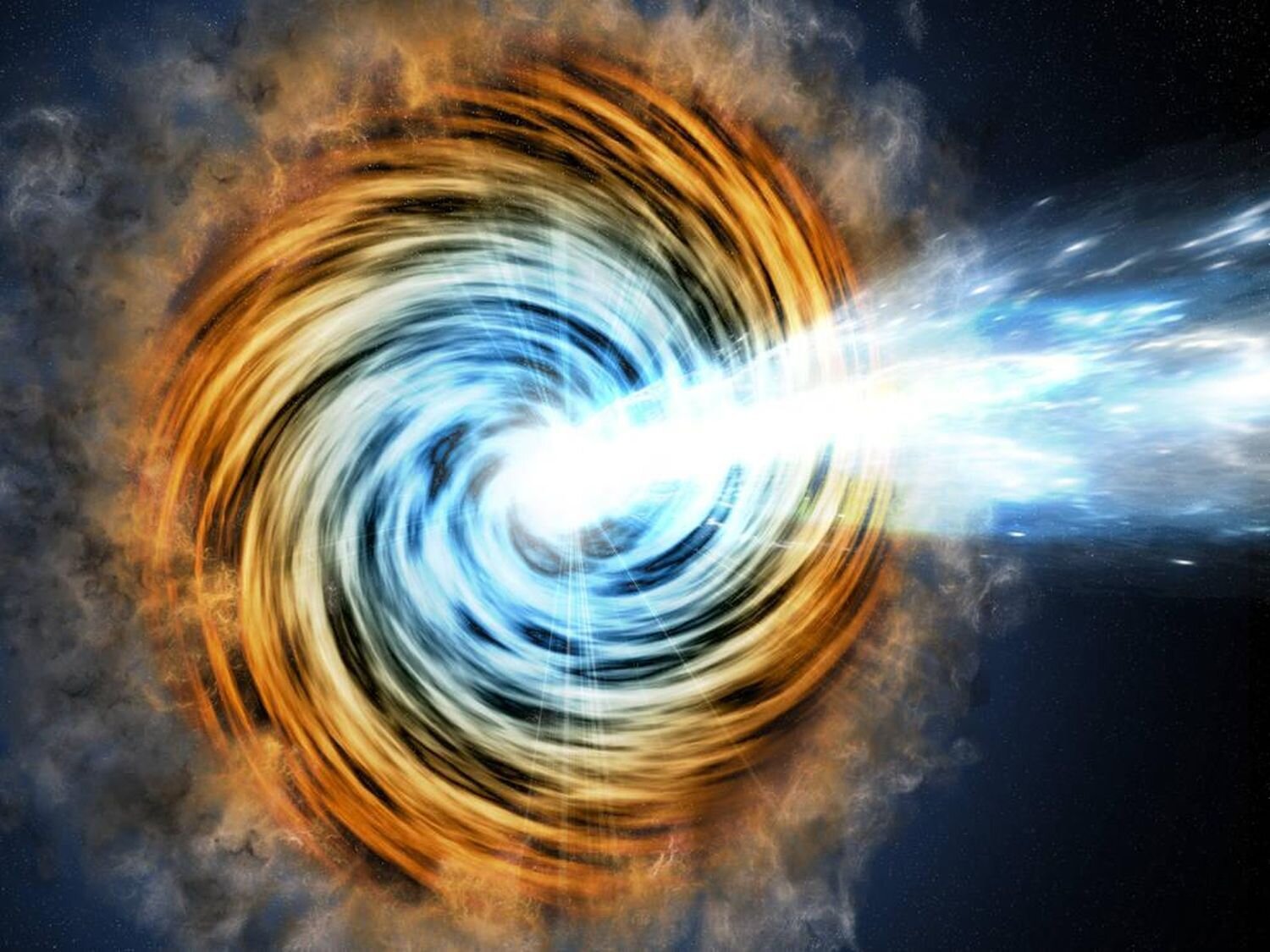
In the vast, silent stretches of our universe, there exist beacons of light so intense they defy easy comprehension. These are the blazars, the most luminous and extreme members of the active galactic nuclei family. At the heart of distant, giant elliptical galaxies, supermassive black holes act as the engines for these cosmic spectacles, funneling matter into highly collimated relativistic jets. When these jets point almost directly at our line of sight on Earth, we witness the blinding brilliance of a blazar. Among these celestial titans, one particular object known as Ton 599 has long captivated the curiosity of the scientific community, standing as a testament to the violent and unpredictable nature of the deep cosmos.
A Titan Awakens in the Dark
Ton 599 is not merely a distant point of light; it is a monster of physics located at a redshift of 0.725. To understand the scale of this object, one must look to its heart, where a supermassive black hole containing the mass of approximately 900 million suns resides. Astronomers classify Ton 599 as a flat-spectrum radio quasar, or FSRQ, a category of blazar distinguished by prominent and broad optical emission lines. But beyond its classification, Ton 599 is known for being “strongly polarized and a highly optically violent variable.” It does not shine with a steady glow; instead, it flickers, surges, and explodes with light in a rhythmic yet chaotic dance that has spanned years of observation.
The history of this blazar is one of dramatic upheaval. In the past, researchers have watched as it underwent variations of nearly 5.0 magnitudes, with hints of cycles repeating every 1.58 and 3.55 years. It is a restless giant. In 2017, it entered a protracted flaring state that sent energy screaming across the full electromagnetic spectrum. Only a few years later, between July and September 2021, it signaled its presence again with a brilliant flare of gamma-rays. Seeking to decode the secrets hidden within these erratic pulses, a team of astronomers led by Oliver Vince of the Astronomical Observatory in Belgrade, Serbia, turned the collective eyes of the Whole Earth Blazar Telescope toward this distant powerhouse.
Monitoring the Heartbeat of a Giant
To truly understand Ton 599, the researchers knew they needed more than a snapshot; they needed a cinematic view of its life over time. By utilizing the Whole Earth Blazar Telescope (WEBT) and supplementing their view with data from the Steward Observatory, the team analyzed a decade-long saga of light covering the period from November 2011 to September 2023. What they found was a portrait of “complex variability.” The blazar was never truly still. Its light curves followed a “red-noise power-law trend,” a signature that confirms its flickering isn’t just random noise, but a “correlated stochastic process.”
As the team watched, Ton 599 displayed significant intraday variability, changing its brightness noticeably within the span of a single night. By measuring these rapid shifts, the astronomers were able to peer into the very anatomy of the jet. They calculated that the emitting regions responsible for this light were between 670 and 6,700 AU in size, influenced by magnetic fields with a strength of 0.14 to 0.5 Gauss. Perhaps most surprising was the discovery of where the smallest, fastest flickers were born. The data suggested that the most rapid, low-amplitude variations come from a compact region just 206 AU from the central engine—a distance significantly closer to the black hole than the birthplaces of major gamma-ray flares seen in previous studies.
The Brilliant Fury of a Cosmic Flare
During this twelve-year watch, Ton 599 reached a crescendo of activity that showcased the true “extreme flaring activity” these objects are capable of. At its absolute peak, the blazar reached a flux of 23.5 mJy in the R-band. This number represents a monochromatic luminosity so vast it is hard to visualize: 3.02 quindecillion erg/s. In this state, the blazar becomes a lighthouse for the universe, burning with a ferocity that outshines entire galaxies.
Yet, the beauty of the study lay in the nuances of the light. The astronomers found that the “color evolution of Ton 599 is complex and strongly depends on its brightness.” It was not a simple matter of the object getting brighter and dimmer in a uniform way; instead, the very quality of the light shifted as the energy levels rose and fell. This led the team to conclude that there is no single cause for the blazar’s behavior. Instead, the findings “underlined the complexity of the blazar’s variability, pointing to a combination of different physical processes acting on different timescales, behind the observed behavior.” It is a symphony of physics, where different forces clash and harmonize to produce the light we see across the void.
Why the Story of Ton 599 Matters
The study of Ton 599 is vital because blazars represent the most extreme laboratories in the universe. By tracking the optical variability of this object over more than a decade, astronomers are able to map the environment surrounding supermassive black holes—regions so dense and energetic that they cannot be replicated on Earth. The discovery that rapid variations occur much closer to the central engine than previously thought challenges our understanding of how these cosmic jets are structured and how they accelerate particles to near-light speed.
Understanding Ton 599 helps scientists piece together the “stochastic” nature of the universe, proving that even in the chaos of a black hole’s jet, there are patterns and physical laws to be found. This research provides the framework for understanding how galaxies evolve and how the most massive objects in existence influence the fabric of space and time around them. Through the lens of the Whole Earth Blazar Telescope, we are learning that the universe’s brightest lights have the most complex stories to tell.
More information: Oliver Vince et al., Multiband optical variability on diverse timescales of the blazar Ton 599 from 2011 to 2023, Astronomy & Astrophysics (2025). DOI: 10.1051/0004-6361/202555986.