For as long as humans have looked to the sky, the sun has been a constant, predictable presence. It rises and sets with rhythmic certainty, rotating on its axis once every 28 days. Yet, this celestial clockwork creates a blind spot for those of us living on Earth. Because of this rotation, any particular active region on the sun’s surface is only visible to us for two weeks at a time before it slips behind the solar horizon, disappearing into a two-week period of total mystery. We are often left in the dark about what is brewing on the far side of our star until it rotates back into view, sometimes bringing with it a tempest of fire and radiation.
A Hidden Giant Awakens in the Dark
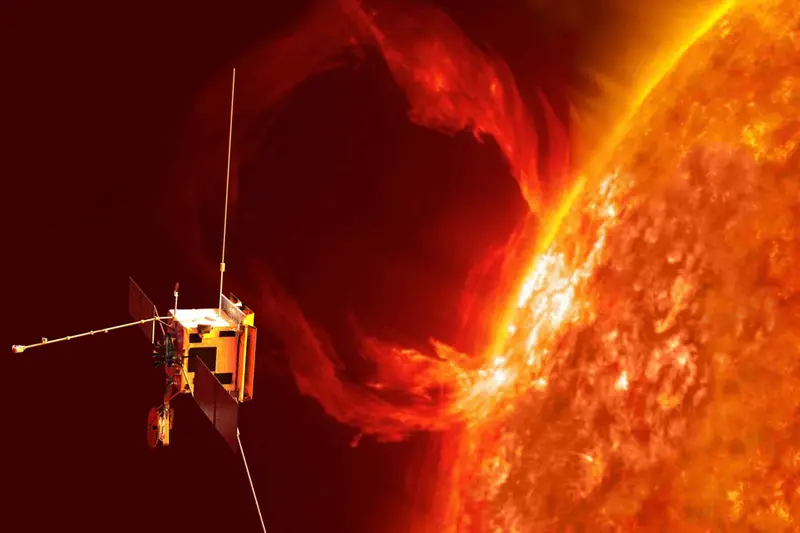
In the spring of 2024, something extraordinary began to stir in that hidden territory. On April 16, a region of the sun known as NOAA 13664 was born. While Earth-based observers were oblivious to its arrival, a silent sentinel was watching from a unique vantage point. The Solar Orbiter mission, a spacecraft launched by the European Space Agency in 2020, was positioned to see what we could not. Because the Solar Orbiter circles the sun every six months, it has the ability to peer at the solar far side, broadening a perspective that has been limited for centuries.
Under the watchful eye of the Solar Orbiter, NOAA 13664 began to grow. It wasn’t just any solar patch; it was becoming one of the most active regions seen in the last two decades. As the sun turned, this brewing storm eventually rotated toward Earth in May 2024, and the results were immediate and spectacular. It triggered the most powerful geomagnetic storms our planet had experienced since 2003. In the night sky, the heavens glowed with the aurora borealis, reaching so far south that the lights were visible even in Switzerland.
Bridging the Gap Between Two Worlds
To understand the life and death of such a “superactive” region, researchers needed more than just a glimpse; they needed a continuous story. Ioannis Kontogiannis, a solar physicist at ETH Zurich and the Istituto ricerche solari Aldo e Cele Daccò, joined forces with Louise Harra, a professor at ETH Zurich and director of the Davos Physical Meteorological Observatory. Together, they led an international team to do something that had never been done before.
By weaving together data from the Solar Orbiter on the far side of the sun with images from NASA’s Solar Dynamics Observatory—which sits on the line between the Earth and the sun—the team created a seamless record. They tracked NOAA 13664 for 94 days without interruption. “This is the longest continuous series of images ever created for a single active region: it’s a milestone in solar physics,” Kontogiannis explains. For the first time, scientists could watch the birth, the chaotic middle life, and the eventual decay of a solar monster across three full rotations.
The Invisible Tangle of Solar Fury
The story of a solar storm is written in the language of magnetic fields. Deep within the sun, strongly magnetized plasma rises to the surface, bringing with it immense energy. In active regions like NOAA 13664, these magnetic fields become incredibly complex and intertwined. As the researchers watched the data from the two probes, they saw the magnetic field of this region grow increasingly knotted and unstable over several weeks.
When these magnetic structures become too complex to hold their shape, they snap, releasing enormous amounts of electromagnetic radiation known as flares. These eruptions also eject massive clouds of plasma from the sun’s atmosphere, sending high-energy particles screaming through the vacuum of space toward whatever lies in their path. On May 20, 2024, while the region was once again on the far side of the sun, it released the strongest flare of the past twenty years, a final paroxysm of energy from a truly historic solar feature.
The High Cost of Living with a Star
While the resulting auroras are beautiful, the physical reality of these storms is far more sobering. We live in a high-tech world that is increasingly vulnerable to the whims of our local star. Solar storms can cause power outages, disrupt vital communication signals, and even pose a threat to those in the sky. Aircraft crews can be exposed to increased radiation, and satellites can be knocked out of orbit. In February 2022, a solar event caused 38 of 49 SpaceX Starlink satellites to crash just two days after they were launched.
The effects can be deeply unsettling. Louise Harra points out that even the infrastructure we take for granted on the ground is at risk. “Even signals on railway lines can be affected and switch from red to green or vice versa,” she says. “That’s really scary.” The May 2024 storm also hit the agricultural sector hard. Modern “digital agriculture” relies on a delicate web of sensors, drones, and satellites. When the signals from these devices were disrupted by NOAA 13664, farmers lost precious working days, leading to crop failures and significant economic damage.
Reading the Signs of a Coming Storm
The ultimate goal of this research is to turn these observations into a reliable “weather forecast” for space. If we can understand the patterns of the sun, we can protect the technology that keeps our modern world running. “When we see a region on the sun with an extremely complex magnetic field, we can assume that there is a large amount of energy there that will have to be released as solar storms,” explains Harra.
However, the sun still holds many secrets. While researchers can now identify the regions that harbor great energy, they cannot yet predict exactly when an eruption will occur or how large it will be. It remains a mystery whether a region will release its energy in one massive, catastrophic flare or a series of smaller, less damaging ones. “We’re not there yet,” Harra admits, though there is hope on the horizon. The European Space Agency is currently developing a new probe called Vigil, slated for launch in 2031, which will be dedicated entirely to understanding space weather.
Why This Research Matters
This study is a profound reminder that humanity does not exist in a vacuum. “It’s a good reminder that the sun is the only star that influences our activities,” says Kontogiannis. “We live with this star, so it’s really important we observe it and try to understand how it works and how it affects our environment.”
By tracking the life cycle of NOAA 13664, scientists have gained a blueprint for how superactive regions evolve and decay. This knowledge is the foundation for a future where we are no longer blindsided by the sun’s far-side fury. As we become more dependent on satellite navigation, digital communication, and automated infrastructure, the ability to predict a solar storm is no longer just a matter of scientific curiosity—it is a necessity for the survival of our modern way of life. Understanding the sun is, quite literally, a matter of protecting our world from the power of the star that sustains it.
More information: I. Kontogiannis et al, Near-continuous tracking of solar active region NOAA 13664 over three solar rotations, Astronomy & Astrophysics (2025). DOI: 10.1051/0004-6361/202556136