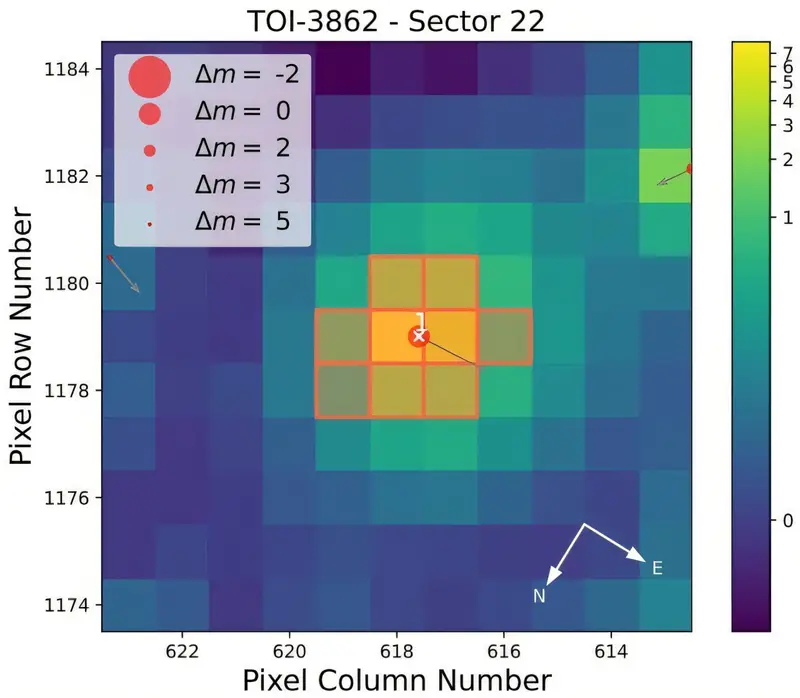
It began, as so many planetary discoveries do, with a faint and persistent flicker in starlight. NASA’s Transiting Exoplanet Survey Satellite (TESS) spends its days quietly watching the sky, measuring tiny dips in brightness as planets pass in front of their stars. Among the roughly 200,000 bright nearby stars under its watch, one sun-like star produced a signal that refused to be ignored. The light curve showed a steady, repeating shadow, subtle but unmistakable, hinting that something solid was racing across the star’s face every few days.
That star lies about 800 light years from Earth and carries the catalogue name TOI-3862. The object casting the shadow would eventually be confirmed as TOI-3862 b, a newly discovered extrasolar planet that challenges expectations about how planets survive under intense stellar heat. The confirmation was reported in a study published on January 15 on the arXiv preprint server, adding another chapter to TESS’s growing legacy of planetary discoveries.
How TESS Turned a Suspicion into a World
TESS was designed to find planets using the transit method, watching for the rhythmic dimming that occurs when a planet crosses in front of its star. Since its launch, the mission has identified more than 7,800 candidate planets, known as TESS Objects of Interest, and confirmed 733 of them as genuine worlds. TOI-3862 b first appeared as one of these candidates, flagged by its repeating transit signal.
Yet a flicker alone is never enough. Many cosmic phenomena can mimic a planetary transit. To be sure, the research team, led by Ilaria Carleo of the Observatory of Turin in Italy, turned to follow-up observations from the ground. These measurements tracked the star’s subtle motion, the tiny gravitational wobble caused by an orbiting companion. By combining transit data with radial velocity measurements, the astronomers were able to confirm that the signal truly came from a planet and not an impostor.
Through this joint analysis, the team did more than confirm the planet’s existence. They measured its mass, radius, and orbit, allowing them to precisely characterize what kind of world TOI-3862 b actually is. What emerged from the data was not a gentle, gas-rich planet like Neptune, but something denser, hotter, and far more extreme.
Meeting a Planet That Should Barely Exist
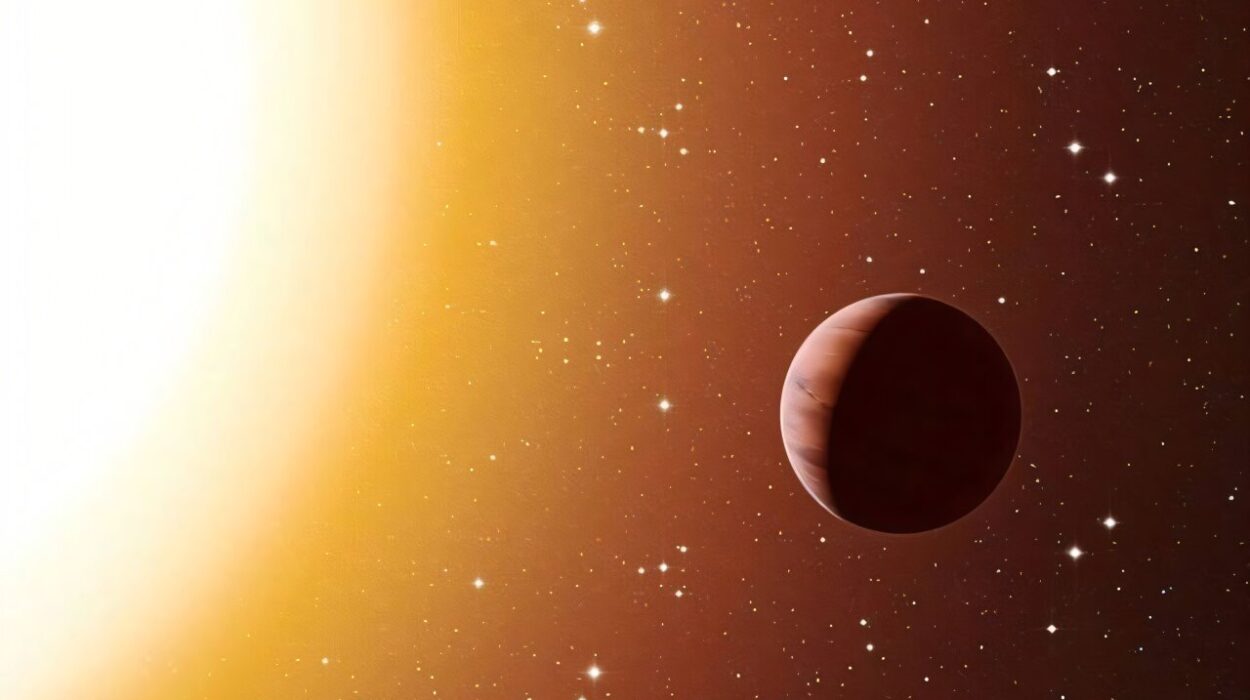
TOI-3862 b orbits its star at a staggering pace, completing one full revolution every 1.56 days. It circles at a distance of just 0.025 astronomical units, far closer to its star than Mercury is to the Sun. As a result, the planet’s estimated equilibrium temperature reaches about 1,539 kelvin, placing it firmly in the category of intensely heated worlds.
In size, the planet measures roughly half the radius of Jupiter, yet its mass is only about 0.169 times that of Jupiter. These two numbers together reveal something striking. When the astronomers calculated the planet’s average density, they found it to be about 1.75 grams per cubic centimeter, significantly higher than what would be expected for a gas-dominated world of that size.
This combination of size, mass, and density led the researchers to classify TOI-3862 b as a dense super-Neptune exoplanet. It is larger than Neptune but does not approach the bloated proportions of gas giants like Saturn. Instead, it occupies an awkward middle ground, one where planets are surprisingly rare.
Lost in the Hot Neptune Desert
TOI-3862 b resides in a region astronomers call the hot Neptune desert. This is a puzzling zone in planetary parameter space defined by short orbital periods below 3.2 days and planetary sizes between Neptune and Saturn. Despite the fact that such planets should be relatively easy to detect, they appear infrequently in surveys.
The scarcity suggests that planets entering this region struggle to survive. The intense radiation from their nearby stars is thought to strip away thick gaseous envelopes over time, leaving behind smaller, denser remnants. TOI-3862 b appears to be one such survivor, a world that once may have looked very different from what astronomers observe today.
Its host star, TOI-3862, is slightly smaller and less massive than the Sun, by about 6 percent. The star has an effective temperature of 5,300 kelvin, a metallicity of 0.11 dex, and an estimated age of 7.5 billion years. Over such a long lifetime, the planet has endured relentless stellar irradiation, shaping its structure and composition in profound ways.
Peering Beneath the Clouds That Remain
By modeling the planet’s mass and radius, the astronomers were able to infer its internal composition. Their results suggest that TOI-3862 b is rich in heavy elements and possesses only a relatively thin atmosphere compared to typical gas giants.
According to their findings, the planet likely contains an iron core making up about 38 to 41 percent of its mass, surrounded by a silicate mantle accounting for roughly 40 to 45 percent. Only a small fraction of the planet consists of a hydrogen and helium envelope, indicating that most of its original atmosphere has been lost.
This structure paints the picture of a planet that has been stripped nearly to its bones. The researchers propose that TOI-3862 b once possessed a much thicker gaseous layer, which gradually escaped into space under the star’s intense radiation. Over billions of years, this process reshaped the planet into the dense, compact world seen today.
A Planet Shaped by Time and Fire
The team’s analysis of the planet’s radius evolution history supports theories of long-term atmospheric stripping. As the planet orbited so close to its star, high-energy radiation likely heated its upper atmosphere, allowing lighter gases to escape. Slowly but relentlessly, this erosion transformed the planet’s appearance and composition.
What remains is a rare glimpse into planetary survival under extreme conditions. TOI-3862 b stands as evidence that not all close-in planets are doomed to vanish entirely. Some endure, though changed, offering astronomers a window into processes that unfold over billions of years.
Why This World Matters
TOI-3862 b is more than just another point on an exoplanet catalogue. The researchers describe it as a benchmark object for studying planetary structure and atmospheric evolution in environments dominated by extreme stellar irradiation. Its well-measured properties make it an ideal case for testing theories about how planets lose their atmospheres and how internal composition influences survival.
By existing within the hot Neptune desert, TOI-3862 b challenges astronomers to explain why such planets are rare and how a few manage to persist. Each detail, from its dense interior to its thin remaining atmosphere, helps refine models of planetary evolution and deepens our understanding of how diverse planetary systems can be.
In the faint dip of starlight that first revealed TOI-3862 b, astronomers found not just a planet, but a story written by heat, gravity, and time. It is a reminder that even in the harshest cosmic neighborhoods, worlds can endure long enough for us to notice their passing shadows and ask how they came to be.
Study Details
Ilaria Carleo et al, TOI-3862 b: A dense super-Neptune deep in the hot Neptune desert, arXiv (2026). DOI: 10.48550/arxiv.2601.10450