In the cold, quiet reaches of space, far from planets and sunlight, chemistry still unfolds. Inside a vast molecular cloud near the center of the Milky Way, a molecule has been waiting to be recognized. It is large, intricate, and carries an element that life on Earth depends on. Researchers have now identified this molecule, 2,5-cyclohexadiene-1-thione (C₆H₆S), as the largest sulfur-bearing compound ever detected in interstellar space. The discovery did not arrive by accident. It came from the careful marriage of laboratory work and astronomical observation, and it reshapes how scientists think about the chemical richness of the cosmos.
The molecule resides in the molecular cloud G+0.693–0.027, about 27,000 light-years from Earth. This region, close to the galactic center, is dense with gas and dust, a place where stars have yet to ignite. It is precisely this stillness that makes the finding so striking. In a cloud with no stars, no planets, and no life, researchers have uncovered a molecule whose complexity rivals substances found much closer to home.
The Surprise Hidden in Sulfur
Sulfur is an unassuming element in astronomy, often detected in small, simple molecules scattered through space. Until now, astronomers had only identified sulfur-containing compounds with six atoms or fewer in interstellar environments. This stood in sharp contrast to what scientists know from meteorites and comets, which contain a richer and more complex organic chemistry. Sulfur plays an essential role in proteins and enzymes, yet its larger molecular forms in space had remained frustratingly out of reach.
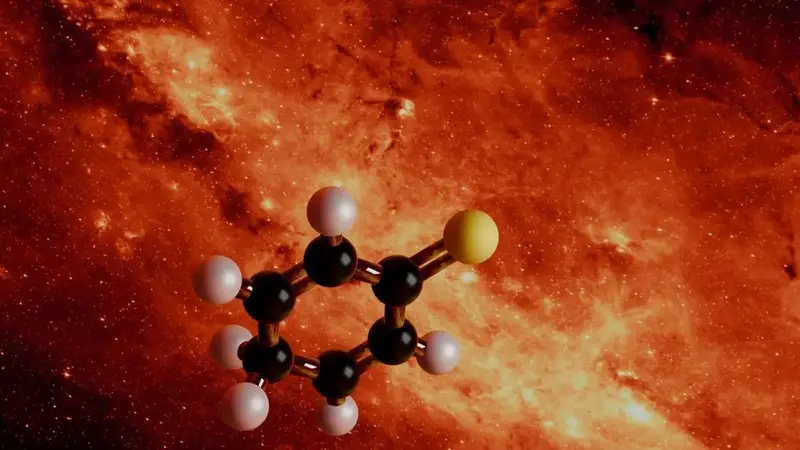
The newly detected C₆H₆S changes that picture. With a stable six-membered ring and a total of 13 atoms, it is far larger than any sulfur molecule previously found beyond Earth. Its structure immediately sets it apart. This is not a fragile chain likely to snap apart under cosmic radiation, but a robust ring, the kind of architecture associated with chemical resilience and versatility.
For Mitsunori Araki of the Max Planck Institute for Extraterrestrial Physics, the discovery represents a milestone. He describes it as the first unambiguous detection of a complex, ring-shaped sulfur-containing molecule in interstellar space. More than a new entry in a chemical catalog, it is a step toward understanding how the chemistry of space connects to the ingredients of life.
Chasing a Molecular Ghost
Finding such a molecule required more than pointing a telescope at the sky. The challenge lay in knowing exactly what to look for. Every molecule emits and absorbs radio waves at specific frequencies, creating a pattern as distinctive as a fingerprint. Without that fingerprint in hand, even the most powerful telescope cannot confidently identify a molecule drifting through space.
To solve this, the research team recreated the molecule on Earth. In the laboratory, they began with thiophenol (C₆H₅SH), a pungent liquid known for its strong odor. By applying a 1,000-volt electrical discharge, they triggered reactions that produced C₆H₆S. This was not an act of chemical curiosity alone; it was preparation for the real hunt.
Using a self-developed spectrometer, the team measured the radio emission frequencies of the newly formed molecule with extraordinary precision. The resulting spectrum was accurate to more than seven significant digits, creating a definitive reference. With this data, the molecule was no longer a theoretical possibility. It had a clear and measurable voice.
Listening to the Sky
Armed with this laboratory fingerprint, the researchers turned to the sky. They compared their measurements with astronomical data from a large observational survey led by the Centro de Astrobiología (CAB), CSIC-INTA. This survey drew on observations from the IRAM 30m and Yebes 40-meter radio telescopes in Spain, instruments capable of capturing the faint whispers of molecules across vast cosmic distances.
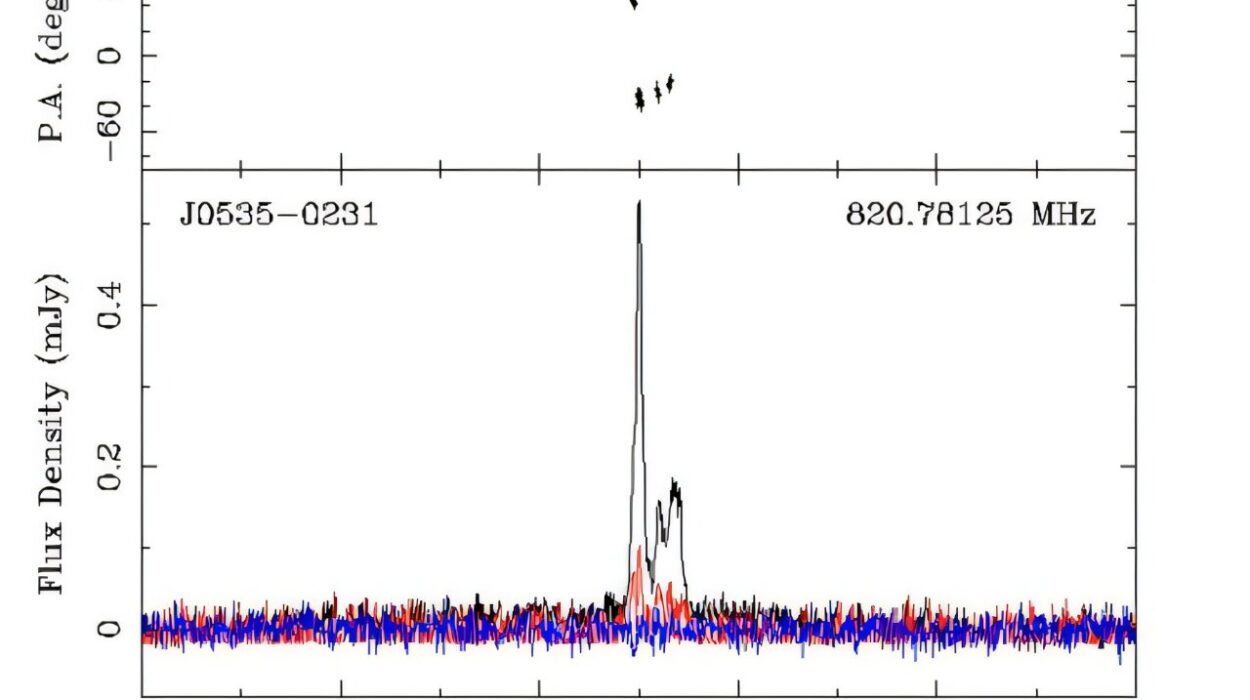
Within the data from G+0.693–0.027, the match emerged. The radio signals aligned precisely with the laboratory spectrum of C₆H₆S. This agreement left no room for ambiguity. The molecule was not a coincidence or a misidentification. It was there, floating within the molecular cloud, its complex ring intact.
For Valerio Lattanzi, also at MPE, the implications were immediate and profound. A 13-atom molecule, structurally similar to compounds found in comets, exists in a young, starless molecular cloud. This means that such chemistry does not require stars, planets, or solar systems to begin. It unfolds earlier, in the raw material from which those structures eventually emerge.
Bridging Two Chemical Worlds
One of the long-standing puzzles in astrochemistry has been the apparent gap between what is observed in interstellar space and what is found in extraterrestrial samples like comets and meteorites. These objects contain a diverse array of organic molecules, including sulfur-bearing ones, suggesting a rich chemical heritage. Yet space itself seemed comparatively barren, populated mostly by simpler compounds.
The detection of 2,5-cyclohexadiene-1-thione provides a crucial missing link. The molecule is structurally related to compounds found in extraterrestrial samples, establishing what researchers describe as a direct chemical bridge between the interstellar medium and our solar system. It suggests that at least some of the complex chemistry seen in comets did not originate within planetary systems but was inherited from the clouds that gave birth to them.
This bridge reshapes the narrative of chemical evolution. Instead of life-relevant molecules forming late, on planets alone, the groundwork appears to be laid much earlier, in the diffuse and dark environments between stars.
A New View of Interstellar Chemistry
The discovery also forces a reconsideration of how rich interstellar chemistry can be. If a molecule as large and specific as C₆H₆S can exist undetected until now, it raises an obvious question. How many more complex sulfur-bearing molecules are still hiding in the data, their signatures overlooked simply because no one knew what to search for?
Sulfur’s importance to biology makes this question especially compelling. The presence of complex sulfur molecules in space strengthens the idea that essential chemical ingredients may be widespread, forming naturally under conditions that predate planets and life itself. Each new detection adds weight to this perspective, turning interstellar clouds from chemically simple backdrops into active laboratories of molecular construction.
Why This Discovery Matters
This finding matters because it redraws the boundaries of where and when complex chemistry begins. The identification of the largest sulfur-bearing molecule ever found in space demonstrates that interstellar clouds can host sophisticated molecular structures once thought exclusive to later stages of cosmic evolution. It closes a critical gap between simple interstellar molecules and the richer chemistry observed in comets and meteorites.
By showing that a ring-shaped, 13-atom sulfur molecule exists in a starless molecular cloud, the research provides direct evidence that the chemical foundations associated with life can form long before stars ignite and planets assemble. It suggests that the universe prepares its ingredients early, quietly, and far from any living world. In doing so, it deepens our understanding of how cosmic chemistry unfolds and brings us one step closer to tracing the long, interstellar path from simple atoms to the complex molecules that life depends on.
Study Details
Mitsunori Araki et al, A detection of sulfur-bearing cyclic hydrocarbons in space, Nature Astronomy (2026). DOI:
10.1038/s41550-025-02749-7. www.nature.com/articles/s41550-025-02749-7