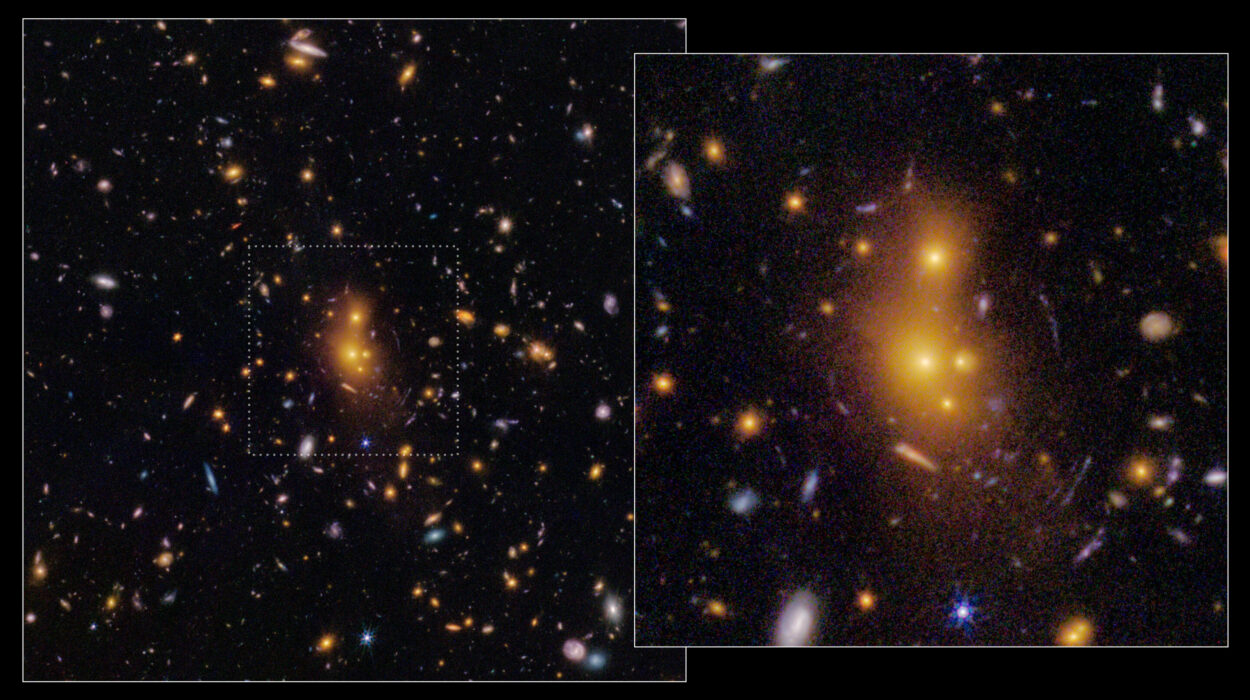
In the vast expanse of the universe, most galaxies seem to live predictable lives. Their stars shine, their black holes hum quietly at their centers, and their cosmic dramas unfold over millions of years. But every so often, astronomers find a galaxy that behaves like a cosmic chameleon—shifting its appearance in ways that defy expectations. One such galaxy is NGC 3822, located roughly 276 million light-years away in the constellation Leo.
Recently, a team of Indian astronomers led by Narendranath Layek of the Physical Research Laboratory in Ahmedabad has unveiled new secrets about this mysterious object. Their 17-year, multiwavelength study, drawing data from some of the world’s most advanced observatories, has revealed that NGC 3822 is not just another distant galaxy—it’s a changing-look active galactic nucleus (CL-AGN), a rare and puzzling class of cosmic objects that can alter their identity before our very eyes.
The Powerhouse at a Galaxy’s Heart
At the center of nearly every large galaxy lies a supermassive black hole—a gravitational monster millions or even billions of times heavier than our Sun. While black holes themselves are invisible, the regions around them often blaze with light. This happens when the black hole devours nearby gas and dust, forming a swirling accretion disk that heats up to millions of degrees, radiating intensely across the electromagnetic spectrum.
Such energetic centers are known as Active Galactic Nuclei (AGNs)—some of the most luminous objects in the cosmos. They can outshine the combined light of all the stars in their host galaxies. But AGNs are not static. They flicker, flare, and sometimes, astonishingly, change their very nature.
When Galaxies Change Their Face
Most AGNs maintain consistent spectral signatures, meaning astronomers can classify them based on the kind of light they emit. Some are bright in X-rays, others in visible light or radio waves. But a special group—known as Changing-Look AGNs (CL-AGNs)—can transform between these types.
In practical terms, this means that the broad emission lines (BELs)—distinct features in a galaxy’s light spectrum that indicate the presence of fast-moving gas near the black hole—can appear or disappear over time. When this happens, it’s as if the galaxy is changing its “personality.”
Such transformations can occur over months or years, a blink of an eye on cosmic timescales. What triggers these changes remains one of modern astronomy’s great mysteries. Some scientists suspect shifts in the accretion rate—the amount of matter falling into the black hole—while others believe moving clouds of dust or gas can temporarily obscure the core.
NGC 3822, as it turns out, is a remarkable example of this cosmic metamorphosis.
The Long Watch: Seventeen Years of Observation
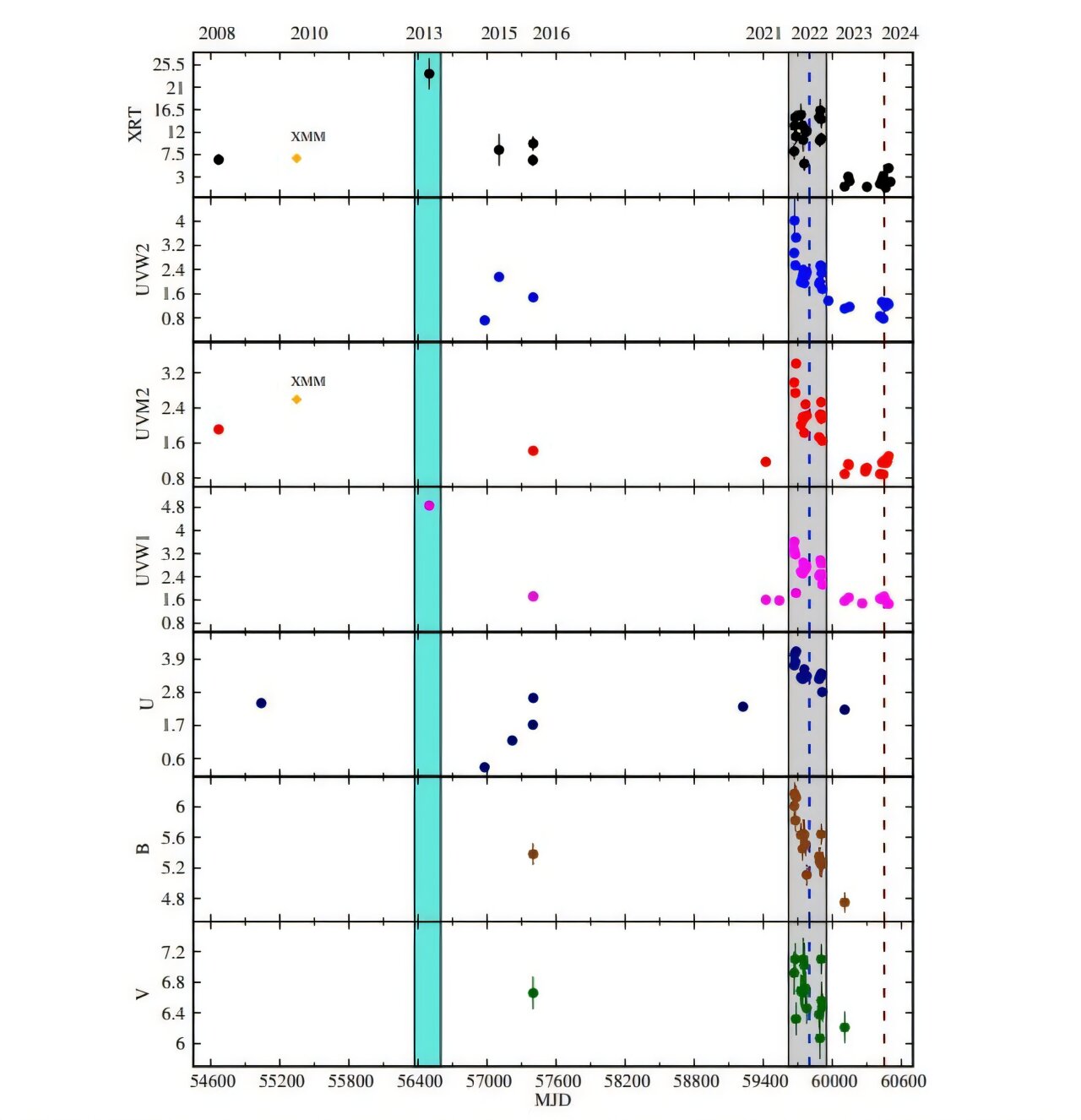
To decode NGC 3822’s strange behavior, Layek and his team analyzed a comprehensive dataset spanning from 2008 to 2025. Their observations came from both space-based observatories and ground telescopes, including NASA’s Swift, ESA’s XMM-Newton, NuSTAR, the Very Large Telescope (VLT) in Chile, and India’s own Himalayan Chandra Telescope (HCT) in Ladakh.
By examining data across X-ray, ultraviolet, and optical wavelengths, the researchers could track changes in the galaxy’s brightness and spectral structure with unprecedented precision. What they discovered painted a fascinating picture of a galaxy in flux.
A Symphony of Variations
The data revealed that NGC 3822’s brightness fluctuated dramatically, especially at shorter wavelengths. In the X-ray band, the team observed a variability amplitude of about 63%, a strong indicator that the central black hole’s feeding rate or visibility was changing.
As the wavelengths grew longer, this variability decreased—dropping to 40% in the ultraviolet W2 band, 39% in M2, 33% in W1, and finally 29% in the optical U band. These gradual shifts tell a clear story: the most energetic, high-frequency radiation comes from the black hole’s immediate surroundings, while the calmer optical light emerges from farther out, where changes occur more slowly.
The black hole itself, estimated to weigh around 27 million times the mass of the Sun, exhibited X-ray luminosity ranging between 1.3 and 14 tredecillion erg/s—an almost unimaginable power output. Yet, despite its ferocity, the black hole remained in a sub-Eddington regime, meaning it wasn’t consuming matter fast enough to reach its theoretical maximum brightness.
Shadows and Disappearances: The Role of Absorption
One of the study’s most intriguing findings was the intermittent appearance of absorption features in the X-ray spectrum. During observations in 2016 and 2022, the data showed clear evidence of intrinsic absorption—clouds of gas and dust crossing our line of sight, temporarily dimming the black hole’s light. Before and after those years, however, the absorption vanished.
This behavior suggests that moving clouds or dust structures near the black hole are playing an active role in NGC 3822’s changing appearance. Like curtains drifting across a cosmic stage, these clouds may occasionally block our view of the central engine, making the AGN seem to “turn off” and later “turn on” again.
Such discoveries are crucial, as they reveal that changing-look transitions can arise not just from internal changes in the black hole’s feeding process, but also from external dynamics—the chaotic dance of matter swirling around it.
The Accretion Rate Mystery
While obscuring clouds explain some of the fluctuations, the researchers believe that the key driver behind NGC 3822’s transformations is the changing accretion rate—the rate at which matter falls into the black hole. When the accretion rate increases, the black hole becomes more luminous, energizing surrounding gas and producing the broad emission lines characteristic of a bright AGN. When it slows, those lines fade or disappear.
This explanation aligns with the idea that black holes are not constantly ravenous. They can go through quiet periods, followed by renewed bursts of activity when new material falls into their gravitational grip. In this sense, a changing-look AGN is like a breathing cosmic organism—periodically inhaling and exhaling light.
A Window Into Cosmic Evolution
The study of NGC 3822 is more than a case study—it’s a key piece in the larger puzzle of galactic and black hole evolution. Changing-look AGNs challenge the traditional view that galaxies evolve slowly and predictably. Instead, they reveal that galactic nuclei can undergo rapid and reversible changes, reshaping their energy output in mere human timescales.
Understanding how and why these transformations occur could illuminate the lifecycles of galaxies, especially how supermassive black holes grow and influence their environments. Every flicker of light from NGC 3822 is a clue to the powerful mechanisms that sculpt the universe on grand scales.
India’s Growing Role in Astrophysical Research
This discovery also underscores the growing importance of Indian astronomy in global astrophysics. With observatories like the Himalayan Chandra Telescope and upcoming projects such as ASTROSAT-2, Indian researchers are contributing vital insights into some of the universe’s most complex phenomena.
By combining local observatories with international collaborations and space missions, teams like Layek’s are showing that the frontiers of discovery are no longer confined to a few nations—they are global endeavors, powered by shared curiosity and technology.
The Cosmic Stage: What Comes Next
The story of NGC 3822 is far from over. Like a celestial actor changing costumes, its behavior continues to evolve. Future observations may reveal new transitions—perhaps another brightening, or an even deeper fade into obscurity.
Astronomers will keep their eyes on this enigmatic galaxy, not just for what it teaches about black holes, but for what it says about change itself—how even the mightiest forces in the cosmos can fluctuate, transform, and surprise us.
In the end, NGC 3822 reminds us that the universe is not static. It is alive with motion, flux, and renewal. What seems constant from afar is, upon closer look, a theater of change—where galaxies breathe, black holes pulse, and light itself tells the story of transformation.
And as scientists continue to watch, they are not just studying a distant galaxy—they are witnessing the heartbeat of the universe.
More information: Narendranath Layek et al, Discovery of Changing-Look behavior in AGN NGC 3822: A long-term multiwavelength study, arXiv (2025). DOI: 10.48550/arxiv.2510.05599