The story began with rocks so ancient that they predate continents as we know them, rocks older than animals, older than plants, older even than the air rich with oxygen that sustains life today. For decades, scientists accepted that these rocks were nearly silent about life’s earliest chapters. Whatever fragile traces early organisms had left behind had been baked, crushed, and transformed beyond recognition by Earth’s restless interior. The past, it seemed, had been erased.
But in a new study published in the Proceedings of the National Academy of Sciences, an international team of researchers found that the past had been whispering all along. They just needed the right interpreter.
Using a pioneering blend of advanced chemical analysis and artificial intelligence, the scientists uncovered the oldest chemical evidence of life yet seen—faint “whispers” preserved in rocks more than 3.3 billion years old. Even more astonishing, the team detected molecular hints that oxygen-producing photosynthesis emerged nearly a billion years earlier than previously believed.
For scientists who study the dawn of life, this discovery feels like the moment a long-sealed door creaks open.
The Search for Clues in a Shattered Past
Katie Maloney, an assistant professor at Michigan State University and one of the study’s collaborators, has spent her career trying to understand how early life shaped Earth’s ancient ecosystems. She knows better than most how elusive those answers can be.
“Ancient rocks are full of interesting puzzles that tell us the story of life on Earth, but a few of the pieces are always missing,” Maloney said. “Pairing chemical analysis and machine learning has revealed biological clues about ancient life that were previously invisible.”
Invisible is the right word. Earth’s earliest life left little behind to begin with—just delicate cells, soft mats, and molecular traces that were later buried, heated, fractured, and transformed. What remained seemed too heavily altered to contain reliable information. Scientists could see the rocks, but not the life that once pulsed within them.
Yet Maloney and her colleagues believed there was more hidden in those fragments than the eye could see. They suspected that even when original biomolecules were destroyed, the distribution of the surviving molecular remnants carried patterns—patterns that life itself had created.
They just needed a way to recognize those patterns through all the geological noise.
Teaching Machines to Hear the Whispers of Life
To unlock the secret messages inside ancient rocks, the team turned to high-resolution chemistry. They broke down organic and inorganic materials into their smallest molecular components, creating detailed profiles of the fragments each sample contained.
But the real breakthrough came from the artificial intelligence system they trained to read these profiles. Scientists fed the AI more than 400 samples: modern plants, modern animals, billion-year-old fossils, chunks of meteorites, and everything in between. Slowly, the model learned to distinguish biological from non-biological material with extraordinary precision. It learned to see what humans could not.
The result was astonishing. The AI identified signs of photosynthesis in rocks at least 2.5 billion years old—far older than any previously confirmed molecular evidence of the process. Until now, scientists could only rely on chemical biosignatures in rocks younger than 1.7 billion years. This new technique effectively doubles the window into Earth’s biological past.
“Ancient life leaves more than fossils; it leaves chemical echoes,” said Dr. Robert Hazen, senior staff scientist at Carnegie and a co-lead author. “Using machine learning, we can now reliably interpret these echoes for the first time.”
These echoes, once dismissed as meaningless debris, proved to be the oldest chemical footprints of life ever recognized.
A Seaweed Fossil and a Billion Years of Perspective
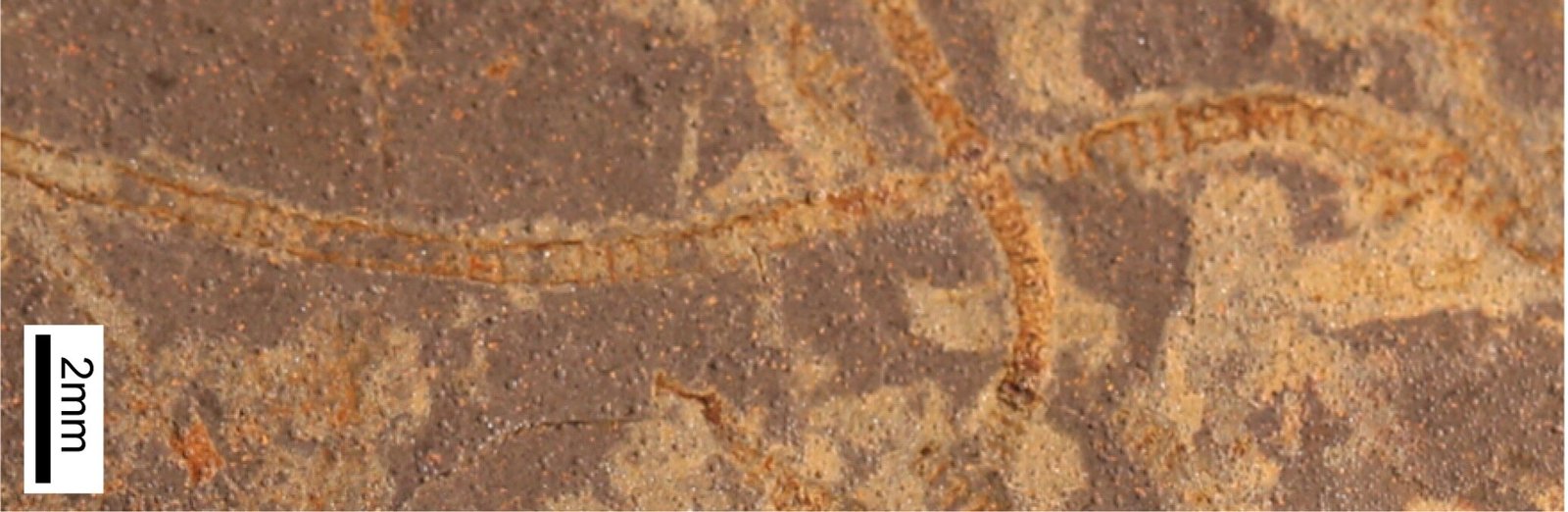
Among the many samples used to train the model were Maloney’s own contributions: exquisitely preserved one-billion-year-old seaweed fossils from the Yukon Territory in Canada. These fossils are some of the earliest seaweeds known in the record, a reminder that long before forests and animals filled Earth’s landscapes, complex life was already experimenting with new forms in the ancient seas.
To Maloney, the significance of this technique extends far beyond any single fossil. Her work centers on how early photosynthetic organisms transformed the planet—how their tiny molecular experiments eventually flooded Earth’s atmosphere with oxygen, clearing the way for complex life.
Now, with AI’s help, she and other researchers can peer deeper into time than ever before. They can look past the distortions of heat and pressure, past the fractures and faults, past the seeming absence of evidence.
“This innovative technique helps us to read the deep time fossil record in a new way,” she said. “This could help guide the search for life on other planets.”
Why This Discovery Matters
The implications of this breakthrough ripple outward in every direction. For Earth scientists, it rewrites the timeline of life’s emergence and resilience. It shows that even in the most ancient, altered rocks, chemical signals of biology are still waiting to be found. It reveals that oxygen-producing photosynthesis—a process that fundamentally reshaped the planet—began far earlier than expected. And it offers a powerful new window into the hidden history of life’s rise.
But the impact doesn’t stop at Earth’s boundaries. The same technique could one day sift through samples from Mars, or from other planetary bodies, searching for the same faint chemical whispers. It offers a way to detect life even when no cells or intact molecules remain. It suggests that absence of fossils does not mean absence of life.
Most of all, this research is a reminder that the universe keeps its stories well, even across billions of years of chaos and change. And with the right tools, humanity is learning to read those stories at last—not in bones or imprints, but in the quiet molecular echoes left behind by the earliest living worlds.
More information: Hazen, Robert M., Organic geochemical evidence for life in Archean rocks identified by pyrolysis–GC–MS and supervised machine learning, Proceedings of the National Academy of Sciences (2025). DOI: 10.1073/pnas.2514534122. doi.org/10.1073/pnas.2514534122