For centuries, humanity has gazed up at the stars, their light flickering like diamonds in the vast darkness of space. But there is one structure among the stars that stands out, not as a tiny spark of light but as a glowing ring, shaped like a brilliant diamond, hanging in the heavens. This is the “Diamond Ring” in Cygnus X, a star-forming region located about 4,500 light years from Earth. Until recently, scientists could only speculate about how such a stunning cosmic phenomenon came to be. Now, thanks to an international team of researchers led by the University of Cologne, the mystery has been solved.
The “Diamond Ring” is no ordinary star formation. While similar structures in space tend to form spherical shapes, this one is flat—like a ring. It’s a cosmic puzzle that had baffled astronomers, who had never before observed such a distinct, flat structure in a star-forming region. But after years of study, the answers finally began to emerge.
A Ring of Gas and Dust
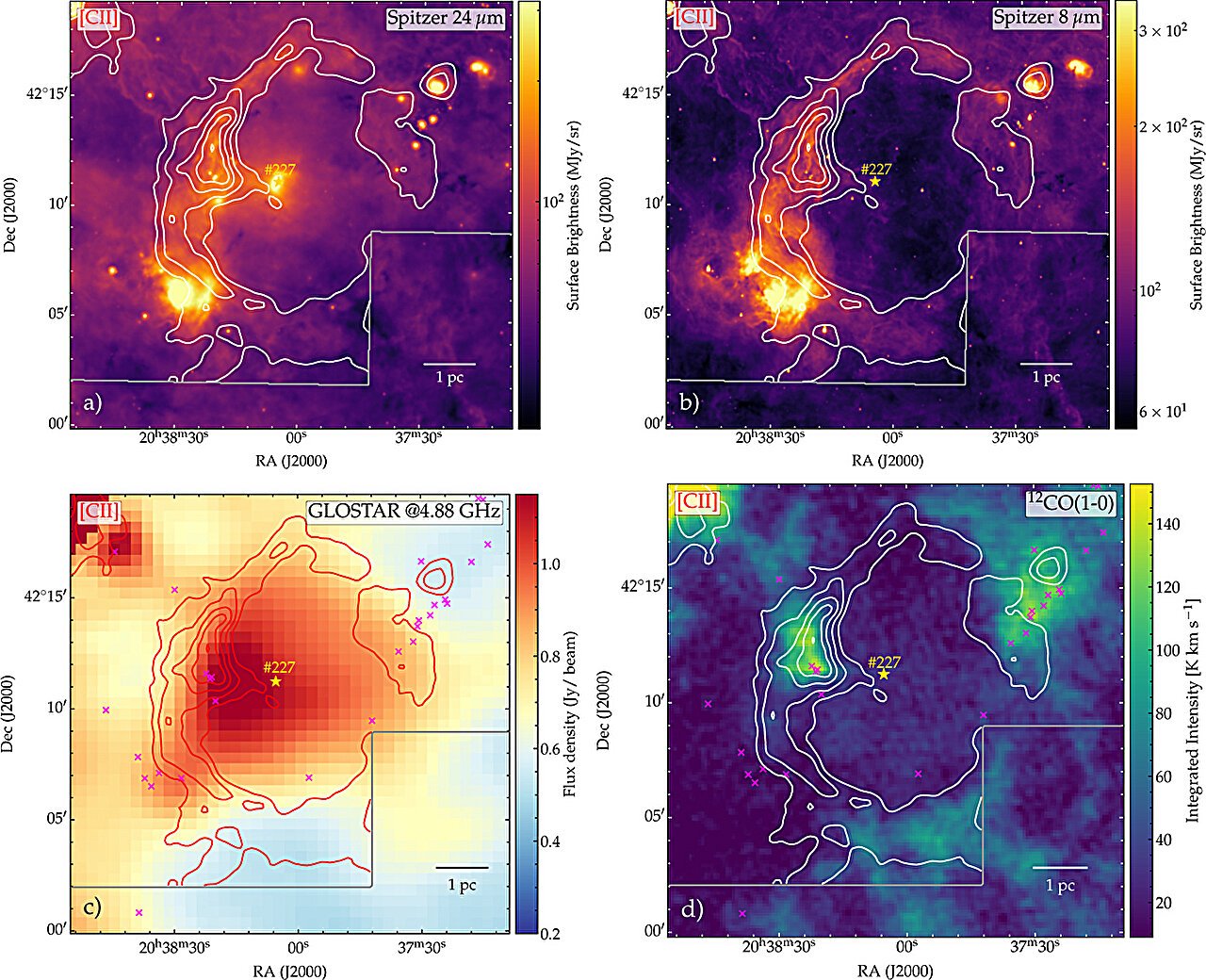
This peculiar formation has a diameter of roughly 20 light years and shines brightly in infrared light. It’s the remains of a once-expanding cosmic bubble that was formed by the intense radiation and stellar winds from a massive star. Unlike other structures, which expand outward in a spherical shell, the “Diamond Ring” appears as a slowly expanding ring.
Simon Dannhauer, a lead researcher from the University of Cologne’s Institute for Astrophysics, was the first to propose an explanation for the ring’s unusual shape. “For the first time, we observed the final stage of such a gas bubble in a distinctly flat cloud structure,” he explains. “The bubble has ‘burst,’ because gases were able to escape into the thinner areas around it. All that remained was the particular flat shape.”
The researchers realized that the bubble, originally expanding symmetrically in all directions, had eventually “broken through” its spherical form. As gases escaped from the sides of the bubble, the once-rounded shape flattened out, leaving behind the glowing “ring” we observe today.
The Bubble’s Birth and Evolution
The origin of this cosmic bubble is tied to a young, extremely massive star—one with a mass about 16 times greater than our Sun. This star’s intense radiation and stellar winds inflated a bubble of ionized carbon gas, causing the surrounding gas and dust to glow. But as the star continued to burn brightly, the bubble began to expand.
Computer simulations, run on the supercomputer “RAMSES” by Sebastian Vider, revealed the true nature of the bubble’s transformation. Initially, the bubble had expanded in all directions, as expected. However, as the forces from the star continued to push outward, the gas began to escape from the weaker, thinner areas surrounding the bubble, leaving behind the flat ring that we see today.
The structure is relatively young by cosmic standards, estimated to be around 400,000 years old. Considering that massive stars have lifespans much shorter than that, this is a late-stage relic of a stellar formation that continues to evolve.
SOFIA: The Key to Unlocking the Mystery
This breakthrough was made possible by observations from SOFIA, the Stratospheric Observatory for Infrared Astronomy. SOFIA is a modified Boeing aircraft equipped with a powerful telescope, flying high above the Earth’s atmosphere at altitudes of 13 kilometers or more. From this vantage point, the team could observe wavelengths of light that are normally blocked by the Earth’s atmosphere, allowing them to study the infrared glow of the “Diamond Ring.”
The researchers were able to precisely measure how fast the gas is expanding. The ring itself moves at a speed of around 1.3 kilometers per second, or roughly 4,700 kilometers per hour—slower than typical cosmic bubbles but still incredibly fast by everyday standards. This slow pace further indicated that the gas was not under the intense pressure typical of more violently expanding cosmic phenomena.
The Impact on Star Formation
This discovery has far-reaching implications for our understanding of how stars form and shape their environments. The “Diamond Ring” is more than just a beautiful, celestial oddity—it’s a window into the processes that govern the birth of stars. The winds and radiation from young stars like the one that created the bubble play a major role in influencing the surrounding gas and dust. They can push material away, flattening clouds and triggering the formation of new stars.
“The ‘Diamond Ring’ is a prime example of how enormous the influence of individual stars can be on entire cloud complexes,” says Dr. Nicola Schneider, co-author of the study. “It’s a key piece of the puzzle in understanding how stars form and evolve in the Milky Way.”
As Dr. Robert Simon, another member of the research team, adds, “Such processes are crucial for understanding the formation of stars in our Milky Way.” This new understanding of how stars influence their surroundings could help scientists refine models of star formation and further illuminate the lifecycle of stars within our galaxy.
A Cosmic Illusion
However, not everything about this celestial “diamond ring” is as it first seems. For those romantic enough to imagine a perfect, glowing jewel in the sky, there is one slight disappointment: the “diamond” is not actually part of the ring. In fact, the cluster of young stars that seems to be sitting in the center of the glowing ring is located several hundred light years in front of it. So, what appears to be a single, dazzling object is actually two separate entities—an illusion created by their alignment in space.
Even so, this does not diminish the significance of the discovery. The fact that the “Diamond Ring” is actually made up of two distinct objects only adds to its allure, as it reflects the complexity and dynamism of the universe.
Why This Discovery Matters
The discovery of the “Diamond Ring” structure in Cygnus X is more than just a fascinating cosmic mystery solved. It offers us a glimpse into the forces at play in one of the most fundamental processes of the universe: the birth of stars. Understanding how massive stars shape their environments, influence the formation of new stars, and leave behind spectacular remnants like the “Diamond Ring” can help scientists unlock even more secrets about the life cycles of stars.
For astronomers, this research represents a critical piece of the puzzle. It sheds light on how radiation and stellar winds from young, massive stars mold the surrounding gas and dust, sometimes triggering the birth of new stars. It also provides a more detailed understanding of the final stages of cosmic bubbles—information that will likely be used to study similar phenomena in other star-forming regions across the galaxy.
In the end, the “Diamond Ring” is a reminder of how much we still have to learn about the universe. And though the stars that formed this cosmic wonder are long gone, their influence will continue to shape the cosmos for millions of years to come.
More information: Simon M. Dannhauer et al, The Diamond Ring in Cygnus X: Advanced stage of an expanding bubble of ionised carbon, Astronomy & Astrophysics (2025). DOI: 10.1051/0004-6361/202556159