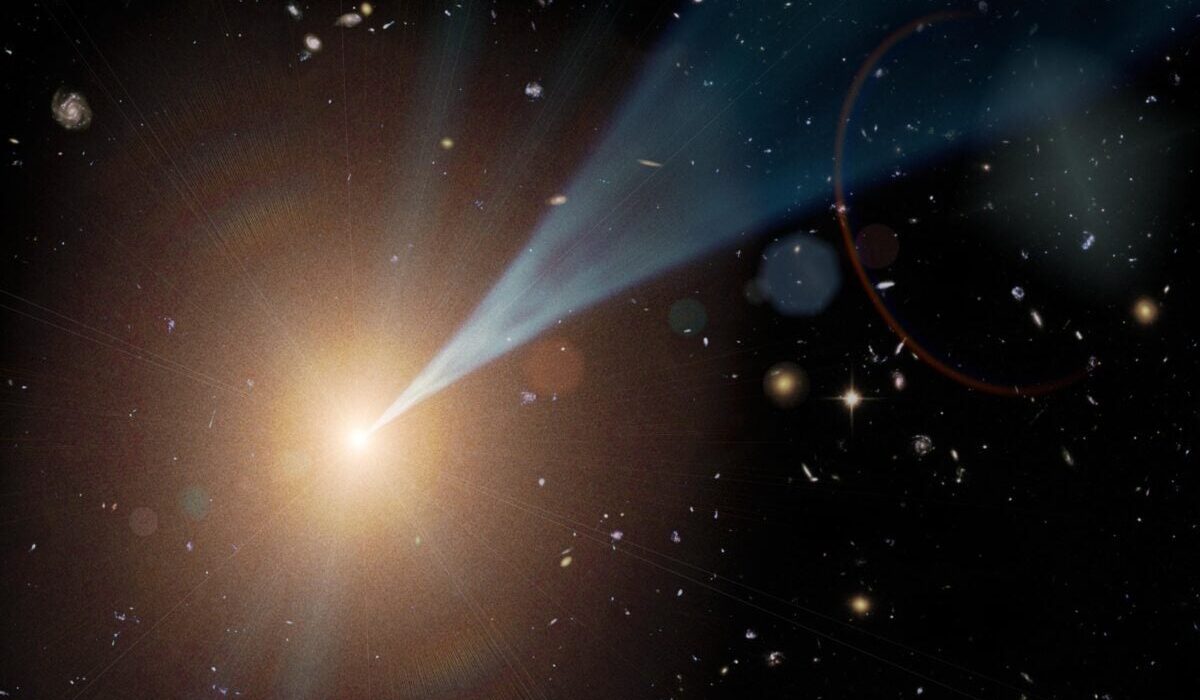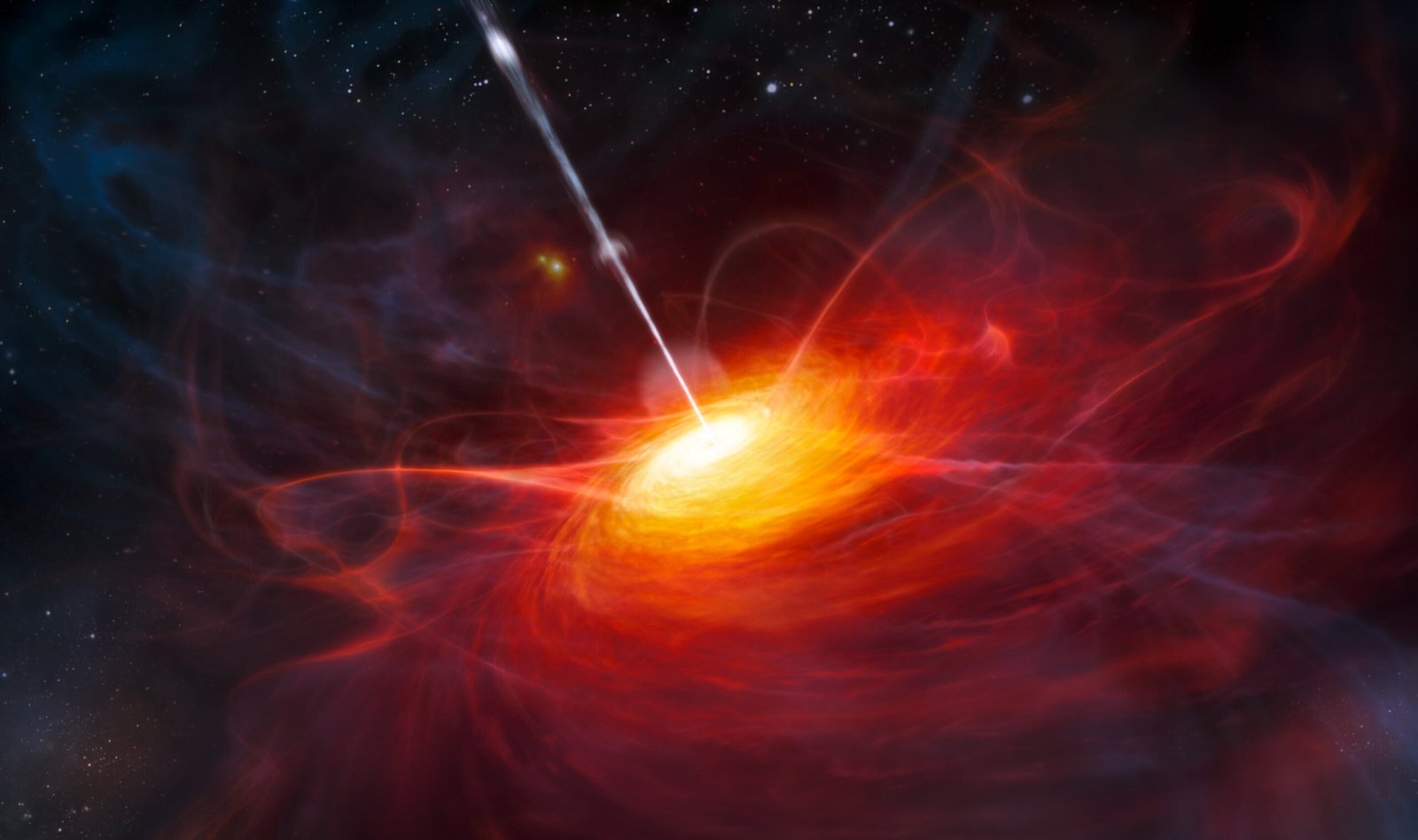
In the vast, mysterious reaches of the universe, there lies a quasar named ID830, an object so extraordinary that it might just redefine how we think about some of the most powerful forces in existence. It’s a star-like entity, but don’t be fooled by its appearance. What seems like a distant point of light is actually an active galactic nucleus (AGN) that blazes with unimaginable energy, fueled by a supermassive black hole at its heart. Scientists have just uncovered startling new details about this quasar, revealing it to be the most X-ray luminous radio-loud quasar ever discovered.
ID830, located far beyond our own galaxy, at a redshift of 3.43, is pushing the boundaries of what we know about the universe. The international team of astronomers who studied it—led by Sakiko Obuchi of Waseda University in Tokyo—used some of the most sophisticated tools at their disposal to peer into the quasar’s complex behavior, from the ground-based telescopes to the Spektr-RG spacecraft in orbit.
The Power of Light
Quasars are known for their intense radiance, outshining entire galaxies with the energy they radiate. This particular quasar, ID830, has a bolometric luminosity that reaches an astounding level of around one quindecillion erg per second—an incomprehensibly large amount of energy. To put it in perspective, a single erg is a tiny amount of energy, but when you’re dealing with one quindecillion of them, you’re talking about the kind of power that could outshine entire galaxies.
What makes ID830 so interesting, however, is the nature of its energy production. It likely houses one of the most massive supermassive black holes ever observed—possibly reaching near the maximum mass limit of 10 billion solar masses. Or perhaps it’s in a super-Eddington accretion phase, a state in which the black hole is pulling in matter at an accelerated rate. Either way, ID830’s intense luminosity is no ordinary feat.
To get to the heart of the mystery, Obuchi and her team decided to investigate further by combining data from multiple sources. They turned to eROSITA X-ray spectroscopy, SDSS, Subaru/MOIRCS rest-frame ultraviolet–optical spectra, and extensive radio data from various observatories. With these tools, they uncovered the true scale of ID830’s power, revealing that this quasar is not just bright, but uniquely bright in X-rays, pushing the limits of what we thought was possible.
A Glowing Giant
ID830’s X-ray luminosity reached an astonishing 0.01 quindecillion erg per second, which makes it one of the most X-ray luminous radio-loud quasars ever detected. Bolometric luminosity, another measure of a quasar’s total energy output, was found to be around 0.076 quindecillion erg/s. The result? An Eddington ratio of 1.4, which indicates that the quasar is undergoing super-Eddington accretion—a process in which the black hole pulls in more material than what is traditionally thought possible.
This discovery sheds new light on the behavior of supermassive black holes. Not only is ID830 incredibly luminous, but it’s also in a unique phase of accretion. The team noted that the quasar is “in a transitional phase,” where the black hole’s corona and jet are energized simultaneously following a burst of accretion. In simpler terms, it’s like a cosmic engine that’s firing on all cylinders, displaying a level of complexity that scientists hadn’t fully expected.
Revealing the Inner Workings
The team’s research also showed that ID830 has some unusual characteristics, including a moderate level of reddening—about 0.39 magnitudes. This may suggest that the quasar’s light is being partially obscured by intervening dust or gas. However, the biggest revelation came from the quasar’s ultraviolet-to-X-ray luminosity ratio. This ratio, calculated to be -1.2, is higher than that of other quasars in the same super-Eddington phase. It indicates that ID830’s energy output in the ultraviolet and X-ray parts of the spectrum is particularly well balanced, suggesting a more dynamic, energetic process at play.
Another eye-catching detail is the kinetic power of ID830’s jet, which was estimated to be in the range of 1 to 10 quattuordecillion erg per second. This is comparable to its radiative luminosity, a rare feat for a quasar. The implication here is that the mechanical energy from the jet is efficiently interacting with the surrounding interstellar medium, possibly influencing the environment around the quasar in ways that researchers are only beginning to understand.
A Bridge Between Quasar Phases
The team’s findings point to something truly remarkable: ID830 might represent a new phase in quasar evolution. They describe it as a “post-burst super-Eddington quasar bridging the gap between sub-Eddington quasars and the X-ray weak, rapidly accreting ‘little red dots.’” These little red dots are an emerging class of early AGNs recently identified by the James Webb Space Telescope (JWST).
In essence, ID830 is something of a cosmic intermediary, showing characteristics of both older, well-established quasars and newer, still-mysterious objects that are just beginning to be studied in detail. This transitional phase provides astronomers with a rare window into the dynamic processes that occur when a quasar is shifting from one phase of its life cycle to another.
Why This Matters
At first glance, studying quasars like ID830 might seem like an exercise in abstract science, disconnected from our daily lives. However, this research is far more important than it might appear. Quasars like ID830 are not just spectacular in their energy output—they’re also one of the few clues we have to understanding how supermassive black holes evolve and influence their surrounding galaxies.
By studying the behaviors of quasars in various phases of accretion, astronomers can gain insights into the processes that govern galaxy formation and growth. Understanding the relationship between the black hole at the heart of a quasar and the surrounding galactic environment can also shed light on how galaxies themselves are shaped by these invisible giants.
In the case of ID830, the quasar’s transitional phase gives scientists a unique opportunity to observe how a black hole might evolve, potentially offering answers to some of the deepest questions in astrophysics. The work of Obuchi and her team highlights how each new discovery adds a piece to the puzzle of our universe, bringing us closer to understanding the profound forces that govern everything from the stars in our own galaxy to the most distant objects in the universe.
Through this research, we are reminded that even in the vast, cold expanses of space, there are phenomena that hold the potential to redefine our place in the cosmos.
More information: Sakiko Obuchi et al, Discovery of an X-ray Luminous Radio-Loud Quasar at z=3.4: A Possible Transitional Super-Eddington Phase, arXiv (2025). DOI: 10.48550/arxiv.2511.05029