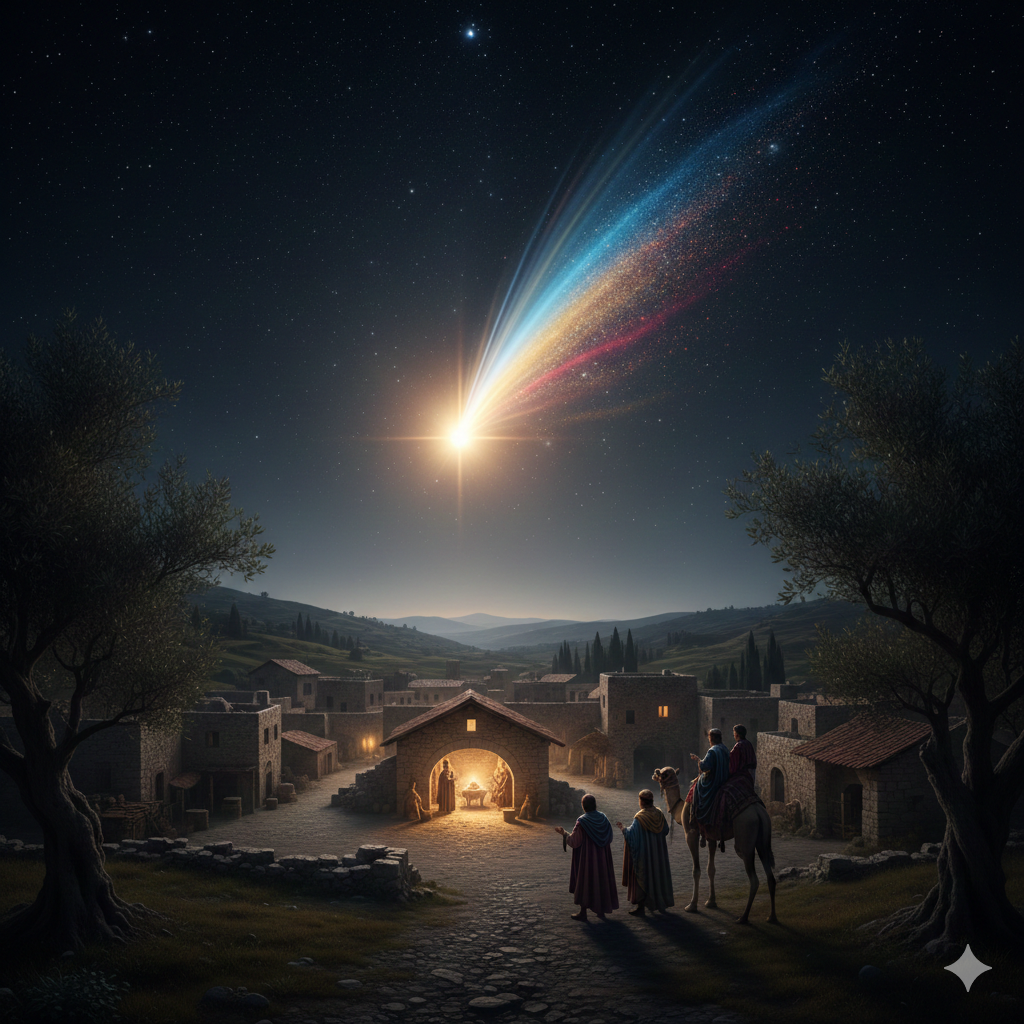
For centuries, the Star of Bethlehem has hovered between faith and mystery. It shines briefly in the biblical story, guiding the Magi across unfamiliar lands, then fades back into legend. Many have tried to pin it down, to match that strange guiding light with something concrete in the sky, something that obeys the laws of nature rather than miracle alone. Yet every attempt seemed to stumble over one stubborn detail: the star’s motion made no sense.
The Gospel of Matthew does not describe a star that simply rose and set like all others. It describes something far stranger, something that moved with intention. It appeared in the east, traveled before the Magi, and then seemed to stop directly over Bethlehem. For generations, astronomers and historians shook their heads. Stars do not behave this way. Planets do not behave this way. So perhaps, many said, it never happened at all.
Now, a new study published in the Journal of the British Astronomical Association has reopened the question with quiet confidence. By following a trail of ancient records and careful simulations, the researchers suggest that the Star of Bethlehem may have been neither myth nor miracle, but something rarer and more subtle: a comet described in a Chinese historical text, moving in a way that only briefly aligns with Earth itself.
When Scripture Meets the Sky
The story begins with a close reading of Matthew’s words. The text does not insist that the object was a star in the modern astronomical sense. It uses a term that could refer to any celestial phenomenon. What matters most is how it behaved.
The researchers focused on the line describing how the star “went before them, till it came and stood over where the young child was.” They examined not just the words but the implied perspective of the travelers watching the sky night after night. In their analysis, they write, “The passage indicates that after the Star appeared to precede the Magi on their short journey to Bethlehem, it reached a position over the town, perhaps overhead near the zenith, where its motion came to a noticeable stop for a period coincident with their arrival.”

This apparent pause is the heart of the mystery. Under normal circumstances, celestial objects appear to move because Earth rotates. Everything rises in the east and sets in the west, night after night, with dependable regularity. Nothing stops.
Faced with this contradiction, scholars have traditionally fallen into three camps. Some argue the story is symbolic, crafted to convey meaning rather than history. Others accept it as a miracle, outside the bounds of natural explanation. The third group, smaller but persistent, wonders whether nature itself might offer a rare but real solution.
A Pause Written Into Motion
The idea that a celestial object could appear to stop in the sky is not entirely impossible. There is one special circumstance where motion and perspective cancel each other out. If an object moves around Earth at exactly the same rate Earth rotates, it would appear frozen in place, hovering over one spot.
This kind of geosynchronous motion is familiar today through satellites, but it can also occur naturally under extraordinary conditions. A comet, if positioned just right and moving at the right velocity, could briefly mimic this effect. For a few precious hours, it could seem to stand still against the stars.
Over the years, several comets were proposed as candidates. Halley’s Comet was an early favorite, but its timing and position failed to align with the biblical account. None of the usual suspects fit the narrow window required by history and motion alike.
So the authors of the new study went back to the records, searching not Western chronicles but Eastern ones, where astronomers meticulously documented the sky.
A Clue Hidden in Ancient Ink
Their search led them to the Han Shu, or History of the Former Han Dynasty, a Chinese document that recorded celestial events with remarkable care. Within its pages, they found a brief but intriguing reference to a “broom star,” an ancient term for a comet.
The timing was precise. The text places the appearance of this comet in the “second month” of the “second year.” Translating this into modern terms, the researchers explain, “The ‘second month’ of the ‘second year’ corresponds to the Chinese lunar month spanning 5 BCE [from] March 9 to April 6, which falls neatly within the estimated window for Jesus’s birth. Being visible ‘for over 70 days’ suggests that the object was likely bright.”
This single passage suddenly aligned several scattered pieces. A bright comet, visible for weeks, appearing in the right era and recorded independently of the biblical narrative, offered a tantalizing possibility. It did not yet explain the strange stopping motion, but it gave the researchers something solid to test.
Replaying the Sky of 5 BCE
With this historical anchor, the team turned to simulations. They generated possible orbits for a comet that could match the Chinese observation and then examined how such a comet would have appeared from Earth.
The results were striking. Their numerical modeling showed that this comet could have passed close enough to Earth in June of 5 BCE to create the illusion of geosynchronous motion. For a brief window, the comet’s movement through space would have matched Earth’s rotation closely enough to make it seem motionless in the sky.
The best-fit orbit suggested that the comet would have appeared nearly stationary over Bethlehem for about two hours. Not days, not weeks, but long enough to be noticed by travelers arriving in a small town at night. Long enough to be remembered.
This does not require the comet to literally stop moving. It requires only the delicate alignment of speed, distance, and perspective. In the language of astronomy, it is rare. In the language of human experience, it is unforgettable.
Reading Meaning in the Heavens
Yet another question lingered. Even if a comet behaved this way, why would it inspire the Magi to begin their journey in the first place? Comets, after all, have often been seen as bad omens.
The researchers confronted this criticism directly. They examined ancient astrological traditions from Greco-Roman and Mesopotamian cultures, looking for clues about how comets were interpreted in the world the Magi inhabited.
They acknowledge the skepticism clearly. “A major criticism of the comet hypothesis is that ancient astrologers interpreted the omens associated with their appearance as harbingers of evil, rather than as signs of good tidings such as a new king. However, closer examination of comet omens will show that interpretations of comet appearances were not always negative,” the study authors explain.
In their analysis, they found texts suggesting that comets could be linked to events within royal families, especially in client kingdoms connected to larger empires. Such an interpretation could have framed the appearance of a bright comet as a sign of political or dynastic change rather than disaster.
Within this worldview, a comet appearing in a specific region of the sky could plausibly be read as signaling the birth of a new Judean king. This cultural context does not prove that the Magi interpreted it this way, but it makes their response understandable within their time.
Between Certainty and Possibility
The researchers are careful not to claim final answers. They do not insist that the comet recorded in the Han Shu was definitively the Star of Bethlehem. History at this distance resists certainty.
What they do claim is narrower and, in its own way, more powerful. They argue that such an object could have existed and could have behaved exactly as Matthew described. The story no longer requires dismissal on astronomical grounds alone.
As they conclude, “This study shows that it is no longer justifiable to claim that ‘no astronomical event’ could possibly have behaved in the manner described by Matthew.”
In that sentence lies the quiet shift. The boundary between myth and nature becomes less rigid, more permeable.
Why This Search Still Matters
This research matters not because it proves a miracle or disproves one, but because it demonstrates how ancient stories and modern science can speak to each other without shouting. It shows that careful reading, historical humility, and rigorous modeling can reopen questions we thought were settled.
The Star of Bethlehem has endured for over two millennia not because of certainty, but because of wonder. By showing that the sky itself might have offered a rare and dramatic display, this study preserves that wonder while grounding it in possibility.
It reminds us that ancient observers were not naïve, that they watched the heavens closely and recorded what they saw with care. It reminds us that the universe is capable of moments so unusual that they echo through history. And it reminds us that science does not strip stories of meaning; sometimes, it gives them new depth.
In the end, the light above Bethlehem may never be fully claimed by either faith or physics alone. But thanks to this research, it no longer stands isolated from the natural world. It becomes part of the same sky we still look up at today, a sky that continues to surprise us when we dare to look closely enough.
More information: Mark Matney, The star that stopped: The Star of Bethlehem & the comet of 5 BCE, Journal of the British Astronomical Association (2025). DOI: 10.64150/193njt