For years, scientists have marveled at the supermassive black hole at the center of our galaxy, Sagittarius A*. It is a force of nature so powerful that it can tear apart anything that strays too close—stars, gas clouds, even light. Or so we thought. A new study from an international research team, led by PD Dr. Florian Peissker at the University of Cologne, has just overturned our understanding of these destructive forces at the heart of the Milky Way. The team, using a cutting-edge observation instrument called ERIS at the Very Large Telescope (VLT) in Chile, has shown that some of the objects closest to Sagittarius A* are not being devoured as once expected. Instead, they are following stable orbits, raising intriguing questions about the true nature of our galaxy’s chaotic center.
From Destruction to Stability
For years, astronomers believed that certain celestial objects—especially “dusty objects” like the mysterious G2—were destined for a violent end. G2, a peculiar object made of gas and dust, was once thought to be a cloud that would be ripped apart by the tidal forces of Sagittarius A*. It seemed a textbook case of what happens when something ventures too close to a supermassive black hole: spaghettification, a process where objects are stretched and torn into long, thin strands before being consumed by the black hole. Many assumed G2 would meet this grim fate.
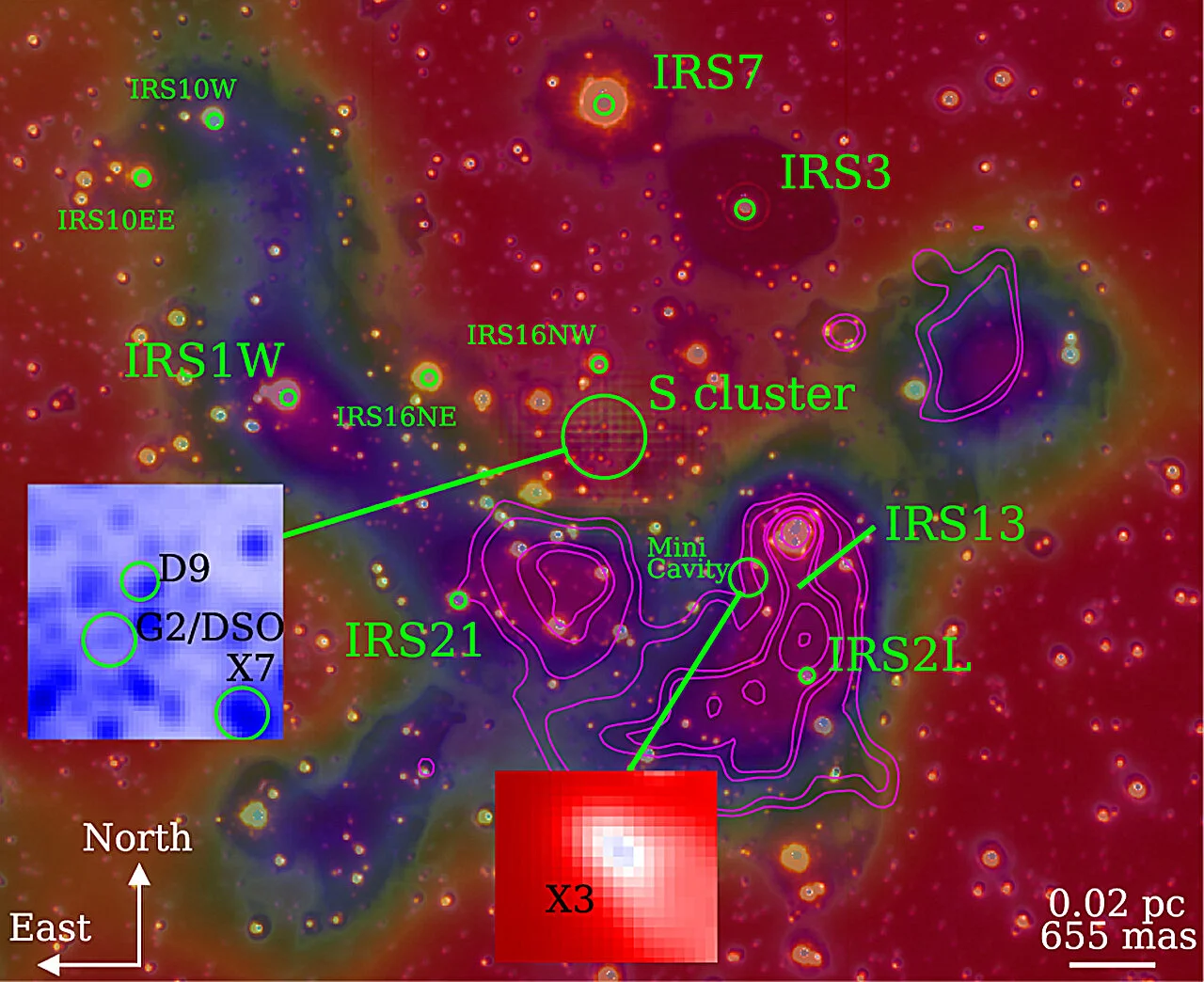
But the new data from the ERIS instrument tells a very different story. “The specific observations we made with ERIS, which captures radiation in the near-infrared range, show that G2 follows a stable orbit,” Dr. Peissker explains. This finding is a game-changer. Instead of being torn apart, G2 is circling Sagittarius A* in a way that suggests there’s a star at its heart—hidden within the dust cloud all along. This insight challenges the old assumptions and reveals that, far from being a death trap, the heart of the Milky Way may also be a place where stars can survive, even thrive.
The Surprising Resilience of D9
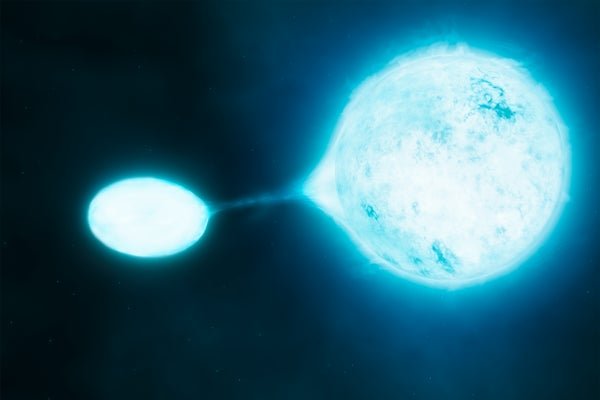
But G2 was just the beginning. The team’s observations didn’t stop there. They turned their attention to other “dusty objects” and unusual bodies near the black hole, including the binary star system D9, which was discovered by Peissker’s team in 2024. The existence of D9 is significant because it is the first known binary star system to be observed so close to a supermassive black hole. In theory, the gravitational forces at play should have torn D9 apart, or at least caused the stars within it to merge into one more massive star. Yet, the team’s observations show that D9 remains remarkably stable.
This stability raises fascinating questions. Could it be that the tidal forces from Sagittarius A*—while immense—are not as destructive as previously thought? Could they, in fact, help maintain the integrity of such systems? Dr. Peissker notes, “The fact that these objects move in such a stable manner so close to a black hole is fascinating.” It seems that the heart of the Milky Way is not only a place of destruction but one of surprising stability, where objects can survive and orbit with grace.
X3, X7, and the Unexpected Stability
Alongside D9, other objects like X3 and X7 have also been found to maintain stable orbits near Sagittarius A*. These objects, long thought to be fragile, are now revealed to be more resilient than earlier models had suggested. The tidal forces of a supermassive black hole, which were once believed to wreak havoc on anything within their reach, seem to have less of an effect than scientists had anticipated.
Dr. Michal Zajaček from Masaryk University in Brno, Czech Republic, adds another layer to this discovery. “The supermassive black hole at the center of the Milky Way has not only the capability to destroy stars but it can also stimulate their formation or the formation of pretty exotic dusty objects, most likely via mergers of stellar binaries.” The team’s findings suggest that the region around Sagittarius A* might be a dynamic, even fertile, environment where stars can form, merge, and evolve—something no one had anticipated from such an extreme and dangerous setting.
A More Complex Galactic Center
These new observations are causing scientists to rethink the role of supermassive black holes in the life cycle of stars and other celestial objects. Far from being purely destructive, Sagittarius A* appears to be a place of both creation and destruction, where the forces at play are far more complex than previously assumed. The interaction between the black hole and its surroundings might not just tear apart what comes too close but could also lead to the formation of new stars and the stabilization of systems that we once thought would inevitably be destroyed.
“This makes the center of our galaxy an ideal laboratory for studying the interactions between black holes and stars,” says Dr. Peissker. The more we understand about how objects behave near Sagittarius A*, the more we learn about the intricate processes that govern not just the heart of our galaxy, but perhaps the behavior of other galaxies as well.
What Does This All Mean?
So, why does this research matter? At its core, this study changes the way we view the center of our galaxy. Sagittarius A* was once considered a destructive force that left nothing in its wake but shredded remnants. But now, thanks to ERIS and the new data, we realize that the galactic center is a place of both immense chaos and unexpected stability. The ability of objects like G2, D9, X3, and X7 to maintain stable orbits shows that, while the black hole is certainly a powerful force, it is not an all-consuming one. Instead, Sagittarius A* is a region where cosmic forces interact in complex and fascinating ways—where stars, dust, and gas can endure, evolve, and even thrive.
This discovery doesn’t just refine our understanding of the Milky Way’s center; it opens the door to new ways of studying the forces that shape galaxies. As future observations from ERIS and the upcoming Extremely Large Telescope (ELT) come online, scientists will continue to track these objects, unlocking more secrets about how stars survive—and sometimes even thrive—in the extreme environments of the universe. This research brings us one step closer to understanding the balance between creation and destruction in the universe and reminds us that even in the most extreme environments, there are surprises waiting to be uncovered.
More information: F. Peißker et al, Closing the gap: Follow-up observations of peculiar dusty objects close to Sgr A*using ERIS, Astronomy & Astrophysics (2025). DOI: 10.1051/0004-6361/202556229