Deep in the heart of space, far beyond our Milky Way galaxy, lies a distant cosmic object that has recently become the focus of intense scientific scrutiny. The object in question is a blazar—specifically, TXS 2013+370. Blazars are some of the most fascinating and mysterious objects in the universe, and TXS 2013+370 is no exception.
Blazars are compact, energetic quasars with relativistic jets of particles that are pointed almost directly at Earth. These jets make them bright, powerful sources of gamma-rays, one of the most energetic forms of light. Unlike most astronomical objects, blazars are so aligned that their jets are aimed directly at us, making them exceptionally visible, and their radiation can be overwhelmingly intense.
Recently, astronomers observed TXS 2013+370 in a way that no one had done before. Thanks to a cutting-edge technique known as Very Long Baseline Interferometry (VLBI), researchers captured a gamma-ray flare from this distant blazar in unprecedented detail. The flare was extraordinary—so powerful that it added a new chapter to our understanding of these mysterious objects. What they discovered, however, goes far beyond the flare itself, revealing intriguing details about the structure of the blazar and the behavior of its energetic jets.
The Gamma-Ray Flare That Sparked the Investigation
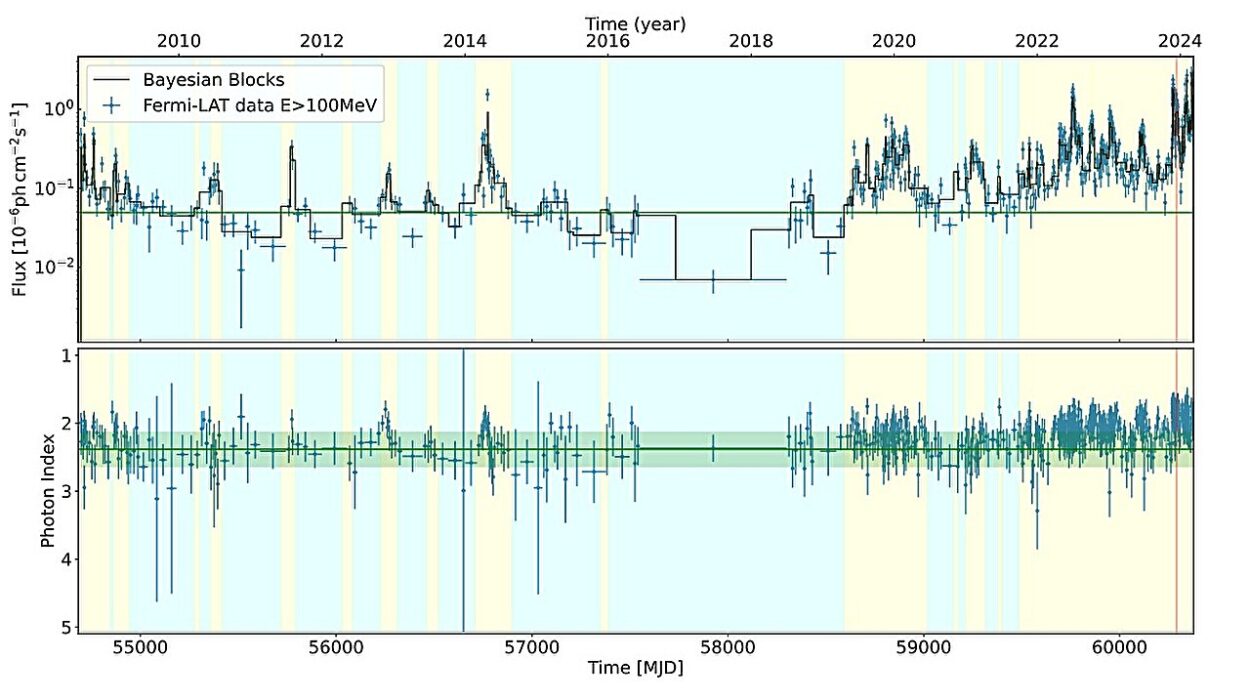
The story began on December 6, 2020, when TXS 2013+370 started to emit an unusually high level of gamma-rays. Over time, this increased activity evolved into a full-fledged gamma-ray flare—an outburst of energy so intense that it caught the attention of astronomers around the world.
Giorgos Michailidis, a lead researcher from the Aristotle University of Thessaloniki in Greece, and his team decided to focus their efforts on capturing this flare with the most advanced observational tools available. They chose to use the Very Long Baseline Array (VLBA), a network of radio telescopes scattered across the globe, to perform very long baseline interferometry (VLBI). This method allowed them to observe the blazar with an angular resolution so fine that it could reveal details on scales smaller than the size of our solar system—down to about 0.1 milliarcseconds.
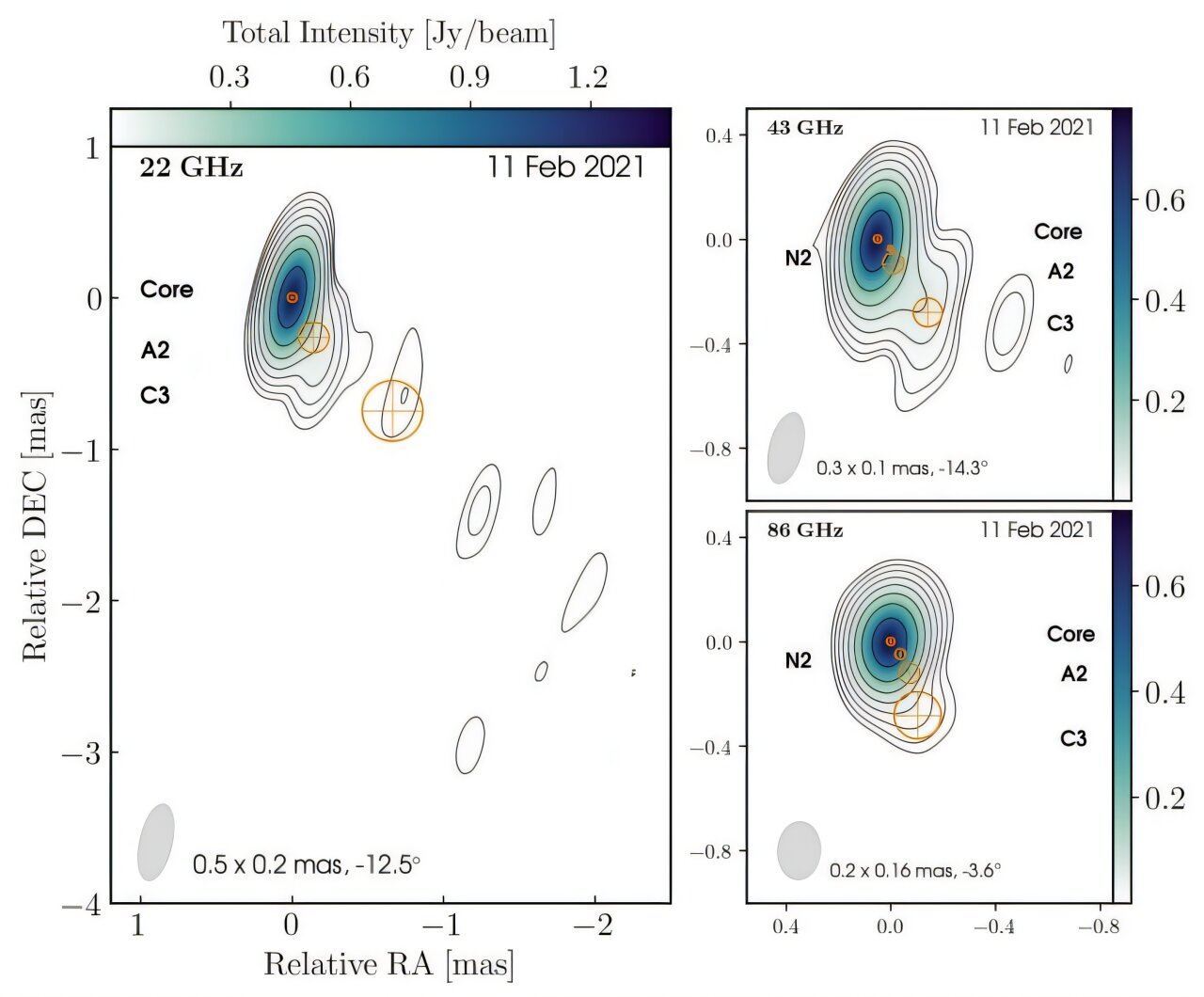
On February 11, 2021, the team took their observations, capturing the flare in real-time. What they found was groundbreaking: the gamma-ray emission from TXS 2013+370 was not only exceptionally bright but also rich in detail. It was the first multi-frequency polarimetric VLBI study of the blazar, and it would open the door to a deeper understanding of the object’s internal structure and behavior.
Discovering the Structure of the Blazar’s Jet
What emerged from the detailed observations was an intricate picture of the blazar’s jet structure. The images revealed that TXS 2013+370 is a compact, core-dominated source. In simpler terms, most of the energy emitted by the object comes from its central core. Surrounding this bright core, astronomers saw a curved jet extending southwestward—a powerful flow of particles traveling at nearly the speed of light.
The team was able to distinguish several components of the jet, each with its own unique characteristics. At higher frequencies, the structure became increasingly well-resolved, allowing the scientists to see the fine details of the jet. One of the most exciting discoveries was the emergence of a new jet component, labeled “N2,” which appeared just 60 microarcseconds away from the blazar’s core. This newly emerged component was a significant clue in understanding the processes at play within the jet.
The formation of this new component was linked to enhanced multi-wavelength activity, suggesting that something important was happening within the jet itself. The addition of this feature further confirmed that blazars like TXS 2013+370 are dynamic, ever-changing objects that can evolve in ways that astronomers are still learning to track and interpret.
Where the Gamma-Ray Emission Comes From
One of the most intriguing aspects of this research was the discovery of the location of the gamma-ray emission. The team found that the site of the gamma-ray flare lies just beyond the broad-line region (BLR) of the blazar. In simpler terms, the gamma-ray emission happens in a region further out from the blazar’s central black hole than expected. This was a key piece of the puzzle.
The emission site was not inside the central black hole’s “dusty torus,” where previous theories might have placed it. Instead, the gamma-ray flare was linked to a process known as external Compton (EC) emission. In this process, infrared photons from the blazar’s dusty torus are intercepted by the jet and scattered to much higher, gamma-ray energies. This explains the high-energy outbursts that make blazars such powerful gamma-ray sources.
Moreover, the study revealed an interesting connection between the gamma-ray and radio emissions. The researchers discovered a time lag between the two, with the gamma-ray flare leading the radio emission by about 102 days. This observation suggests that high-energy processes in the blazar’s jet lead the radio emission, offering more clues about the dynamics of the jet and how energy propagates within it.
The Bigger Picture: What the Research Reveals
By comparing the flare of 2021 with a similar one from 2009, the team noted that the gamma-ray emission occurred in the same subparsec or parsec-scale region of the jet. This discovery suggested that the observed lag between the flare and the radio emission was likely not due to a moving dissipation site within the jet, but rather changes in the opacity conditions of the jet.
This deeper understanding of the gamma-ray flare from TXS 2013+370 provides astronomers with a more detailed picture of how these objects work. It sheds light on the behavior of jets from supermassive black holes, which are key players in some of the most energetic phenomena in the universe. Blazars like TXS 2013+370 are some of the brightest and most energetic objects known, and by studying their flares, astronomers can uncover the complex processes that drive them.
Why This Research Matters
The importance of this research goes far beyond the specific case of TXS 2013+370. Blazars are among the most extreme and mysterious objects in the universe. Their jets, traveling close to the speed of light, are capable of producing gamma-rays, and understanding the structure and behavior of these jets can help scientists decipher some of the universe’s most fundamental processes. The ability to capture and analyze these high-energy flares in such detail offers a unique window into the heart of these distant, powerful objects.
By understanding the processes within blazars, astronomers hope to gain insights into the nature of supermassive black holes, the jets they produce, and the mechanisms behind the most energetic phenomena in the universe. This research adds another piece to the puzzle of how these distant objects interact with their surroundings, and it could lead to new discoveries that shape our understanding of astrophysics for years to come.
Ultimately, studies like this allow us to peer deeper into the universe, unveiling the secrets of its most powerful and enigmatic objects. The flare from TXS 2013+370 is just one of many cosmic events that continue to challenge our understanding, pushing the boundaries of human knowledge and inspiring future generations of scientists to look even further into the cosmos.
More information: Giorgos Michailidis et al, Catching the 2021 γ-ray flare in the blazar TXS 2013+370, arXiv (2025). DOI: 10.48550/arxiv.2511.15601