Far from Earth, 730 light-years away, a small, dead star drifts through the galaxy, following the same slow orbit around the Milky Way’s center as countless others. By every rule astronomers thought they understood, this star should be calm, subdued, almost invisible in its final stage of life. Instead, it is wrapped in a glowing arc of gas and dust, a cosmic wave frozen in motion. When astronomers first saw it, they knew immediately that something was wrong in the best possible way.
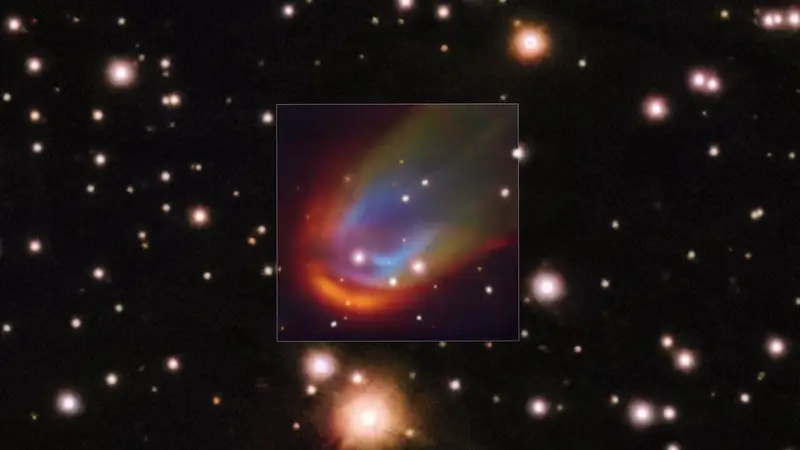
The star is called RXJ0528+2838, and what surrounds it is a shock wave so striking that it has left scientists searching for answers. Using the European Southern Observatory’s Very Large Telescope, researchers captured images of a structure that should not exist around such a star. The discovery is visually beautiful, but scientifically unsettling. It forces a question that echoes through the study: how can a dead star create something so alive with motion?
The Moment the Universe Broke the Rules
“We found something never seen before and, more importantly, entirely unexpected,” says Simone Scaringi, one of the scientists who led the research. His words reflect more than excitement. They reveal disbelief. The observations show a powerful outflow of material streaming away from RXJ0528+2838, carving a curved shape through the surrounding gas of space.
Astronomers use the word outflow to describe matter ejected from celestial objects. These outflows are not unusual in astronomy, but they are deeply tied to specific conditions. RXJ0528+2838 does not meet those conditions. According to everything scientists know, it should not be able to produce an outflow strong enough to shape its environment. And yet, there it is, clearly visible, glowing against the dark.
“This discovery challenges our understanding of how dead stars interact with their surroundings,” the researchers explain. The universe has presented a contradiction, and contradictions are where science begins to evolve.
A Bow Shock Like a Ship in Space
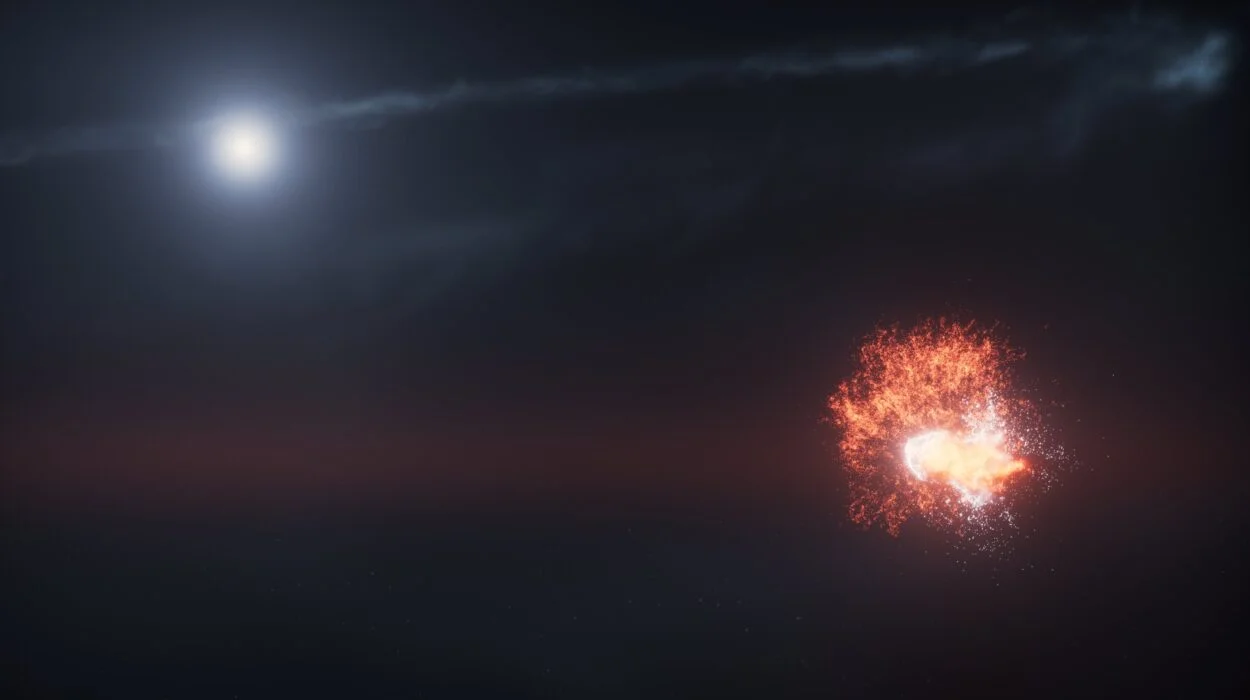
As RXJ0528+2838 moves through the galaxy, it plows into the thin gas that fills the space between stars. This interaction creates a bow shock, a curved arc of material shaped by motion. Noel Castro Segura, part of the research team, describes it as similar to “the wave that builds up in front of a ship.” In space, there is no water, but gas and dust can behave in surprisingly familiar ways.
Bow shocks are usually powered by material flowing outward from a star. That outward push slams into the surrounding medium, compressing and heating it into a glowing arc. In most cases, astronomers can point to a clear source of energy driving the process. But RXJ0528+2838 refuses to cooperate with expectations. None of the known mechanisms fully explain what the telescopes are seeing.
The Nature of a Dead Star
RXJ0528+2838 is a white dwarf, the dense core left behind when a low-mass star reaches the end of its life. It no longer burns fuel in its center. It no longer shines with youthful energy. White dwarfs are remnants, stellar embers cooling over time. This one, however, is not alone.
Orbiting it is a sun-like companion star, locked together in a binary system. In such systems, gravity can pull material from the companion onto the white dwarf. Usually, this stolen matter forms a swirling disk around the dead star. That disk often becomes the engine that powers outflows, jets, and glowing nebulae.
But RXJ0528+2838 shows no signs of a disk. This absence is the heart of the mystery. Without a disk, the standard explanation collapses. There should be no fuel delivery system capable of sustaining a long-lasting outflow. And yet, the bow shock tells a different story.
A Nebula That Should Not Exist
“The surprise that a supposedly quiet, discless system could drive such a spectacular nebula was one of those rare ‘wow’ moments,” Scaringi says. That reaction captures the emotional core of the discovery. Astronomers are trained to be cautious, but sometimes the universe earns a moment of wonder.
The nebula around RXJ0528+2838 is not small or fleeting. Its shape and size suggest that the white dwarf has been expelling material for at least 1,000 years. This is not a brief outburst or a recent accident. It is a sustained process, quietly sculpting space over centuries.
The question becomes unavoidable. If there is no disk, what is powering this long-lived outflow?
Seeing the Mystery More Clearly
The first hint of something unusual came from images taken by the Isaac Newton Telescope in Spain. Astronomers noticed a strange nebulosity, a faint glow with an odd shape. Curiosity led them to look closer, and that closer look changed everything.
Using the MUSE instrument on ESO’s Very Large Telescope, the team mapped the bow shock in detail. MUSE allowed them to analyze not just the shape, but also the composition of the glowing structure. This step was critical. It confirmed that the nebula truly originates from the RXJ0528+2838 system and is not an unrelated cloud drifting by in the foreground or background.
“Observations with the ESO MUSE instrument allowed us to map the bow shock in detail and analyze its composition,” explains Krystian Ilkiewicz, another co-lead author of the study. With this confirmation, the mystery deepened rather than faded.
A Magnetic Shortcut Through Space
One clue stands out. RXJ0528+2838 is known to host a strong magnetic field, and the MUSE data confirmed its presence. This field appears to change the usual rules of matter transfer in binary systems.
Instead of forming a disk, material from the companion star may be channeled directly onto the white dwarf by magnetic forces. The field acts like invisible rails, guiding gas along specific paths. This could explain why no disk is seen, while still allowing matter to fall onto the dead star.
“Our finding shows that even without a disk, these systems can drive powerful outflows,” Ilkiewicz explains. It reveals a mechanism that scientists do not yet understand, one that rewrites the standard picture of how matter moves in these extreme environments.
The Engine That Still Hides
Even with magnetism in the picture, the puzzle is not solved. The data show that the current magnetic field is only strong enough to power a bow shock lasting a few hundred years. That falls short of the 1,000-year timescale implied by the nebula’s size.
Scaringi describes the situation as a “mystery engine.” Something is helping this white dwarf sustain an outflow far longer than expected. The magnetic field may be part of the answer, but it is not the whole story. There is missing physics here, an unseen process quietly shaping space.
This gap between observation and explanation is not a failure. It is an invitation.
Looking Ahead to Deeper Answers
To uncover the nature of these diskless outflows, astronomers know they must look beyond a single system. Many more binary stars need to be studied in similar detail. Patterns may emerge. Exceptions may multiply. Either outcome would be valuable.
The upcoming Extremely Large Telescope will play a key role in this search. With its power, astronomers will be able to map more systems, including fainter ones, and search for similar bow shocks hidden in the galaxy. Each new detection could bring scientists closer to understanding the mysterious energy source that remains unexplained.
Why This Discovery Matters
This research matters because it shows that the universe is still capable of surprising us, even with objects we thought we understood. White dwarfs are among the most studied stellar remnants, yet RXJ0528+2838 demonstrates that they can behave in ways that defy established models.
By revealing a powerful outflow where none should exist, this discovery challenges the foundations of how astronomers think about matter transfer, magnetic fields, and stellar interaction. It reminds us that cosmic systems are not always tidy, and that nature often finds paths we have not imagined.
Most importantly, it proves that discovery does not end when a star dies. Even in its final form, a star can still reshape its surroundings, leaving behind not silence, but a glowing question written across the fabric of space.
Study Details
A persistent bow shock in a diskless magnetised accreting white dwarf, Nature Astronomy (2026). DOI: 10.1038/s41550-025-02748-8