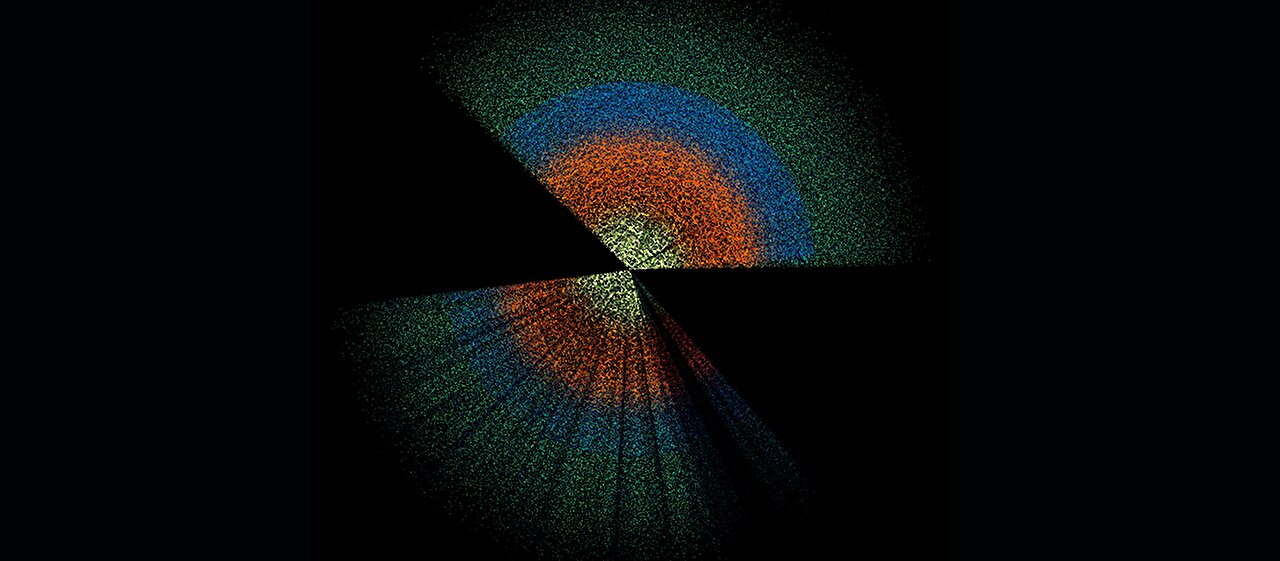
For decades, scientists have been chasing one of the greatest mysteries in modern cosmology: what exactly is dark matter? It neither emits, absorbs, nor reflects light, making it invisible to even the most powerful telescopes. Yet, its presence is undeniable. It shapes galaxies, influences cosmic evolution, and makes up about 85% of the total matter in the universe—five times more abundant than the matter we can see and touch.
Now, a team of researchers led by scientists from the University of Geneva (UNIGE) has taken a bold step toward understanding whether dark matter behaves according to the same physical laws as ordinary matter—or whether it might be governed by an entirely new, unknown force. Their results, published in Nature Communications, bring us closer than ever to grasping how this mysterious cosmic substance interacts with the universe around it.
The Hidden Heart of the Universe
Ordinary matter—the kind that makes up stars, planets, and people—obeys four fundamental forces: gravity, electromagnetism, and the strong and weak nuclear forces. Together, these forces explain nearly every physical phenomenon observed in nature. But dark matter, invisible and ghost-like, refuses to fit neatly into this framework.
For years, physicists have wondered: does dark matter obey the same rules as ordinary matter, or does it feel an additional, hidden “fifth force”? If such a force exists, it could rewrite our understanding of the cosmos and the laws of physics themselves.
“Dark matter could be subject to interactions that ordinary matter cannot experience,” explains Camille Bonvin, associate professor in the Department of Theoretical Physics at UNIGE and co-author of the study. “If a fifth force acts on dark matter, it would change how galaxies move within the gravitational landscape of the universe.”
Testing the Invisible
To explore this idea, the UNIGE team designed a clever experiment based on how galaxies move through the cosmic web of space. The universe is not uniform—it is filled with vast gravitational wells, created by massive celestial structures like galaxy clusters. Ordinary matter falls into these wells, drawn by the pull of gravity, following the well-established equations of Einstein’s general relativity and Euler’s equations of motion.
If dark matter is affected by only gravity, then galaxies—composed mostly of dark matter—should fall into these wells exactly as ordinary matter does. But if there is an extra, unknown force acting on dark matter, its motion would subtly deviate from what gravity alone predicts.
“To answer this question, we compared the velocities of galaxies across the universe with the depth of the gravitational wells they fall into,” says Bonvin. “If a fifth force exists, galaxies would accelerate differently depending on how that force interacts with dark matter.”
By analyzing vast cosmological datasets that record the movement of galaxies and the shape of spacetime itself, the researchers tested whether the laws of motion still held true when dark matter was involved.
The Results: Familiar, Yet Uncertain
The findings were striking. The team discovered that, so far, dark matter appears to fall into gravitational wells in the same way as ordinary matter, following the same fundamental physical laws. In other words, Euler’s equations still hold true for dark matter—at least within the limits of current observations.
This result suggests that dark matter behaves in a way consistent with general relativity, the cornerstone theory that describes how gravity shapes the cosmos. However, the story doesn’t end there.
“At this stage, these conclusions do not yet rule out the presence of an unknown force,” cautions Nastassia Grimm, the study’s first author, who worked at UNIGE and now continues her research at the Institute of Cosmology and Gravitation at the University of Portsmouth. “But if such a fifth force exists, it cannot exceed about 7% of the strength of gravity—otherwise, we would have already detected its effects in our analyses.”
That means the door remains open for new physics. There could still be a hidden interaction, incredibly weak and subtle, shaping the unseen universe in ways we have not yet measured.
The Search for a Fifth Force
The idea of a fifth fundamental force is one of the most exciting possibilities in modern physics. It would not only expand our understanding of the universe but could also help explain some of the biggest unresolved puzzles in cosmology.
A fifth force acting exclusively on dark matter could clarify why galaxies rotate faster than visible matter alone can explain, or why some galactic structures behave differently than expected. It might also provide clues about the early formation of the universe and the mysterious acceleration of its expansion—currently attributed to dark energy.
For now, though, the evidence suggests that if such a force exists, it is extremely faint—far weaker than gravity, the weakest of the known forces. Detecting it will require unprecedented precision, and that’s exactly what the next generation of cosmological experiments aims to achieve.
The Future of the Quest
The researchers are already looking ahead to upcoming surveys that could push the limits of detection even further. Projects like the Legacy Survey of Space and Time (LSST), conducted by the Vera C. Rubin Observatory, and the Dark Energy Spectroscopic Instrument (DESI) will soon provide a flood of new data about billions of galaxies.
These instruments will allow scientists to measure cosmic structures with remarkable accuracy—so fine, in fact, that they could detect forces as small as 2% of gravity’s strength.
“Upcoming data from these experiments will be sensitive to forces much weaker than what we can currently test,” says Isaac Tutusaus, co-author of the study and researcher at the Institute of Space Sciences (ICE-CSIC and IEEC) and the University of Toulouse. “They will allow us to learn even more about the behavior of dark matter, and perhaps uncover hints of new physics hidden in the cosmos.”
The results from LSST and DESI will not only refine measurements of galaxy motion but may also help distinguish between competing theories of dark matter—such as cold dark matter, which behaves like a heavy, slow-moving fluid, and self-interacting dark matter, which could experience subtle internal forces.
The Profound Implications of Understanding Dark Matter
If scientists confirm that dark matter obeys the same laws as ordinary matter, it will reinforce general relativity as the ultimate framework for cosmic dynamics. But if evidence of a fifth force emerges, it could revolutionize physics as profoundly as Einstein’s theories did a century ago.
Such a discovery would point toward a new layer of reality—one that might connect dark matter, dark energy, and the fundamental structure of spacetime itself. It could offer insight into why the universe looks the way it does, why galaxies cluster the way they do, and perhaps even how everything began.
Beyond its scientific implications, this search speaks to something deeply human: our drive to uncover what we cannot see. The universe, vast and mysterious, still holds countless secrets. Dark matter is one of its most tantalizing puzzles—a silent force sculpting the cosmos, whispering truths that lie just beyond our reach.
A Step Closer to the Unknown
The latest findings from the University of Geneva team mark a significant milestone in this cosmic investigation. By confirming that dark matter behaves like ordinary matter within the precision of current instruments, they’ve tightened the boundaries of what’s possible and refined the search for the unknown.
Yet, even as one question edges closer to an answer, countless others arise. What exactly is dark matter made of? Why does it exist in such abundance? And if a hidden force does act upon it, what new dimensions of physics might it reveal?
As humanity continues to peer deeper into the universe—with more sensitive telescopes, more powerful computers, and more daring ideas—the veil that hides dark matter may finally begin to lift. Each new discovery brings us a little closer to understanding the invisible heart of the cosmos and, in doing so, to understanding ourselves.
Because in the end, the search for dark matter is not just a scientific pursuit—it’s a reflection of our endless curiosity, our need to know what lies beyond the stars, and our unyielding desire to make sense of the unseen universe that surrounds us.
More information: Nastassia Grimm et al, Comparing the motion of dark matter and standard model particles on cosmological scales, Nature Communications (2025). DOI: 10.1038/s41467-025-65100-8