Imagine a recording artist with a career so long and so rich that every performance, every improvisation, every subtle shift in tone has been preserved. That is how NASA’s Chandra X-ray Observatory now appears, not as a single instrument frozen in time, but as a living archive of the energetic universe. Over decades of watching the sky, Chandra has collected cosmic recordings that cannot be replayed or reproduced. The universe has moved on, changed its rhythm, altered its light. What remains is the record.
To make sense of this immense collection, scientists have created something like the ultimate album box set. It is called the Chandra Source Catalog, or CSC, and it gathers Chandra’s X-ray observations into a single, searchable compendium. This catalog is not just a list. It is a memory of the universe as Chandra saw it, stretching from its earliest observations through the end of 2020, capturing moments that will never occur in quite the same way again.
Opening the Vault of X-ray Light
The latest release, known as CSC 2.1, reveals the staggering scale of this effort. Within it are more than 400,000 unique compact and extended sources, each one an object or region in space emitting X-rays. Alongside these are over 1.3 million individual detections, showing how often and how persistently Chandra has returned to the same parts of the sky.
Each entry in the catalog carries layers of detail. There are precise positions, telling astronomers exactly where to point their telescopes. There is information about the X-ray energies detected, offering clues about the physical processes at work. This depth allows scientists to treat the CSC not as an endpoint, but as a bridge. By combining Chandra’s X-ray data with observations from other telescopes, including NASA’s James Webb Space Telescope and the Hubble Space Telescope, researchers can assemble a fuller, multiwavelength view of the cosmos.
The catalog transforms individual observations into a coherent story. It lets astronomers trace how sources appear, disappear, brighten, or fade across time. It turns years of focused staring into a dynamic portrait of an ever-changing sky.
A Crowded Heart of the Milky Way
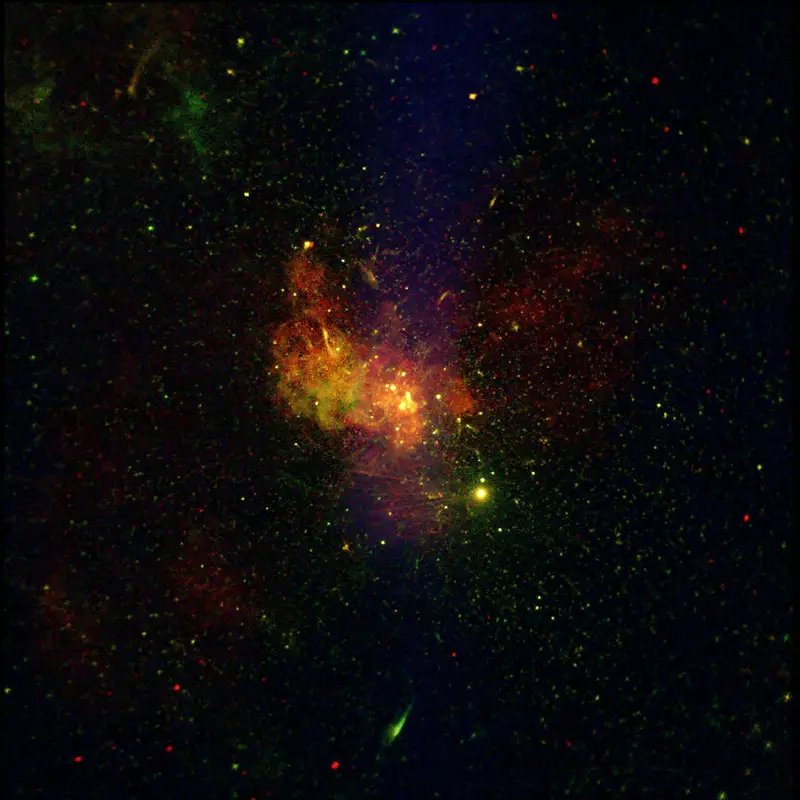
Few places show the power of the Chandra Source Catalog more vividly than the center of our own galaxy. A newly released image of the Galactic Center, the region surrounding the Milky Way’s supermassive black hole known as Sagittarius A*, offers a glimpse into this density of information.
The image spans only about 60 light-years across, a tiny patch when compared to the vastness of the sky. Yet within this small window, Chandra has detected more than 3,300 individual X-ray sources. Each point of light represents an object or event energetic enough to shine in X-rays, crowded together in a region where gravity and motion are intense.
This image did not come from a single glance. It is the sum of 86 separate observations, layered together to create a deeper, clearer view. In total, it represents over three million seconds of observing time, accumulated patiently as Chandra returned again and again to the same region. What emerges is not just a snapshot, but a record of sustained attention, revealing details that would remain hidden in shorter or fewer observations.
When the Sky Becomes Music
The vastness of the Chandra Source Catalog is not limited to images and tables. It has also been translated into sound through a newly released sonification, turning X-ray data into music-like sequences. This approach offers a different way to experience the data, one that emphasizes change and repetition over time.
The sonification is built from a new map that includes 22 years of Chandra observations, beginning from the observatory’s launch and continuing through observations made in 2021. Because many X-ray sources have been observed repeatedly throughout Chandra’s lifetime, these recurring detections are represented as different notes. As time progresses, the sounds shift, echoing how the same regions of the sky have been revisited and re-examined.
The visual counterpart to this sound is a sky map projected in a familiar way, similar to how Earth appears in world maps. The core of the Milky Way sits at the center, with the Galactic plane stretching horizontally across the middle. Each detection appears as a circle, and the size of that circle reflects how many times Chandra has detected X-rays from that location over the years. A year counter at the top of the frame marks the steady passage of time.
…And Beyond
As the video unfolds, something subtle but telling happens. After the year 2021, the text shifts to read “… and beyond.” This small change carries a powerful message. Chandra is not finished. The observatory remains fully operational, continuing to collect new observations that will one day expand the catalog even further.
During the video, a collage of images produced by Chandra gradually fades into the background, a visual reminder of the diversity of scenes captured over the mission’s lifetime. In the final moments, thousands of tiny thumbnail images appear behind the sky map, each one representing a separate Chandra observation. Together, they form a quiet testament to persistence, to the idea that understanding the universe often comes not from a single dramatic moment, but from years of careful watching.
Why This Cosmic Memory Matters
The Chandra Source Catalog is more than a technical achievement. It is a shared memory of the high-energy universe, preserved in a form that scientists around the world can explore and build upon. By gathering decades of X-ray observations into a single, coherent resource, it allows researchers to ask questions that span time as well as space.
This catalog makes it possible to connect the dots between different kinds of light, to see how X-ray sources relate to what other telescopes observe. It captures fleeting cosmic events and long-lasting structures alike, ensuring they are not lost as the universe continues to change. In doing so, it turns Chandra’s long career into something enduring, a back catalog of cosmic recordings that future discoveries will continue to remix and reinterpret.
As Chandra keeps observing, the story does not end. It deepens. And with each new entry added, the catalog grows not just in size, but in meaning, reminding us that the universe we study today will soon become the universe we remember.