For decades, astronomers have watched the sky expecting certain stars to end their lives in a blaze of glory. Massive stars, when they die, are supposed to explode as supernovas—cataclysmic outbursts that briefly outshine entire galaxies. But in a quiet corner of the neighboring Andromeda galaxy, something astonishing happened. A star reached the end of its life… and simply failed to explode.
Instead of detonating in brilliance, it collapsed inward and became a black hole.
This rare cosmic moment has now become the most complete observational record ever made of a star transforming directly into a black hole. By stitching together over a decade of archival data with new observations, astronomers have reconstructed the story of a stellar death that defied expectations. Their findings, published in Science, are already reshaping how we think about how the most massive stars meet their end.
The Vanishing Giant in Andromeda
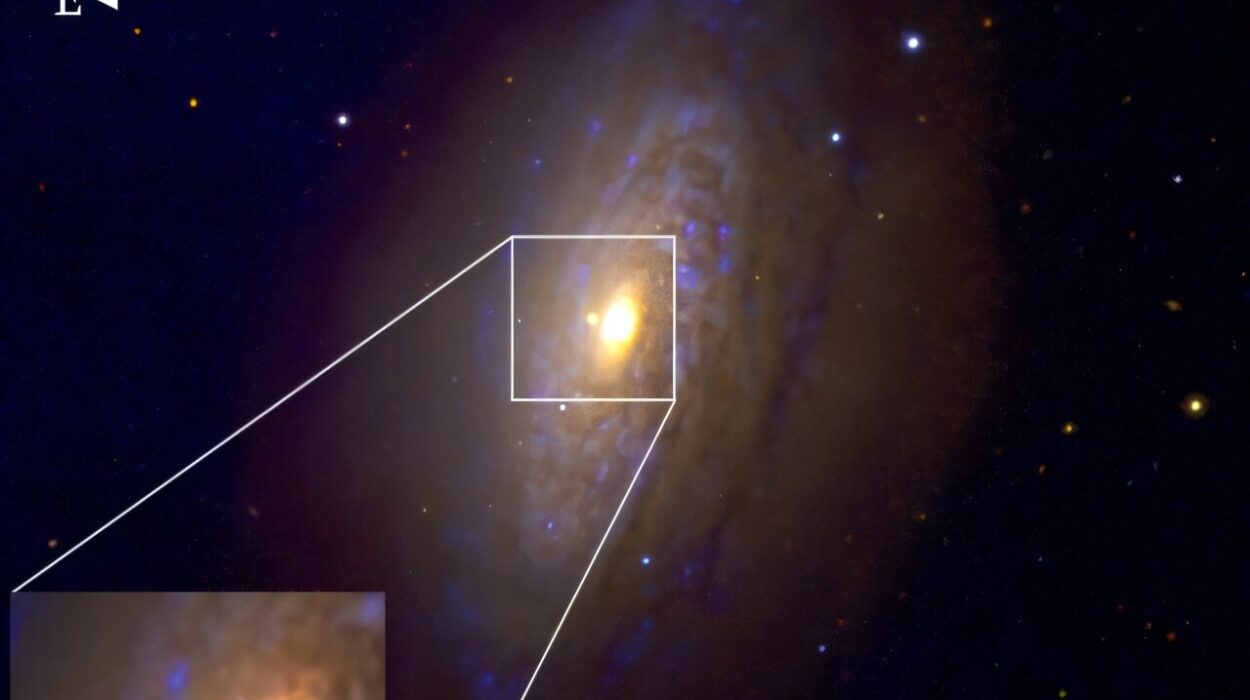
The star at the heart of this mystery was known as M31-2014-DS1, located about 2.5 million light-years away in the Andromeda galaxy. For years, it was one of the most luminous stars in its galactic neighborhood. Then, in 2014, something changed.
Astronomers analyzing data from NASA’s NEOWISE project and other telescopes noticed that the star’s infrared light began to brighten. It was subtle at first, a strange warming glow in wavelengths invisible to the human eye. But by 2016, the star dimmed dramatically—far below its original brightness—in less than a year.
The most shocking twist came later. Observations in 2022 and 2023 revealed that the star had essentially vanished in visible and near-infrared light, becoming just one ten-thousandth as bright in those wavelengths. What remained was detectable only in mid-infrared light, shining at merely one-tenth its former brightness.
Lead researcher Kishalay De from the Simons Foundation’s Flatiron Institute described the emotional weight of the discovery. This star, once a beacon in Andromeda, was now nowhere to be seen. He invited us to imagine if Betelgeuse—a bright, familiar star in our own sky—suddenly disappeared. The sense of cosmic shock would be overwhelming. That, he said, is what happened in Andromeda.
When Gravity Wins
To understand what happened, we have to journey into the heart of a massive star.
Stars live in a delicate balance. At their cores, they fuse hydrogen into helium, generating energy that pushes outward. Gravity, meanwhile, pulls everything inward. For millions of years, these forces counteract each other in a stable truce.
But when a star roughly ten times heavier than our sun begins running out of fuel, that balance falters. The outward pressure weakens. Gravity tightens its grip. The core collapses.
Often, this collapse releases a flood of neutrinos that power a shock wave strong enough to blast the star apart in a supernova. The explosion rips through the star’s outer layers, scattering heavy elements into space.
But sometimes, the shock wave fails.
When it does, theory has long suggested that the stellar material would fall back inward, feeding the collapsed core until it becomes a black hole. For nearly fifty years, scientists have known that black holes exist. Yet, as De notes, we are only beginning to understand which stars turn into black holes—and how.
In the case of M31-2014-DS1, the dramatic fading matched predictions of a star whose core collapsed without a successful explosion. The evidence strongly suggests that instead of erupting, the core imploded and became a black hole.
The Invisible Hand of Convection
But one puzzle remained. If the star collapsed inward, what happened to its outer layers? Why didn’t everything simply plunge straight into the newborn black hole?
The answer lies in a subtle but powerful process called convection.
Inside massive stars, temperatures vary dramatically. The core burns fiercely hot, while the outer regions are far cooler. This difference causes material to churn and circulate, with hot gas rising and cooler gas sinking. Even at the moment of collapse, the star’s outer layers are still in motion.
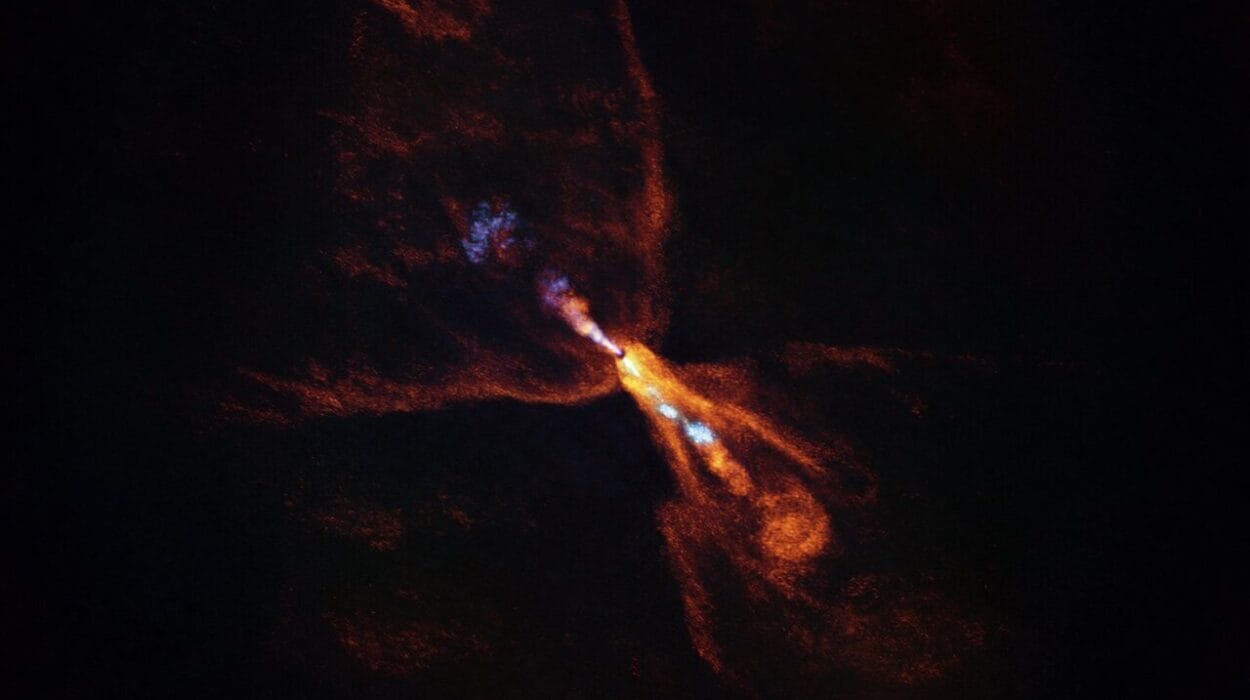
Theoretical models developed at the Flatiron Institute revealed that this convective motion changes everything. When the core collapses, the gas in the outer layers doesn’t fall straight in. Instead, much of it carries angular momentum, meaning it swirls around the forming black hole rather than plunging directly into it.
Flatiron Research Fellow Andrea Antoni had previously developed predictions for how this convection would behave. The new observations provided striking confirmation. The material forms a kind of orbiting disk. Instead of falling inward in months or a year, it takes decades.
This slow spiral alters the entire brightness story. Because the material lingers and gradually feeds the black hole, it creates a brighter and longer-lasting glow than a rapid implosion would have produced.
Only about 1% of the original stellar envelope gas ultimately falls into the black hole, powering the light still visible today. The rest is expelled outward.
Dust, Darkness, and a Lingering Glow
As this expelled material moves away from the intense heat near the black hole, it cools. In that cooling environment, atoms and molecules combine to form dust.
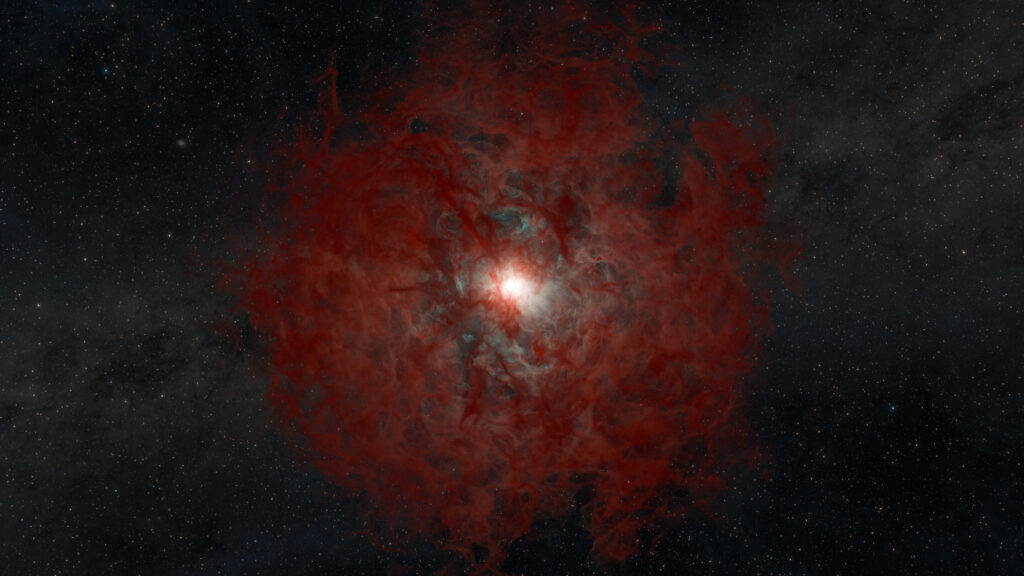
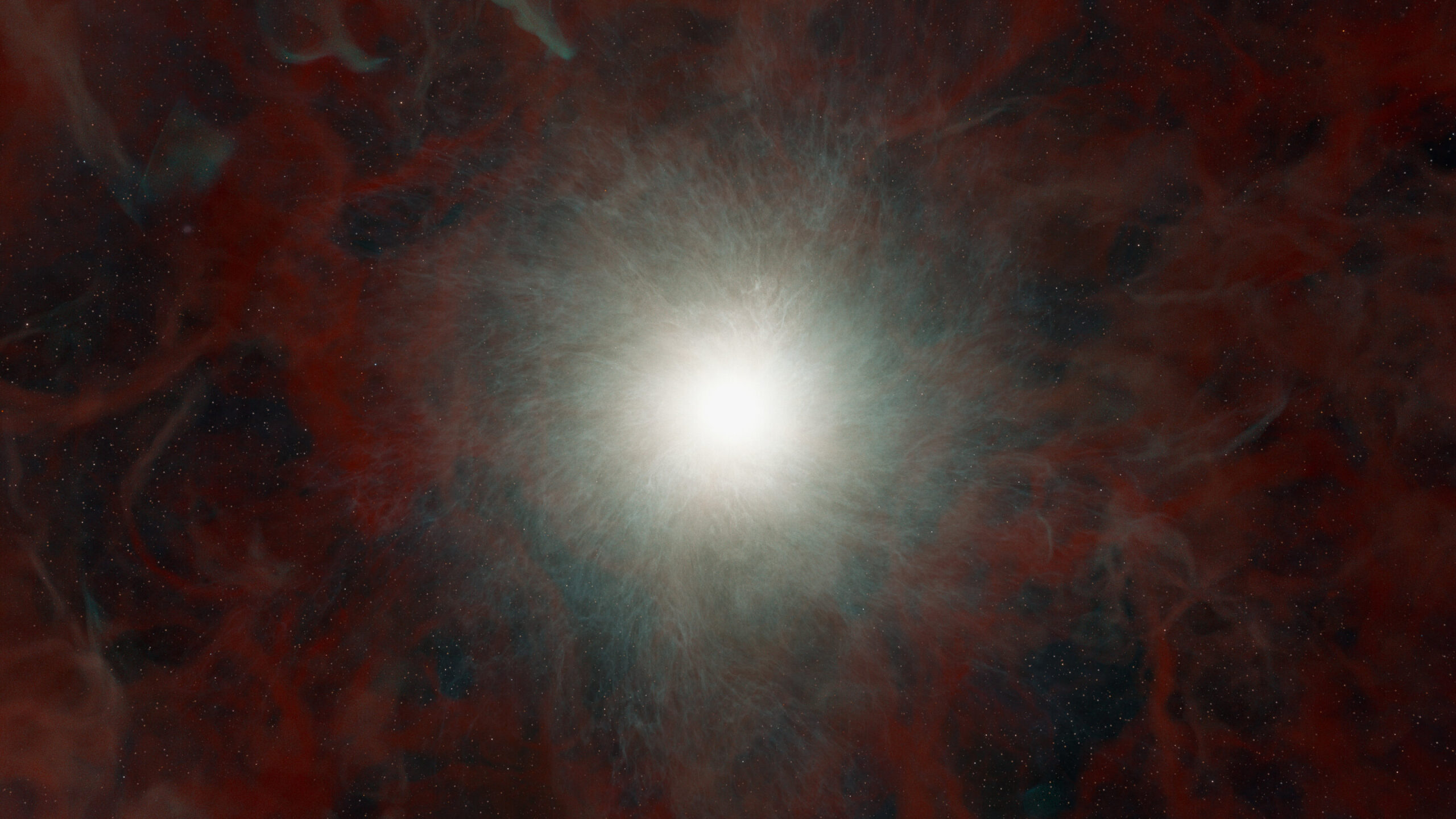
This dust does something remarkable. It obscures the hotter gas orbiting the black hole while simultaneously warming up from its radiation. The result is a persistent glow in infrared wavelengths—a faint, reddish afterglow that can remain visible for decades.
It explains the strange brightening seen in 2014 and the slow fading that followed. The star didn’t explode. It quietly transformed, leaving behind a newborn black hole wrapped in a dusty shroud.
De suggests that this lingering infrared light may remain detectable for decades, especially with powerful instruments like the James Webb Space Telescope. This fading glow could become a benchmark—a reference case for understanding how stellar black holes form throughout the universe.
From Oddball to Pattern
At first, M31-2014-DS1 seemed like a cosmic oddity. But as researchers revisited another star, NGC 6946-BH1, which had shown a similar disappearance years earlier, a new picture emerged.
What once looked like a singular anomaly now appears to be part of a growing class of so-called failed supernovas. These are massive stars that don’t go out in explosive fireworks. They simply collapse and fade.
With each new case, astronomers gain another piece of the puzzle. As De puts it, it’s only through these individual “jewels” of discovery that a coherent story begins to form.
Why This Quiet Collapse Matters
This discovery matters because it changes the narrative of how black holes are born.
For generations, supernovas have been the dramatic headline act of stellar death. But now we know that some massive stars exit the stage differently. They collapse inward, their light dimming instead of exploding outward. They leave behind black holes shrouded in dust, glowing softly in infrared wavelengths.
Understanding this process helps answer one of astrophysics’ most fundamental questions: why do some massive stars become black holes while others do not? The answer appears to lie not only in mass but in the delicate physics of neutrino-driven shock waves, convection, and the swirling dance of matter with angular momentum.
This research provides the most complete observational record of such a transformation ever captured. It confirms and refines theoretical models that have existed for decades, grounding them in real data from 2005 to 2023.
Perhaps most profoundly, it reminds us that the universe is not obligated to follow our expectations. Sometimes, a star does not explode in triumph. Sometimes, it fades quietly, reshaping our understanding in the process.
And in that quiet disappearance—one luminous giant vanishing from Andromeda—we gain a clearer glimpse of how the darkest objects in the cosmos are born.
Study Details
Kishalay De, Disappearance of a massive star in the Andromeda Galaxy due to formation of a black hole, Science (2026). DOI: 10.1126/science.adt4853. www.science.org/doi/10.1126/science.adt4853