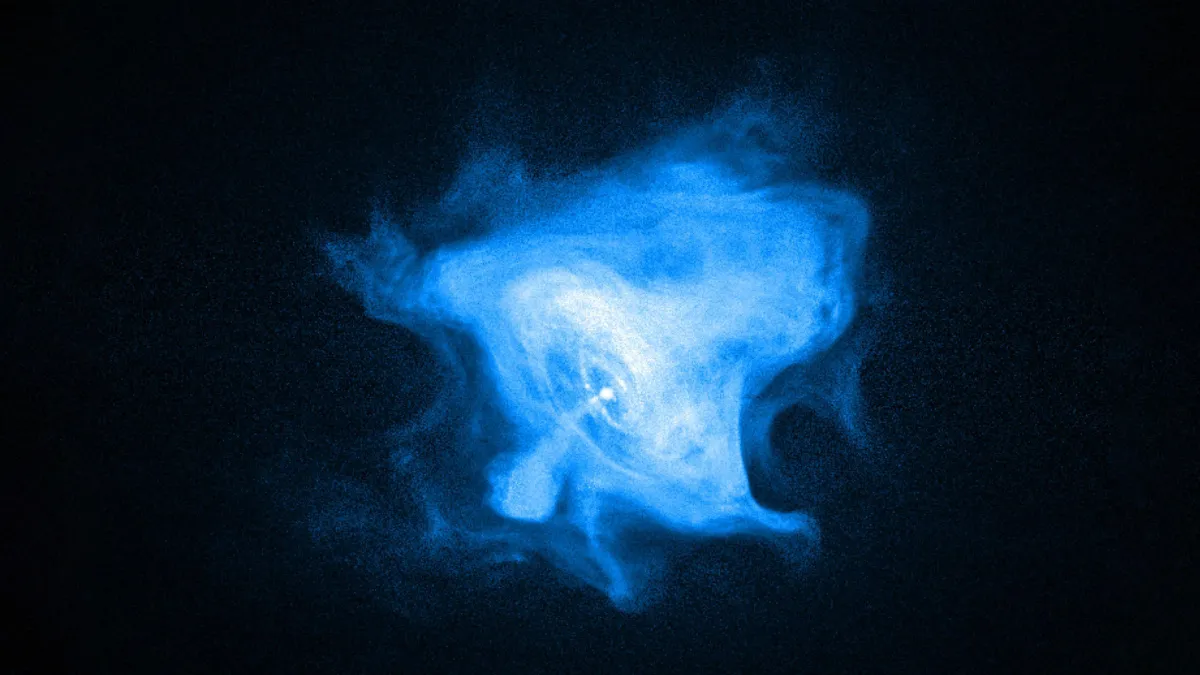
Far beyond our Solar System, scattered across the Milky Way, are the universe’s most precise timekeepers—pulsars. These rapidly spinning neutron stars, the dense remnants of massive stars that exploded long ago, emit powerful beams of radio waves. As they rotate, the beams sweep across Earth with extraordinary regularity, like the rhythmic ticking of a cosmic metronome.
Astronomers on Earth monitor these pulses using vast radio telescopes, tracking the slightest change in timing. For years, these celestial clocks have told us about the physics of extreme gravity and magnetism. But in recent years, they’ve begun to reveal something even more profound—whispers of gravitational waves, the ripples in spacetime predicted by Einstein’s theory of general relativity.
Now, new research from Hideki Asada, a theoretical physicist and professor at Hirosaki University, and Shun Yamamoto, a researcher at the same institution, suggests that pulsars may soon help us not only detect these elusive cosmic ripples but also uncover their true origins.
Their study, published in the Journal of Cosmology and Astroparticle Physics, introduces a creative new way to distinguish whether the faint gravitational-wave signals recently observed across the world come from countless distant sources—or from something far closer and more dramatic.
The Cosmic Rumor of 2023
In 2023, the scientific world buzzed with excitement. International collaborations known as pulsar timing arrays—including NANOGrav in the United States, the European Pulsar Timing Array, and teams in India, China, and Australia—announced strong evidence for ultra–low-frequency gravitational waves.
Unlike the high-frequency waves detected by LIGO and Virgo, which are created by colliding black holes or neutron stars, these new waves are millions of times slower. They oscillate in the nanohertz range, with cycles lasting months or even years, and wavelengths stretching across several light-years.
To detect such enormous waves, astronomers rely on networks of pulsars scattered across the galaxy. If a gravitational wave passes between Earth and these pulsars, it slightly stretches and squeezes spacetime, causing tiny but measurable delays or advances in the arrival of their radio pulses. When several pulsars show correlated timing irregularities across the sky, it suggests that spacetime itself is rippling.
For the first time, scientists had strong evidence that such a signal existed. But the big question remained: Where do these gravitational waves come from?
Two Competing Origins
Asada explains that there are two main contenders for the source of these nanohertz gravitational waves, and they couldn’t be more different.
One possibility reaches back to the dawn of time itself—cosmic inflation, a brief period just after the Big Bang when the universe expanded faster than the speed of light. Such rapid stretching could have generated primordial gravitational waves that still echo faintly through the cosmos today. Detecting them would open a direct window into the first moments of the universe’s existence.
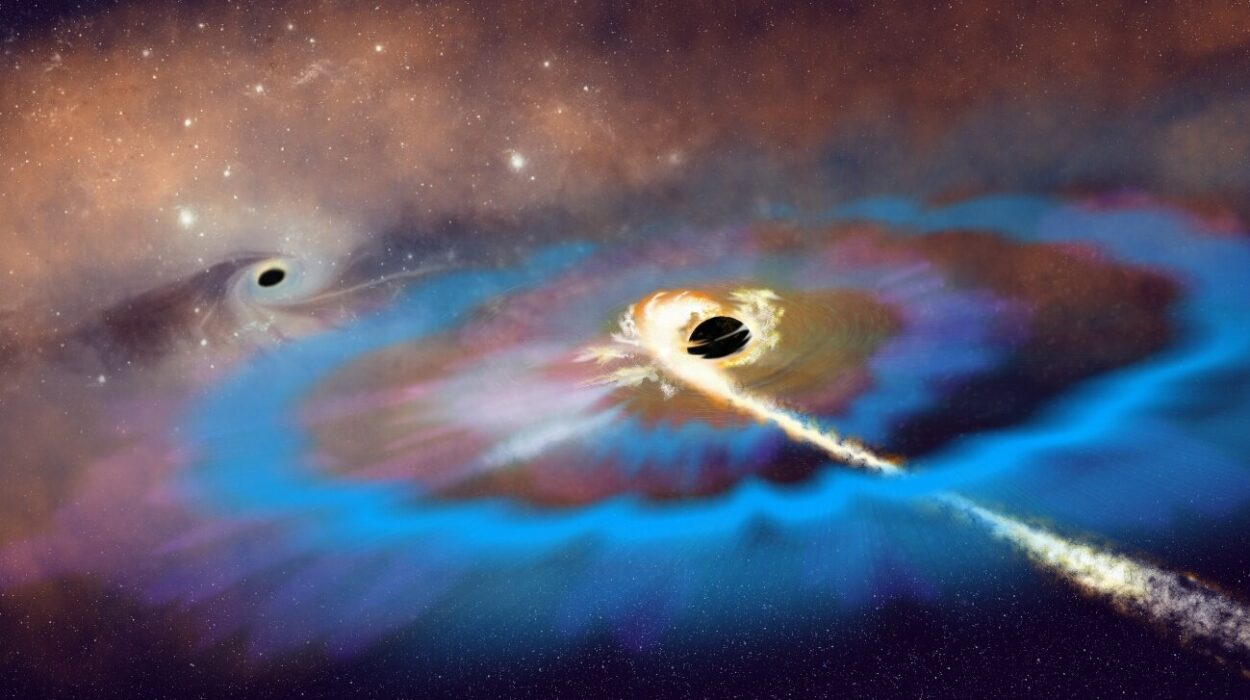
The other contender is more recent and more local: supermassive black hole binaries. When galaxies collide, their central black holes—each containing millions or billions of solar masses—can form pairs that slowly spiral toward each other over millions of years. As they do, they release gravitational waves with ultra-low frequencies, exactly in the range pulsar timing arrays are now sensitive to.
Both scenarios would produce a “hum” of gravitational waves spread throughout the universe—a stochastic gravitational-wave background. Unfortunately, their signatures in pulsar timing data were long thought to be nearly identical, making it difficult to tell which is which.
That’s where Asada and Yamamoto’s insight comes in.
A Cosmic Beat Between Giants
In their new work, Asada and Yamamoto propose that subtle “beat patterns”—similar to those heard in music when two notes are slightly out of tune—could hold the key to solving the mystery.
“When two waves have almost—but not exactly—the same frequency, they interfere with each other,” Asada explains. “Their superposition creates a pattern of periodic strengthening and weakening. In sound, we call this a beat. In gravitational waves, the same phenomenon can happen if two nearby sources have very similar frequencies.”
Imagine two supermassive black-hole pairs orbiting in different galaxies, both emitting gravitational waves of nearly the same frequency. When their waves overlap, they could produce a gentle modulation in the overall signal—a cosmic beat.
This beat would leave a distinctive fingerprint on the timing of pulsar signals. Instead of a uniform background hum, astronomers would observe a subtle, repeating pattern in the way pulsar pulses deviate from their usual rhythm.
Listening for the Universe’s Heartbeat
Detecting this cosmic beat is extraordinarily challenging. The timing variations are measured in nanoseconds, spread across pulsars thousands of light-years away. Yet with dozens of pulsars monitored over decades, pulsar timing arrays are becoming sensitive enough to discern these faint patterns.
If such a beat were found, it would be a powerful clue that the signal doesn’t come from a diffuse background of countless faint sources—like the relic waves from cosmic inflation—but rather from a few dominant, nearby systems of supermassive black holes.
In other words, astronomers would not just be detecting gravitational waves—they’d be pinpointing their cosmic orchestra conductors.
From Evidence to Discovery
Asada is careful to note that the current signal seen by international collaborations remains just below the gold-standard threshold for discovery. “It’s statistically reliable,” he says, “but not yet at the five-sigma level that physicists require for a confirmed detection.”
Still, optimism runs high in the astrophysics community. Many researchers believe that we are now on the brink of the first confirmed detection of nanohertz gravitational waves. When that happens, Asada and Yamamoto’s method could become an essential tool for identifying what’s causing them.
“I think once a confirmed detection at five sigma is achieved—perhaps within a few years—the next step will be to ask: what is the origin of these waves?” Asada says. “That’s where our method could help distinguish whether they arise from cosmic inflation or from nearby supermassive black hole binaries.”
The Universe as a Symphony
The idea of listening to the universe like a symphony isn’t just poetic—it’s real science. Each gravitational wave carries a note in the cosmic soundtrack, played by the most powerful and mysterious objects in existence. Pulsars act as the universe’s metronomes, marking time with astonishing precision while spacetime itself dances around them.
Through these rhythms, astronomers are beginning to perceive a melody older than stars, deeper than galaxies—a song written into the fabric of reality.
What Asada and Yamamoto propose adds a new harmony to this music. The beat pattern they describe could transform how we interpret the gravitational signals that ripple through the cosmos, allowing us to distinguish between the echoes of the Big Bang and the throbbing heartbeats of colliding black holes.
A New Era of Cosmic Listening
The discovery of gravitational waves in 2015 by LIGO opened a new chapter in astronomy, allowing scientists to “hear” the universe for the first time. Now, with pulsar timing arrays tuning into ultra-low frequencies, we are entering another chapter—one that explores the deepest, slowest vibrations of spacetime.
Each pulsar in the sky is like a finely tuned instrument, and together they form a vast interstellar orchestra. By listening carefully, we may soon hear the rhythm of the cosmos itself—the gentle, steady beat of gravitational waves washing through the galaxy.
It’s a hum that has always been there, vibrating invisibly through everything we know. And now, thanks to the patience and creativity of researchers like Asada and Yamamoto, humanity is learning to listen.
Their work reminds us that even the faintest murmurs of the universe can reveal profound truths. Beneath the silence of the stars, there is music—and through the precise ticking of cosmic clocks, we are finally beginning to understand its song.
More information: Shun Yamamoto et al, Can we hear beats with pulsar timing arrays?, Journal of Cosmology and Astroparticle Physics (2025). On arXiv: DOI: 10.48550/arxiv.2501.13450