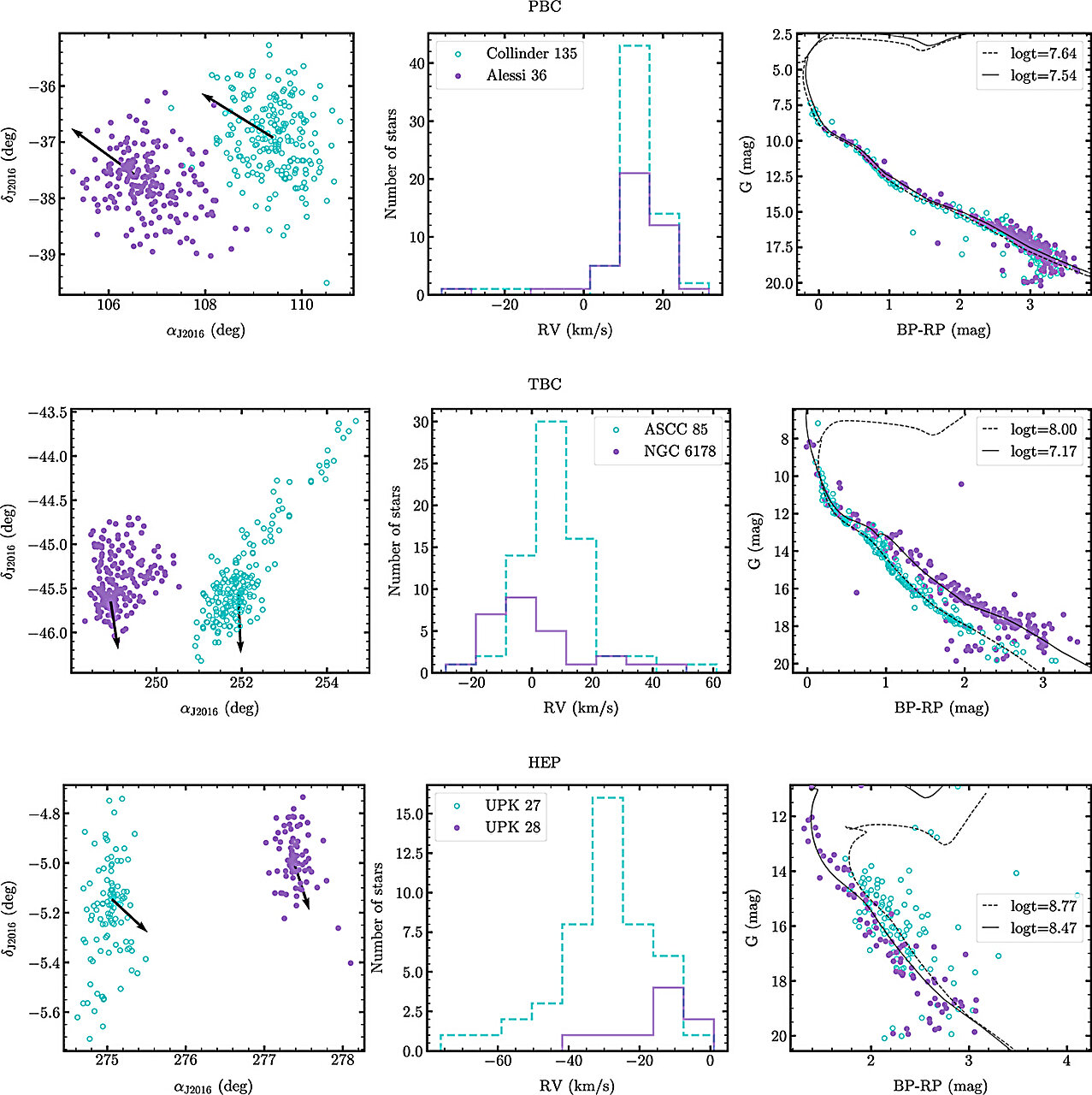
Far from the twinkling lights we see in the night sky, stars form in more complex and fascinating ways than we might imagine. Imagine clusters of stars coming together, not just in isolation but in dynamic pairs and groups, each cluster entwined in a cosmic dance. These binary clusters—pairs of open clusters that are closely associated both in position and movement—are the unsung heroes of stellar birth. Their study offers a window into how stars are born and evolve within the vast, mysterious clouds of gas and dust scattered throughout our galaxy. And now, astronomers have uncovered an astonishing new chapter in this story.
The Quest for Binary Clusters
A team of researchers from the Xinjiang Astronomical Observatory (XAO) and the Shanghai Astronomical Observatory, led by Ph.D. candidate Liu Guimei and her supervisor, Professor Zhang Yu, has made a groundbreaking discovery. Using cutting-edge data from the Gaia satellite, they’ve identified a staggering 400 candidate binary open clusters in the Milky Way. This discovery, reported in the journal Astronomy & Astrophysics, is not just a catalog of stars—it’s a roadmap for understanding how star clusters form and interact.
The team’s approach was precise and systematic. They analyzed nearly 4,000 high-quality open clusters, applying rigorous criteria to classify and differentiate the different types of binary clusters. The result? An organized scheme that will help astronomers identify and study galactic binary clusters for years to come.
“It’s not just about finding new clusters,” said Liu Guimei. “It’s about understanding the processes that drive star formation and cluster evolution on a galactic scale.”
The Anatomy of Binary Clusters
The binary clusters they identified fall into three distinct categories: primordial binary clusters, tidal-capture or resonant-capture binary clusters, and optical pairs. The first category, primordial binary clusters, consists of pairs of clusters that likely formed together from the same giant molecular cloud. The second category, tidal-capture or resonant-capture binary clusters, are systems where one cluster has likely been drawn into the gravitational pull of another. Finally, optical pairs are simply clusters that happen to be aligned in our line of sight, though they may not be physically associated.
The most intriguing finding? A large portion of these binary clusters—61%—are highly consistent in age and kinematics. This consistency suggests that they were born together, originating from the same giant molecular cloud, a massive stellar nursery where new stars are born. Furthermore, 83% of the identified binary clusters show significant tidal interactions between them. The closer the pair of clusters, the stronger their mutual gravitational pull, and this interaction has a profound effect on their dynamics.
“These tidal interactions are key,” explained Professor Zhang Yu. “The closer the clusters, the more they influence each other, which can affect how stars within them evolve.”
Hierarchical Star Formation
The team’s findings reveal more than just new clusters—they uncover a pattern in the way stars and clusters are born. The evidence suggests that hierarchical star formation is an important process, where stars do not form in isolation but instead emerge in clusters that are themselves part of larger, multi-cluster systems. This idea challenges the traditional view of isolated star formation and provides strong observational evidence for the interconnected, clustered nature of star birth.
The study also suggests that around 10% of open clusters in the Milky Way may have formed as primordial binary clusters, just like the ones the team has identified. This supports earlier theories about the role of binary clusters in the star formation process and provides a clearer picture of how star clusters evolve over time.
“The discovery of these binary clusters changes the way we think about star formation,” said Liu. “It shows that stars don’t always form in isolation—they form in clusters, which are often part of much larger systems.”
Why This Matters: Understanding the Evolution of Stars and Galaxies
The implications of this discovery are profound. By studying binary clusters, scientists can gain crucial insights into how stars and star clusters evolve over time. These clusters provide a snapshot of the early stages of star formation and cluster dynamics, which is essential for understanding how galaxies themselves evolve.
This discovery also helps to answer a fundamental question in astronomy: How do clusters of stars come together, and what happens to them over time? By studying the interactions between binary clusters, astronomers can learn more about the forces that shape the formation and evolution of galaxies.
“We’re beginning to piece together the puzzle of how stars form in a more connected way,” explained Professor Zhang. “This is a key step in understanding the larger-scale processes that shape our galaxy.”
More information: Guimei Liu et al, Binary clusters in the Galactic I: systematic identification and classification using Gaia DR3, Astronomy & Astrophysics (2025). DOI: 10.1051/0004-6361/202556299