Imagine standing at the edge of a vast cosmic ocean, gazing at the galaxies twinkling like distant stars. What we see, though awe-inspiring, is only a tiny fraction of what truly exists. The universe, as we know it, is a strange, mysterious place, dominated by unseen forces that drive the behavior of galaxies and the formation of massive structures across the cosmos. Two of these enigmatic forces—dark matter and dark energy—have fascinated scientists for decades, yet they remain largely out of reach, like puzzle pieces that we can’t quite fit together.
A new breakthrough in cosmological research promises to bring us closer to understanding how these invisible entities interact and shape the universe. In a recent study published in Physical Review D, researchers from the Shanghai Astronomical Observatory have revealed how dark matter and dark energy don’t simply exist independently, but actually interact with each other, influencing the very structure of our universe in ways we have never seen before. Their findings open up new pathways for unraveling the mysteries of cosmic formation and structure, providing critical insights for future sky surveys, like the China Space Station Telescope (CSST).
A New Twist on Old Problems
For decades, scientists have worked with a standard cosmological model known as ΛCDM (Lambda Cold Dark Matter), which has explained many phenomena in the universe with remarkable success. However, this model has faced some serious challenges in recent years—most notably, the Hubble Tension and the S8 Tension, both of which suggest that something might be missing or misunderstood in our current theories.
Enter the interacting dark matter-dark energy (IDE) model, an innovative approach that suggests dark matter and dark energy are not separate, independent forces, but interact with one another through a process of energy transfer. This idea turns conventional thinking on its head and opens up new avenues for exploration. The study led by Zhang Jiajun and his team investigated two possible scenarios within the IDE framework, offering fresh insights into how the interaction between dark matter and dark energy could reshape the way we understand the universe.
In the first IDE model (IDE I), dark matter decays into dark energy, while in the second model (IDE II), dark energy is converted into dark matter. These processes, though subtle, have a profound effect on the universe’s structure. By altering the effective mass of dark matter particles, these conversions shape the formation history and dynamics of dark matter halos—massive, invisible structures that surround galaxies and act as their gravitational backbone.
Unveiling the Hidden Forces
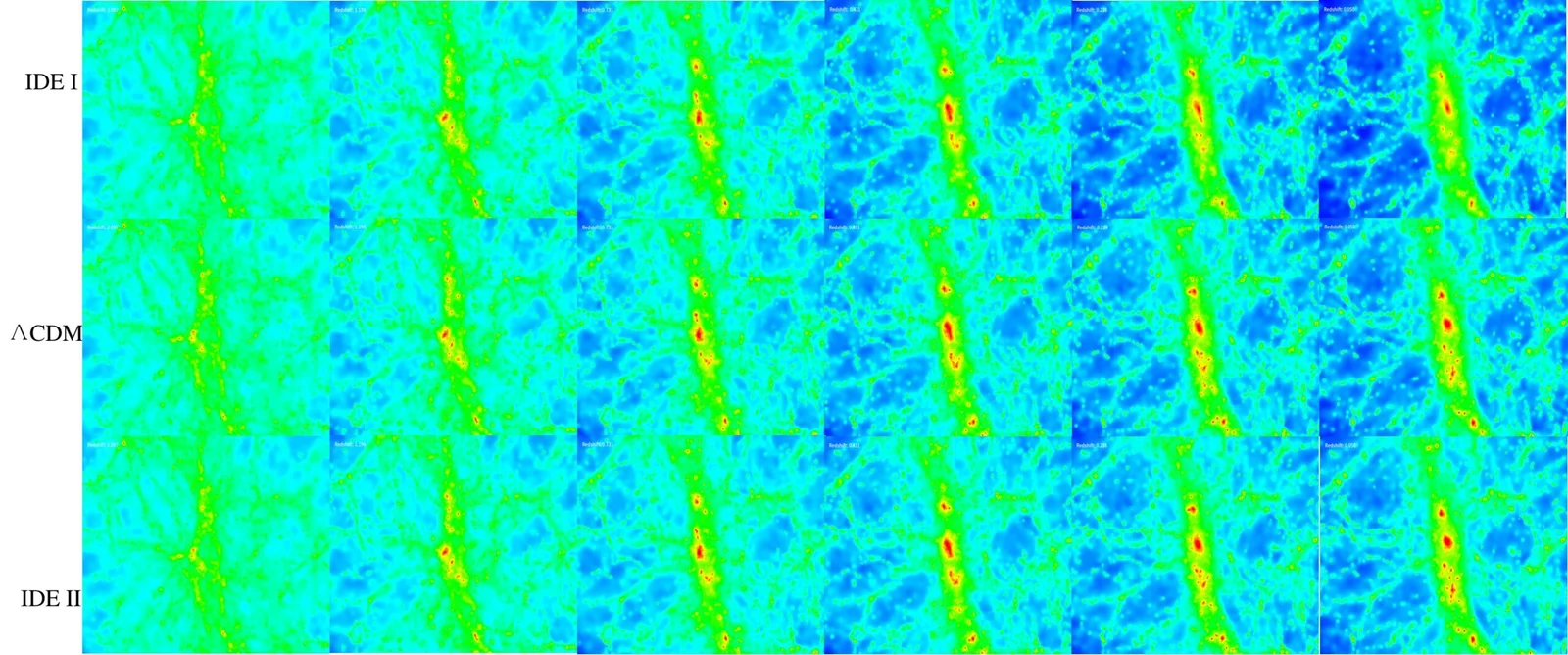
To investigate these ideas, the team used a high-powered computational tool—an N-body numerical simulation program known as ME-GADGET—to simulate cosmic structure formation under both the IDE models and the traditional ΛCDM model. The results were striking, revealing unexpected patterns in the alignment of dark matter halos.
In the IDE I model, where dark matter decays into dark energy, the researchers found that the shapes of dark matter halos became significantly more aligned with the tidal field from surrounding cosmic filaments. In simpler terms, the halos were more “tuned” to the surrounding environment, more responsive to the pull of the cosmic web. This was in stark contrast to what they saw in the ΛCDM model, where such alignment was weaker.
Zhang Jiajun, the study’s corresponding author, offers a straightforward explanation: “When dark matter converts into dark energy, the halo becomes looser and thus more susceptible to environmental influences.” It’s a bit like comparing two people: one who exercises regularly, with strong, toned muscles, and another who doesn’t, carrying more fat. The first person can resist gravity and move freely, while the second collapses easily. “This research not only reveals the distribution patterns of dark matter in the universe, but also reminds us to pay attention to exercise, convert more fat into muscle, to maintain health,” Zhang adds with a touch of humor.
In the second IDE model (IDE II), where dark energy is converted into dark matter, the opposite effect occurred. Here, the dark matter halos became more resistant to environmental influences, showing a weaker alignment with the surrounding cosmic structure. This finding provides new insight into how different forms of dark matter could behave in the universe.
The Intrinsic Alignment Signal: A Key to the Future
The implications of these findings are profound, especially when it comes to future observational studies. One of the critical challenges in cosmology is understanding the alignment of dark matter halos, an issue known as the intrinsic alignment (IA) signal. IA refers to the tendency for galaxies and their dark matter halos to be aligned with one another, a phenomenon that can skew observations made by telescopes, particularly in weak gravitational lensing surveys.
Gravitational lensing occurs when light from distant galaxies is bent by the gravitational pull of massive objects like dark matter halos. This effect can distort our view of the universe, but by carefully studying the patterns of lensing, scientists can extract crucial information about the distribution of dark matter and the properties of dark energy.
However, IA poses a significant challenge. If galaxies and dark matter halos are not randomly aligned, it can introduce systematic errors that muddy our measurements. The new study provides the first detailed depiction of the IA signal in the context of the IDE model. This breakthrough is critical for future large-scale surveys like CSST, which aim to map the universe in unprecedented detail.
As Zhang points out, “Our work provides the necessary physical foundation and fitting formulas for constructing more accurate IA calibration models that include IDE effects. This will directly contribute to extracting cleaner cosmological signals from the future data of CSST.” Essentially, this research lays the groundwork for more precise measurements of the universe’s structure, paving the way for more accurate models of dark matter and dark energy.
Why This Research Matters
The work done by Zhang and his team offers more than just theoretical insights—it provides practical tools for future exploration. By understanding how dark matter and dark energy interact, scientists will be better equipped to interpret data from future telescopes, such as the CSST. The ability to account for the interaction between these mysterious forces will enable more accurate measurements of the universe’s expansion, the distribution of galaxies, and the nature of dark matter itself.
This research also raises the exciting possibility that the true nature of dark matter and dark energy may not be as elusive as we once thought. The interactions between these forces may hold the key to unlocking some of the universe’s deepest secrets. By refining our understanding of how they shape the cosmos, we are one step closer to understanding the true fabric of reality.
As scientists continue to explore the universe’s most fundamental mysteries, studies like this one remind us that the cosmos is far from static. There are still countless wonders waiting to be uncovered, and as we peer deeper into the vastness of space, each new discovery brings us one step closer to understanding the forces that govern all of existence.
More information: Guandi Zhao et al, Halo spin and orientation in interacting dark matter dark energy cosmology, Physical Review D (2025). DOI: 10.1103/lq8t-gw3m. On arXiv: DOI: 10.48550/arxiv.2501.03750