Twelve billion years ago, when the universe was still young and galaxies were only beginning to take shape, a brilliant beacon lit up the cosmic darkness. Today, that ancient light has reached Earth, carrying with it a surprise that has left astronomers rethinking some of their most trusted ideas. An international research team led by scientists at Waseda University and Tohoku University has identified an extraordinary quasar whose behavior seems to break the rules of how supermassive black holes are supposed to grow.
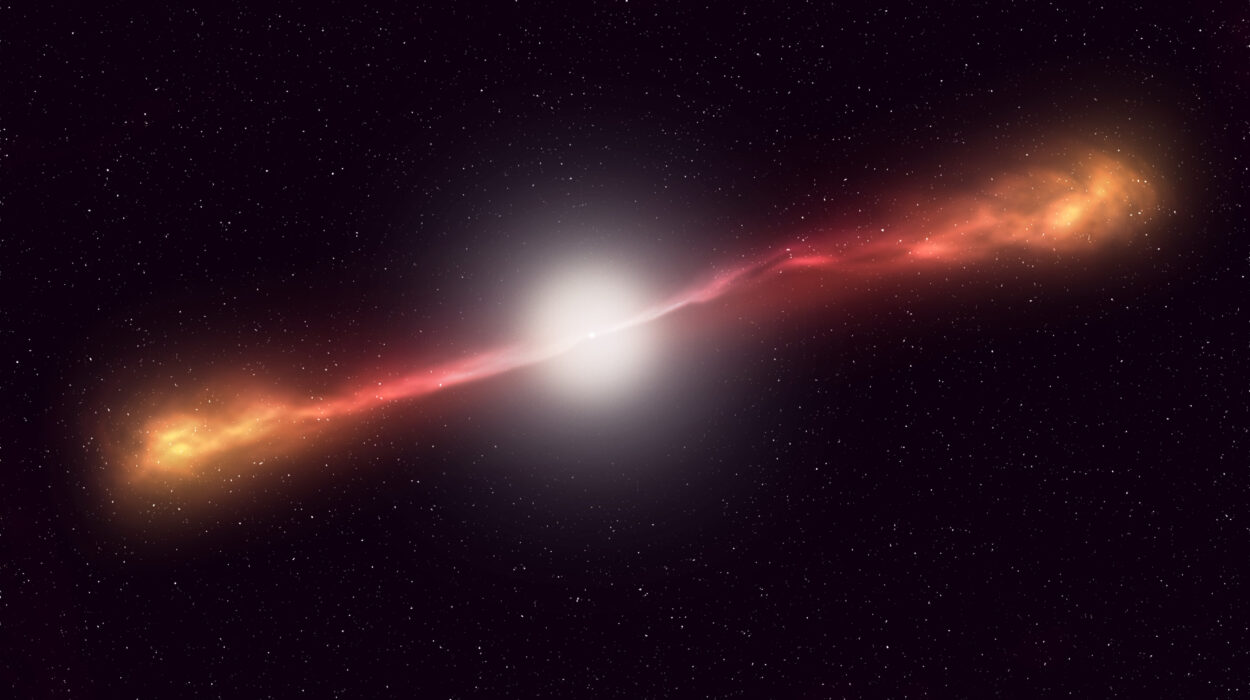
At its heart lies a black hole millions to billions of times the mass of the Sun, feeding at an astonishing pace. Yet what truly sets this object apart is not just how fast it is growing, but how many normally incompatible features it displays all at once. Observations with the Subaru Telescope reveal a system that is accreting matter at an extreme rate while also shining brightly in X-rays and launching a powerful radio jet. According to many theoretical models, these traits should not coexist so easily. And yet, here they are, captured together in a single cosmic snapshot.
The Longstanding Mystery of Rapid Black Hole Growth
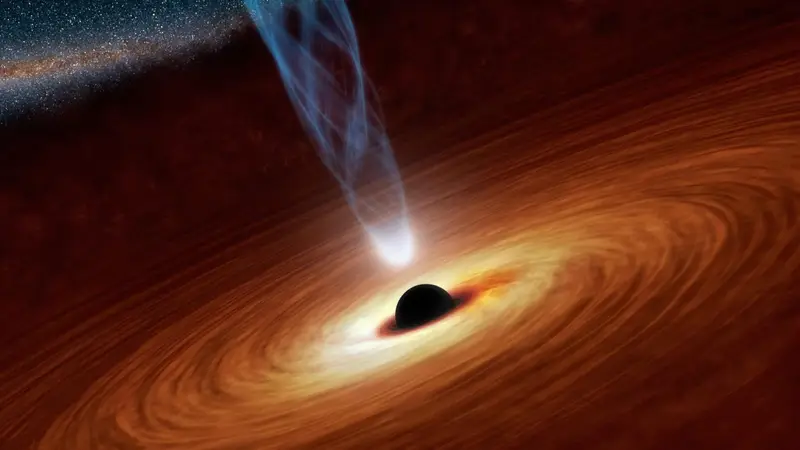
Supermassive black holes sit at the centers of most galaxies, including our own. They grow by pulling in surrounding gas, which spirals inward to form an accretion disk. As this material heats up, it releases enormous amounts of energy, making some black holes visible across vast cosmic distances. These intensely luminous objects are known as quasars, and they rank among the brightest phenomena in the universe.
For decades, astronomers have wrestled with a fundamental question: how did some of these black holes become so massive so early in cosmic history? The universe simply does not seem old enough for them to grow gradually at a steady pace. Something faster, more dramatic, must have happened in its youth.
That mystery has driven researchers to search for signs of unusually rapid growth in the early universe. The newly discovered quasar now offers one of the clearest and most puzzling examples yet.
When a Black Hole Pushes Past Its Supposed Limits
In standard theory, black hole growth is regulated by a balance between gravity and light. As gas falls inward, it heats up and emits radiation. That radiation pushes back on the incoming material, creating a natural ceiling on how fast the black hole can feed. This threshold is known as the Eddington limit, and it represents the maximum rate of steady accretion under normal conditions.
But nature, it seems, does not always obey its own speed limits. Under special circumstances, black holes may enter phases of super-Eddington accretion, temporarily growing faster than the standard theory allows. These episodes are thought to be brief, but they could help explain how massive black holes formed so quickly in the early universe.
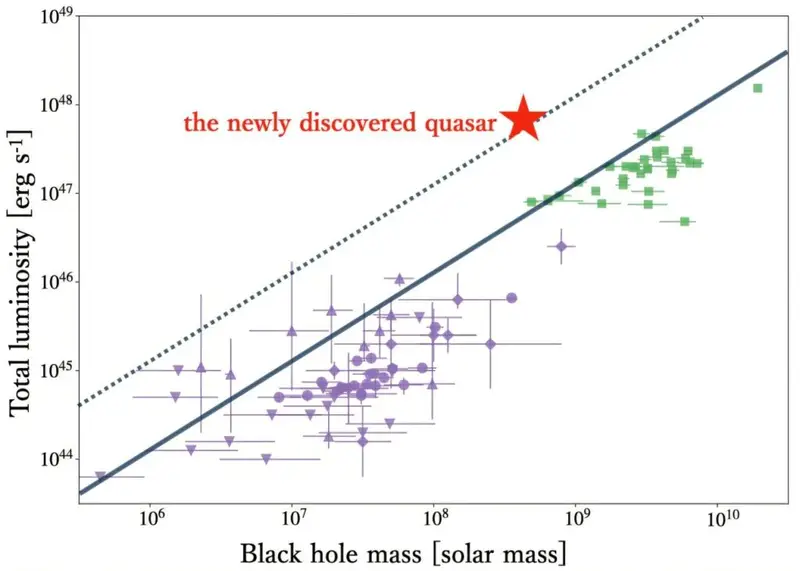
To find evidence of such extreme growth, the research team turned to the Subaru Telescope’s near-infrared spectrograph, MOIRCS. By analyzing the motion of gas close to the black hole, they estimated its mass using the Mg II (2800 Å) emission line, a well-established tracer of black hole properties. X-ray observations then revealed how energetically the object was feeding.
The result was startling. The black hole’s accretion rate appears to reach about 13 times the Eddington limit, marking it as one of the fastest-growing supermassive black holes known at this mass scale. The findings have been published in The Astrophysical Journal, adding a striking new data point to the study of early cosmic evolution.
A Glow and a Jet That Should Not Coexist
Rapid growth alone would have made this quasar noteworthy. What truly elevates it into the realm of the extraordinary is its multiwavelength behavior. During super-Eddington phases, many models predict that the inner structure of the accretion flow changes. These changes are expected to suppress the X-ray emission from the hot plasma region known as the corona, and to weaken or even shut down the formation of powerful jets.
This quasar does the opposite. It shines brightly in X-rays, signaling an active and energetic corona, while also producing strong radio emission from a jet. In other words, it is growing at an extreme rate and simultaneously sustaining features that theory often treats as mutually exclusive.
The combination challenges existing ideas about how matter behaves under such intense conditions. It hints that the physics of extreme accretion and jet formation may be richer and more flexible than current models suggest.
A Brief Moment in a Black Hole’s Turbulent Life
To make sense of this apparent contradiction, the research team proposes that the quasar may be caught in a fleeting transitional phase. Imagine a sudden surge of gas flowing toward the black hole, perhaps triggered by a dramatic change in its surroundings. That burst could drive the system into a super-Eddington state, rapidly increasing the black hole’s mass.
At the same time, the X-ray corona and radio jet might remain active for a short period, still energized by conditions that existed just before the accretion rate spiked. Only later would the system settle into a more typical configuration, with growth slowing and emissions changing accordingly.
If this interpretation is correct, astronomers are witnessing a rare and transient moment in the life of a supermassive black hole. Such moments are difficult to catch, especially in the distant universe, but they may be crucial for understanding how black holes evolve over cosmic time.
Echoes Across a Young Galaxy
The implications of this discovery extend far beyond a single object. The quasar’s strong radio emission implies a jet powerful enough to interact with its host galaxy. These jets can inject energy into surrounding gas, influencing how stars form and shaping the broader environment in which the galaxy evolves.
The connection between super-Eddington growth and jet-driven feedback remains poorly understood, particularly in the early universe. This object now provides a valuable benchmark for testing ideas about how black holes and galaxies influence one another during their formative years.
By studying such systems, astronomers hope to clarify how the most massive black holes assembled so quickly, and how their growth may have helped sculpt the galaxies we see today.
Why This Discovery Changes the Story of the Early Universe
This quasar matters because it brings multiple cosmic mysteries together in one place. It shows that black holes in the early universe could grow at astonishing rates, far beyond traditional limits. It demonstrates that extreme growth does not necessarily silence X-ray emission or shut down jets, as many models predict. And it offers a glimpse into a short-lived but transformative phase of black hole evolution that may have been common long ago.
As lead author Sakiko Obuchi of Waseda University explains, this discovery may bring scientists closer to understanding how supermassive black holes formed so quickly after the universe began. The team now wants to explore what powers the unusually strong X-ray and radio emissions, and whether similar objects have been hiding unnoticed in existing survey data.
In the end, this distant quasar is more than an astronomical curiosity. It is a reminder that the universe still holds surprises, and that even its most extreme inhabitants can defy expectations. By forcing astronomers to rethink how black holes grow and interact with their surroundings, this single, ancient light source helps illuminate the deeper story of how structure emerged in the cosmos we inhabit today.
Study Details
Sakiko Obuchi et al, Discovery of an X-Ray Luminous Radio-loud Quasar at z= 3.4: A Possible Transitional Super-Eddington Phase, The Astrophysical Journal (2026). DOI: 10.3847/1538-4357/ae1d6d