A black hole merger that appeared to involve some of the heaviest objects ever observed may actually have been substantially lighter, because gravity from another massive object could have magnified the gravitational waves before they reached Earth.
When two black holes merge, they produce gravitational waves, tiny distortions in spacetime that travel outward at the speed of light. Detectors including LIGO, Virgo and KAGRA can measure those distortions and use the shape of the signal to estimate the masses of the merging black holes.
In November 2023, the LIGO-Virgo-KAGRA network detected a signal called GW231123. Its initial interpretation put the combined mass of the two black holes at roughly 190 to 265 times the mass of the Sun.
That would make it the largest binary black hole system observed so far and heavier than standard stellar collapse is thought to produce.
But a new analysis led by Miguel Zumalacárregui and colleagues at the Max Planck Institute for Gravitational Physics suggests that the apparent mass could have been inflated before the signal ever reached the detectors.
Gravity can magnify a gravitational wave
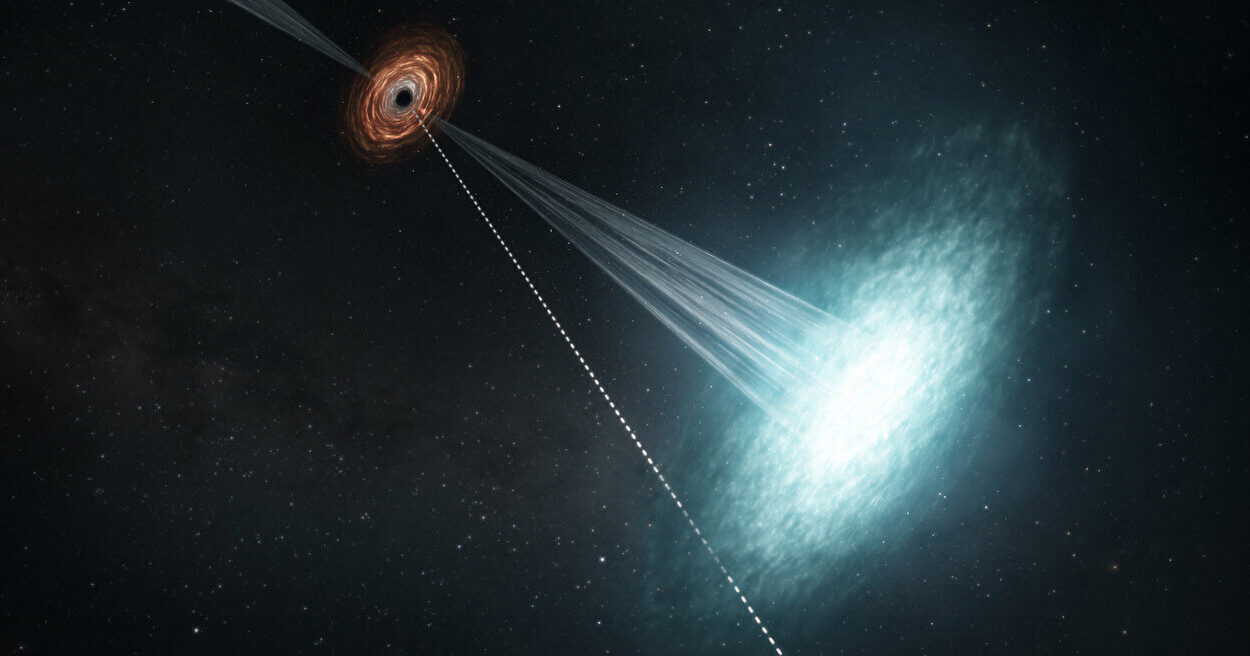
The effect is similar to what happens when a massive object bends light. If a gravitational wave travels close to another massive object, that object’s gravity can bend and magnify the wave.
A magnified signal arrives looking stronger than the original wave. Because researchers infer the masses of merging black holes from the observed signal, that extra strength can make the black holes appear more massive than they actually are.
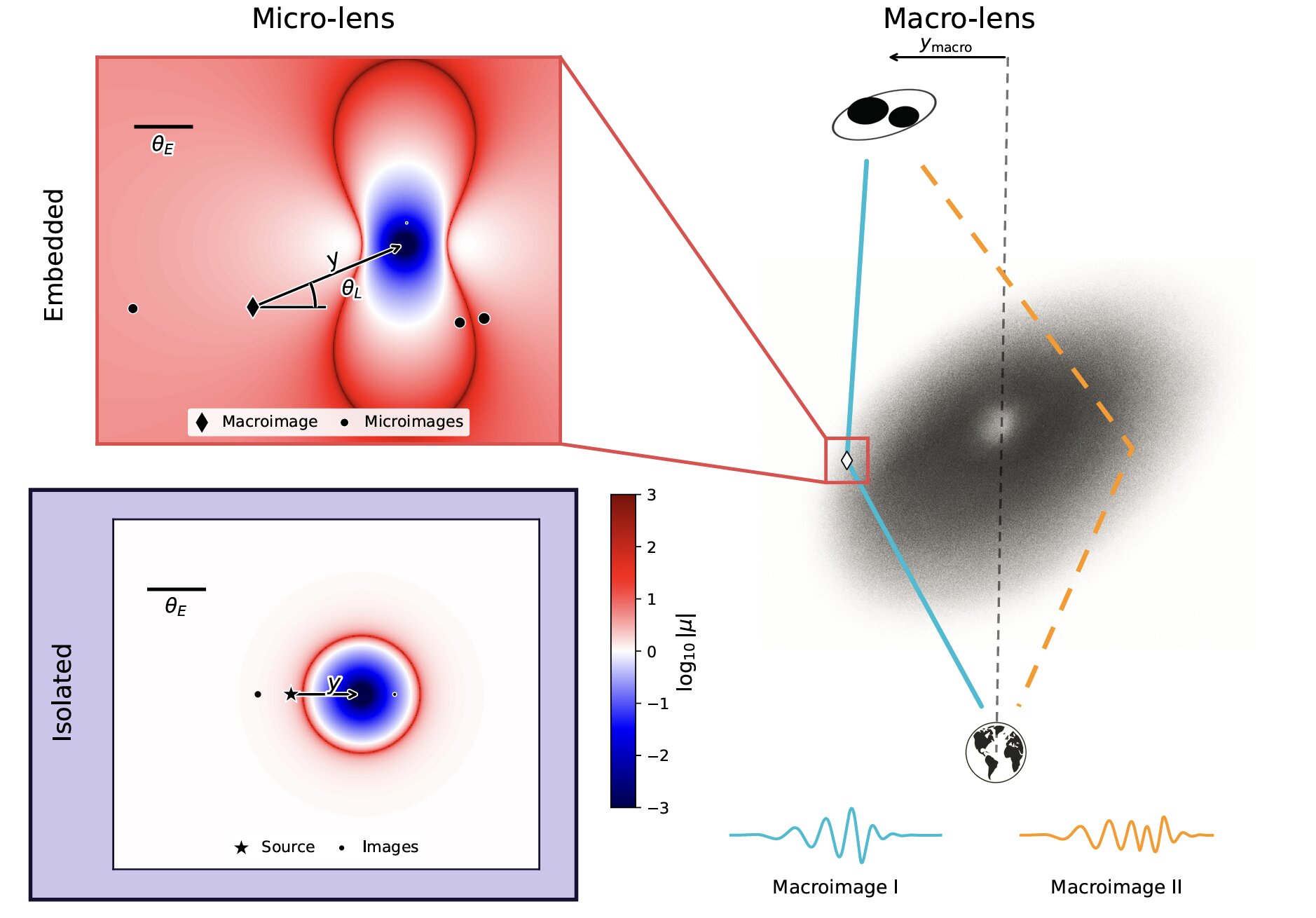
To test whether this could explain GW231123, the researchers built a model in which a compact object, potentially an intermediate-mass black hole, lies along the wave’s route to Earth. The compact object was modeled within the larger gravitational field of a galaxy.
They then compared the model’s predicted distortions with those measured in the GW231123 signal.
The estimated masses drop substantially
The analysis found statistical support for the lensing explanation. The researchers report less than a 1 percent chance that the observed pattern would have arisen by coincidence under their analysis.
If gravitational lensing is responsible, the combined mass of the two merging black holes would instead be about 100 to 180 times the mass of the Sun.
That lower estimate reduces some of the tension between the event and existing models of how black holes form.
The result also means GW231123 may not hold the apparent mass record it initially seemed to set. The analysis raises the possibility that other exceptionally massive black hole mergers detected so far could likewise have had their signals distorted by gravitational lensing.
The researchers argue that earlier detections should be examined for this possibility as gravitational-wave detectors become more sensitive.
The study was published in The Astrophysical Journal Letters.