An experiment with ultracold atoms has measured a predicted change in a quantum wave as it falls under gravity, providing a direct test of Einstein’s equivalence principle in the quantum regime.
For more than a century, physicists have used two powerful theories to describe nature. Quantum mechanics governs atoms and other very small objects, while Einstein’s theory of gravity describes falling objects and the effects of gravity on the universe. How those two descriptions fit together remains an open problem.
The new experiment tested one specific point where they meet: Einstein’s equivalence principle. The principle says that gravity locally disappears for an observer in free fall. In an ordinary example, someone falling freely would experience weightlessness.
The principle has been tested with great precision using ordinary matter. But quantum objects can behave as waves and can effectively follow more than one path at once, making it possible to test the principle in a different way.
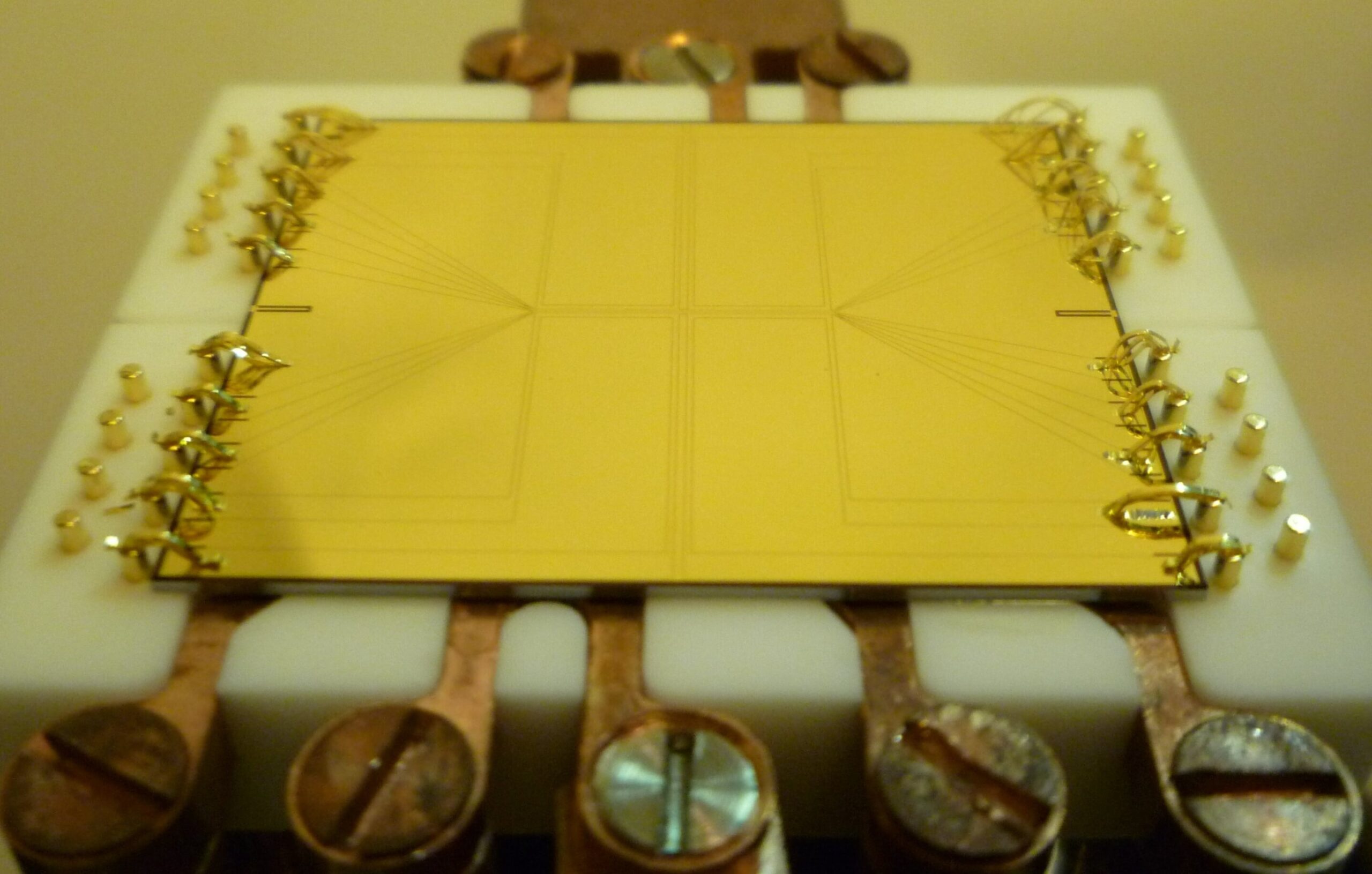
The international team, led by researchers at Ben-Gurion University of the Negev, the University of Ulm and the University of Oxford, built an apparatus called the Quantum Galileo Interferometer to make that test.
One atomic wave takes two paths
The experiment used clouds of rubidium atoms cooled to just above absolute zero near the surface of a specially designed atom chip.
The researchers first used microwave pulses to place the atoms into a quantum superposition. This allowed the quantum wave associated with each atom to follow two paths.
Tiny electrical wires on the chip produced carefully controlled magnetic fields. One part of the atomic wave experienced a magnetic force that counteracted gravity, keeping that part stationary relative to the laboratory and Earth.
The other part was pushed upward by a controlled magnetic pulse. It was then placed in a state that was almost unaffected by the magnetic field, allowing it to fall freely under gravity.
The freely falling part followed a ballistic trajectory, similar to the path of a ball thrown into the air.
At the end of the fall, another magnetic pulse brought the two parts of the wave back together. Their interference provided a way to measure a tiny difference in the quantum phase each part had accumulated.
The measured phase matched the prediction
The phase measured in the experiment was the same as the phase predicted when Einstein’s equivalence principle is applied to a quantum wave.
The result provides an experimental connection between quantum physics and Einstein’s theory of gravity. The researchers describe it as the first direct measurement of the predicted quantum phase of a freely falling object, although earlier experiments had used quantum particles to measure gravity.
For lead author Ron Folman of Ben-Gurion University of the Negev, the experiment addresses a fundamental question about how gravity and quantum theory might ultimately fit into a single understanding of nature. University of Oxford physicist Vlatko Vedral said the result demonstrates that the predictions of quantum mechanics continue to hold in the gravitational setting tested by the experiment.
The findings do not, however, unite quantum mechanics with gravity, and they do not demonstrate that gravity itself is quantum. They instead show that Einstein’s equivalence principle remains consistent with quantum mechanics under the conditions tested.
The experiment leaves a different question open
The result also does not test an argument made by Oxford physicist and study co-author Sir Roger Penrose that quantum mechanics might break down for sufficiently massive objects kept in quantum superpositions for long enough periods.
The atoms in this experiment did not reach the masses or timescales needed to test that possibility.
The researchers hope the technique can eventually be used with much heavier objects, including nanodiamonds, to investigate the question. An experiment using that approach is already underway in the same group at Ben-Gurion University of the Negev.
The study was published in Science Advances.