High-resolution observations of Betelgeuse have found that two hot regions on the star’s millimeter-wavelength surface have changed little over more than seven years, while the surrounding gas remains much more variable and clumpy. The observations point to long-lived structure in the star’s inner atmosphere that the researchers associate with convection and shocks.
Betelgeuse is a nearby red supergiant with a photosphere large enough to be resolved by modern telescopes. Its visible surface is not smooth. Earlier observations at ultraviolet, optical and infrared wavelengths had already found bright spots and other uneven features.
The new observations provide a particularly detailed view at millimeter and submillimeter wavelengths.
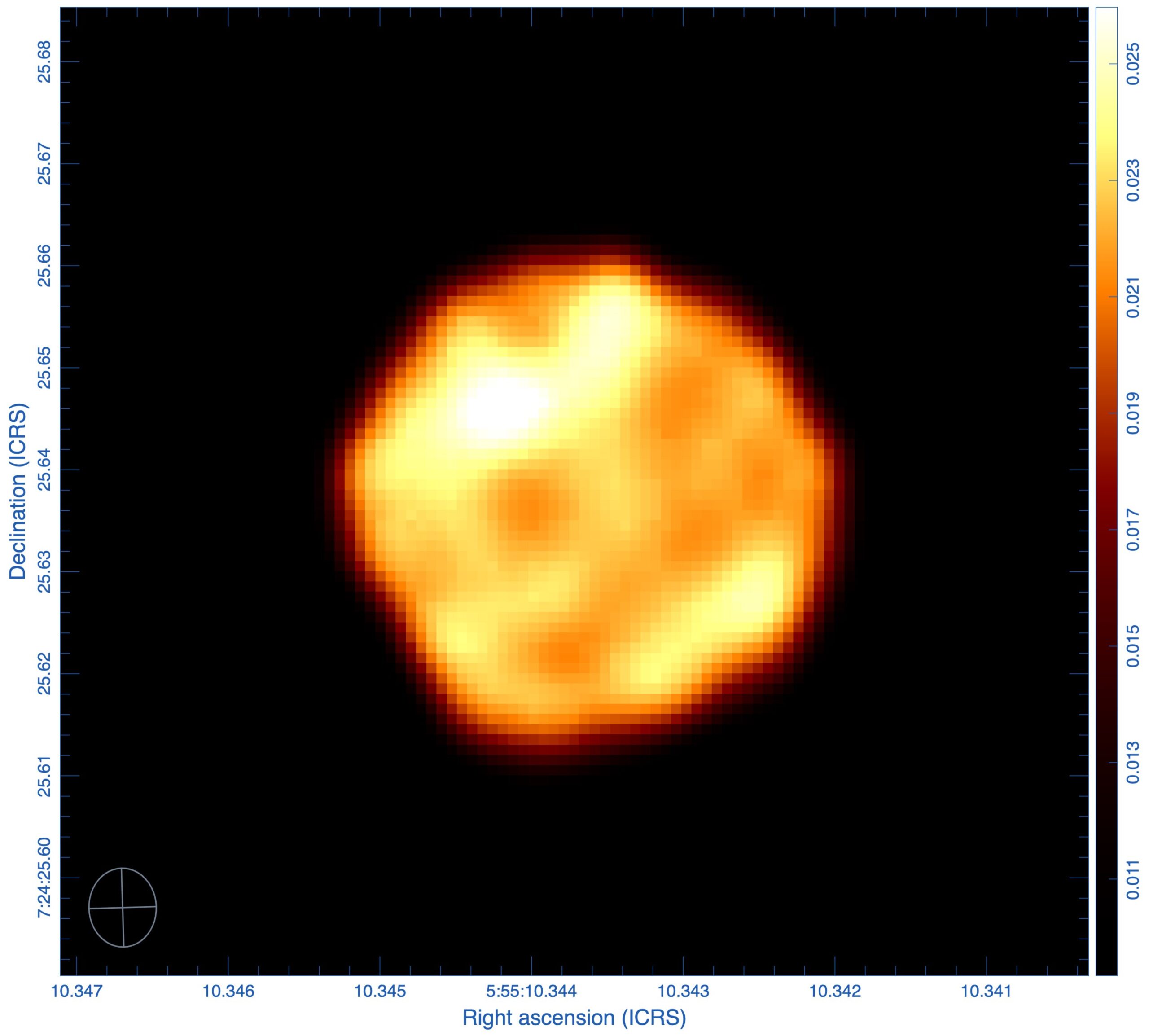
Researchers used the Atacama Large Millimeter/submillimeter Array, or ALMA, in its most extended configuration to observe Betelgeuse in August 2023. The observations covered three frequency bands corresponding to wavelengths of about 0.6 to 1.4 millimeters. The longest baselines produced images with resolutions as fine as about 7 milliarcseconds.
The team also compared the new observations with ALMA data from 2015 that had similar long-baseline coverage.
At these wavelengths, much of the emission comes from an optically thick layer of Betelgeuse’s atmosphere. The observations therefore provide a view of what can be described as a submillimeter photosphere, rather than the optical surface seen by the human eye.
That submillimeter surface has a radius of roughly 1.1 to 1.3 times the star’s adopted photospheric radius. Its average brightness temperature is about 2,300 kelvins.
But the surface is far from uniform.
Two hot regions stand out
All three ALMA frequency bands show a bright region about 12 milliarcseconds northeast of the center of the star. A second, fainter region appears about 18 milliarcseconds to the southwest.
The northeast feature is especially clear. In the highest-frequency observations, its temperature is estimated to be roughly 500 to 800 kelvins higher than the surrounding submillimeter photosphere. Because the feature is only partly resolved, the measured brightness temperatures provide lower limits in some of the images.
The researchers found that the same general structure appears in all three frequency bands. They also tested whether the features could have been produced by the imaging process. Simulations and comparisons using different imaging methods indicated that imaging artifacts do not significantly account for the observed structures.
The bright regions are therefore associated with real structure in Betelgeuse’s atmosphere.
The observations also reveal weaker continuum emission extending well beyond the main submillimeter photosphere, out to roughly 2.2 to 2.5 times the stellar radius depending on how the emission is measured. This extended emission is less uniform than a simple spherical model would predict.
The star’s surface is not perfectly round
The main submillimeter photosphere itself has measurable departures from a circular shape.
At different positions around the star, the radius varies by as much as about 6 percent. The largest outward variation occurs toward the south-southeast, while the southeast region has a smaller radius.
These changes are visible in both the Band 7 and Band 8 observations. They also extend beyond the immediate layer where the continuum becomes optically thick, indicating that the underlying changes in temperature or density are not confined to a single narrow surface.
The pattern is similar in some respects to the structure seen in the 2015 observations, although its detailed shape has changed.
That difference is important. The hot patches and the broader distortions do not behave in exactly the same way over time.
One hot region has persisted for at least seven years
The northeast hot region provides the clearest evidence of long-term persistence.
In the 2015 ALMA observations, a bright region appeared in almost the same location. Measurements of its position and contrast show no significant change over the roughly 7.3 years between the observations.
The researchers therefore conclude that the submillimeter hot region has lasted at least seven years.
The result is notable in comparison with models of turbulent convection, which have generally produced coherent large-scale structures lasting from months to a few years.
Earlier near-infrared observations also found hotspots in similar locations. Optical observations have likewise shown enhanced emission on the northeast side of Betelgeuse, while ultraviolet observations have found a hotspot toward the southwest. The researchers note that these observations may trace the same regions, but the connection between the optical, infrared and submillimeter features has not been established.
If they do represent the same structures, their persistence could extend to roughly 20 years.
Convection is the proposed source of the hot regions
The researchers associate the hot regions and departures from radial symmetry with energy released by convection beneath the atmosphere.
Models of red supergiants predict that their surfaces can be dominated by a relatively small number of large convective cells. Energy and motion from these cells can produce shocks that propagate into the atmosphere.
The northeast hot region is consistent with this picture. Its size and temperature excess correspond to an estimated luminosity of about 1 percent of the star at these wavelengths, similar to the fractional energy carried toward the surface by rising gas blobs in models cited by the researchers.
The observations also provide another possible connection between the hot surface regions and the surrounding gas.
Molecular gas is much more clumpy
ALMA detected numerous spectral lines from silicon monoxide and carbon monoxide, along with their isotopologues. These molecules appear both in absorption against the bright stellar continuum and in emission around the star.
The molecular emission is considerably more uneven than the continuum.
Most of the molecular emission traces a clumpy region extending roughly from 1.3 to 3 stellar radii. At a radius of about 30 milliarcseconds, the contrast between the northeast and southwest sides can reach about 10 to 1, while the continuum varies by only about 10 percent.
The molecular gas also changes substantially over time. Comparing the 2023 observations with the corresponding 2015 SiO observations shows that the locations of the molecular clumps have changed.
This means the gas around the star is considerably more dynamic than the persistent hot region on the submillimeter photosphere.
Hot regions may be linked to moving gas
The molecular absorption provides another clue.
Absorption is stronger near the bright continuum regions. In the northeast region, the integrated SiO absorption is about 40 percent stronger than toward the center, a larger contrast than seen in the continuum itself. The absorption lines are also broader near the hot regions.
The molecular absorption is biased toward velocities blue-shifted relative to Betelgeuse’s adopted stellar velocity. Near the northeast hot patch, the absorption extends to about 30 kilometers per second blueward of that velocity.
The researchers say this is consistent with the possibility that hotter regions are associated with upwelling gas. In their interpretation, convective activity at the surface could drive shocks into the atmosphere and molecular layer.
But the connection is not yet established. Three-dimensional models show that the motions above a convective surface can include both inward and outward flows, and that temperature structure can change with depth. The researchers say observations at additional epochs will be needed to determine whether the hotter continuum regions are consistently associated with blue-shifted upwelling gas.
The atmosphere reaches a temperature minimum
The different ALMA wavelengths also probe different depths in the atmosphere.
The continuum is produced mainly by free-free emission. The opacity changes with frequency, so lower-frequency observations become optically thick farther from the star.
The data indicate that the Band 6, 7 and 8 emission comes from layers around 1.1 to 1.2 stellar radii. A semi-empirical model built from ALMA and Very Large Array observations places the temperature minimum near about 1.2 stellar radii.
The model gives a minimum gas temperature of roughly 1,700 kelvins. The observed brightness temperatures are higher because they represent an average contribution from warmer material along the line of sight.
The new spatially resolved ALMA measurements provide stronger constraints on this part of Betelgeuse’s atmosphere than earlier spatially unresolved millimeter measurements.
These cool layers are also where molecules can form. The observations detect SiO and CO in and around this region, including molecular gas seen in absorption against the continuum.
The molecular absorption can be particularly deep. Some lines imply an apparent brightness temperature of about 1,300 kelvins after accounting for the roughly 2,300-kelvin continuum. Under the assumptions considered by the researchers, this places an upper limit on the gas temperature of the absorbing molecular material.
The gas does not show clear evidence of rotation
Betelgeuse has also been studied for possible signs of rotation in its extended atmosphere.
Earlier observations had been interpreted as showing velocity patterns that could be associated with rotation around a northeast-southwest axis. The new ALMA data do not provide clear evidence for such rotation.
Position-velocity diagrams show no clear southeast-northwest velocity gradient in the molecular emission or absorption, which would be expected for the proposed rotation pattern. If anything, the southeast emission is more blue-shifted in the new observations, opposite to the pattern reported from the 2015 data.
Other velocity structures are present, but they have changed substantially over the seven-year interval.
The researchers conclude that the molecular atmosphere is a complex and changing structure. Its variations occur on timescales of about a year, and possibly faster, while the continuum hot region has remained much more stable.
A possible companion remains an open question
A proposed low-mass companion to Betelgeuse has been suggested to explain some of the star’s observed periodic behavior. The proposed orbit has a semimajor axis of about 2.3 stellar radii and an orbital axis near the same northeast-southwest direction as the two hot regions.
The companion’s estimated position during the 2023 ALMA observations was near the star’s limb and too close to it to be detected in these data.
The researchers note that the companion’s projected orbital axis is close to the direction connecting the two hot regions. Its estimated 2023 location also fell near a part of the submillimeter photosphere that showed strong distortion.
Those coincidences do not establish a connection between the companion and the observed atmospheric structures. The researchers suggest that additional ALMA observations, particularly when the companion is farther from the star in projection, could help test whether shocked or ionized gas associated with the orbit produces a detectable radio signature.
The observations separate persistent and changing structures
The ALMA images present two different timescales in Betelgeuse’s inner atmosphere.
The prominent northeast hot region, along with the southwest feature, has remained in roughly the same locations since 2015. The researchers associate these persistent regions with localized energy input from underlying convection and suggest that they may represent particularly stable convective features.
The irregular corrugations around the edge of the submillimeter photosphere have changed over the same period, although they remain concentrated in the southeast part of the star.
The molecular gas changes more substantially. Its clumpy emission distribution in the region around the star is clearly different from that seen seven years earlier.
Together, the observations show an inner atmosphere that contains both long-lived and rapidly changing structures. The persistent hot regions extend across a radial range of at least about 4 milliarcseconds, or roughly 0.2 stellar radii, in the layers sampled by the different ALMA wavelengths.
The observations also show extended free-free emission and molecular material reaching several stellar radii from the star. The researchers associate the hot continuum regions and the uneven structure of the inner atmosphere with convection and shocks, while emphasizing that additional high-resolution observations are needed to establish how these structures evolve and how the different forms of atmospheric motion are connected.
The study was published in Astronomy & Astrophysics.